Mamdani’s Message to Trump: New York Comes First, But So Does a Free Press
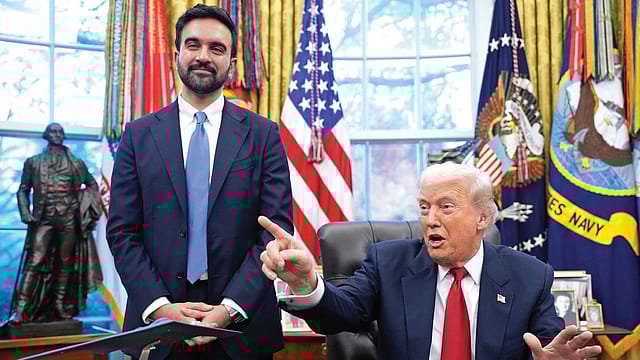
New York City Mayor Zohran Mamdani is drawing a distinction between political cooperation and political agreement. While expressing his willingness to work with US President Donald Trump for the benefit of New Yorkers, Mamdani has also made clear that engaging with the President does not mean setting aside his own positions on press freedom, economic concerns or the role of the Democratic Party.
The distinction came into focus after Mamdani met Trump in New York during the 81st United Nations General Assembly. Speaking to CNN’s Christiane Amanpour on Monday, September 21, the mayor said that differences in political beliefs should not prevent elected representatives from sitting down together when a conversation could serve the public interest.
Zeroing In on ECI
09 Oct 2026 - Vol 05 | Issue 41
Constitutional legitimacy versus political opportunism
“Well, I think we’ve both said that we’d be willing to have a conversation if it could benefit the people of this city,” Mamdani said.
“You can hold very disparate opinions and also be able to sit down because that is what this work demands of us. If I was only willing to speak with people who agreed with me all the time, I would be sitting at home looking in a mirror,” he added.
The comments offer a glimpse into how Mamdani intends to approach his relationship with the Trump administration: engage where there is an opportunity to advance New York City’s interests, while continuing to articulate disagreements in public.
That approach was particularly evident during the mayor’s latest interaction with Trump, which unfolded amid a dispute over the White House’s decision to restrict access for several media organisations.
Why is Mamdani willing to work with Trump despite their political differences?
Mamdani’s position is that political disagreements should not become an obstacle to discussions that could benefit the people he represents. His comments come despite a history of sharp exchanges with Trump, who has described the mayor as a “radical communist” and a “lunatic”. Mamdani, in turn, has called the President a “despot” and a “lunatic”.
Yet their in-person meetings have been notably cordial. Mamdani said he was not particularly surprised by the tone of their interactions, while his aides, according to CNN, have characterised the meetings as political wins, arguing that the mayor has been able to engage with Trump without compromising his positions.
The distinction matters because the relationship between the New York mayor and the President involves more than their personal or ideological differences. Their respective offices also intersect on issues affecting the city and its residents.
For Mamdani, the stated objective is to pursue conversations that could benefit New Yorkers, rather than allow political disagreements to prevent engagement altogether. His remarks do not suggest that the differences have disappeared; instead, they indicate that he sees dialogue and disagreement as capable of existing alongside one another.
That balance was on display when Mamdani publicly expressed his disagreement with Trump’s decision to restrict access for certain media organisations, even as the two leaders appeared together.
What did Mamdani tell Trump about press freedom and the White House media ban?
Mamdani said he had told Trump that he believes in a free press and supports journalists asking questions regardless of whether their coverage is favourable or critical.
“What I said is that I believe in a free press, and I believe in the importance of engaging in questions from all, no matter whether they are based in a compliment or on a critique,” Mamdani told CNN.
He said journalists from a wide range of news organisations would continue to be able to engage with his administration, describing that access as important to the media’s role in public life.
“You saw that we spoke to representatives from CNN, from MS NOW, from Politico, from Crain’s, from The City Reporter, from a wide variety, and that is something that will continue under my administration, because I believe it’s a critical part of the fourth estate being able to do its job,” he said.
Mamdani also pointed to his willingness to answer questions from outlets that have frequently criticised him, including the New York Post.
“You know you could pick up a copy of the New York Post almost every day of the week, and you’d find me there on the cover, and I’ll still take questions from the New York Post because I think that’s also what it means to be in New York City politics—to engage with New Yorkers,” he said.
At a joint press conference at Gracie Mansion, Mamdani reiterated that journalists would be allowed to cover events in New York.
“I told the President that we're going to have all of the members of the press here on the lawn. And that is something that I believe in, as everyone, no matter the opinion or the critique, that we engage,” he said.
The remarks came amid a dispute over the Trump administration’s decision to bar CNN, MS NOW and Politico from the White House. Trump had accused the organisations of repeatedly publishing what he called “fake news”. The outlets subsequently filed a federal lawsuit challenging the restrictions, alleging violations of First Amendment press protections and Fifth Amendment due process rights.
Trump defended the restrictions during his interaction with reporters, arguing that news organisations had an obligation to report fairly. He specifically criticised CNN and MS NOW, accusing them of bias and saying he had an obligation not to allow outlets he considered unfair into the White House.
The dispute has also affected the traditional White House television pool, through which participating networks share footage of presidential events with other news organisations. CNN had been scheduled to serve as the television pool network for Trump’s New York trip, but its removal disrupted the arrangement. Other television networks subsequently halted pool coverage in solidarity with the affected outlets.
The White House has maintained that the First Amendment does not automatically guarantee individual news organisations access to White House grounds, the briefing room or the presidential press pool. The affected outlets have challenged the restrictions in court, bringing the debate over press access and constitutional protections into the legal arena.
Against this backdrop, Mamdani’s remarks underline his stated commitment to allowing journalists to question his administration, irrespective of their editorial positions.
What does Mamdani want Democrats to focus on ahead of the US midterm elections?
Mamdani also used his CNN interview to discuss the Democratic Party and the upcoming US midterm elections, arguing that Democrats need to pay greater attention to the economic concerns shaping voters’ lives.
He said candidates who focus on affordability, as he did during his mayoral campaign, could connect with working-class Americans beyond New York City. Housing and childcare costs, he argued, are concerns shared by working-class households across the country.
“I think this will absolutely translate on a national level, and the reason that I believe that is while we are an exceptional city, as the greatest city in the world, we also know that the struggles that New Yorkers are facing are the struggles that working-class Americans are facing across the country,” Mamdani told CNN.
He added that the difficulty of affording housing, childcare and public housing was not confined to one city.
“I often say that there’s only one majority in this country; it’s the working class and their inability to afford housing, childcare, even public housing — that is something that goes beyond any one city,” he said.
Mamdani also expressed concern that the Democratic Party had lost some of its ambition at the national level.
“I do think it is a sad fact that to find ambition in the Democratic Party, we often have to look to history books, and I’m hopeful that that is changing in this moment,” he said.
His argument was that Democrats contesting the midterms should not define their campaigns solely around opposition to the Trump administration. Instead, they should also address the economic pressures confronting working-class Americans.
“It’s not enough to simply stand up to federal policies we disagree with. We also have to stand up for an entire working class that has been left behind by politics that has come to think of politics as a hobby only certain people can afford,” Mamdani said.
The comments connect his approach to Trump with his broader political message. In New York, he says he is willing to engage with the President when it could benefit the city. On press freedom, he has publicly defended journalists’ ability to ask questions, including those who criticise him. And on the national political stage, he is urging Democrats to address affordability and the concerns of working-class voters.
For Mamdani, the message is that political engagement need not mean political conformity. His willingness to talk to Trump, as he describes it, is tied to the interests of New Yorkers, while his public disagreements reflect the positions he continues to hold.
(With inputs from ANI)