The Future of the Global Economy
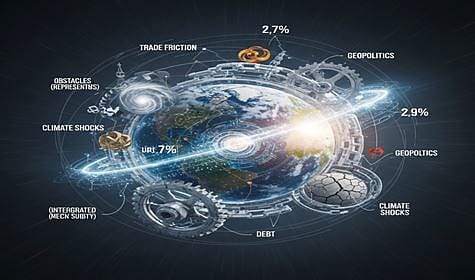
If the global economy appears to be moving but not going anywhere, that is because the big story for 2026 is a stubborn loss of momentum. Global growth has not crashed. Many countries' inflation rates have fallen since their peaks. Financial conditions are no longer tightening globally. However, the engine is running at a lower gear, slowed by trade friction, geopolitics, climate shocks, and debt, which has transformed from a background statistic into a daily restriction.
The United Nations' World Economic Situation and Prospects 2026 forecasts worldwide growth of 2.7% in 2026, down from 2.8% in 2025 but still below the pre-pandemic average of 3.2%. It forecasts a minor increase to 2.9% in 2027. That sounds like small arithmetic. It is not. At the global level, a sustained half-point difference from the old normal means fewer jobs generated, slower wage growth, tighter public budgets, and less opportunity for ambitious development spending.

Zeroing In on ECI
09 Oct 2026 - Vol 05 | Issue 41
Constitutional legitimacy versus political opportunism
What's particularly telling is that the major institutions don't completely agree on the number—but they do on the sentiment. The IMF's October 2025 World Economic Outlook forecasts greater global growth—around 3.1% in 2026—but also emphasizes that medium-term risks remain skewed downward and that dynamism has deteriorated relative to previous decades. The OECD predicts global growth to slow to around 2.9% in 2026 before picking up somewhat in 2027. Different models, different assumptions, but the same conclusion: 2026 will be a "manage the downside" year rather than a boom.
The new burden is trade barriers and policy uncertainty
One of the most visible forces impeding growth is the resurgence of trade as a geopolitical tool. The United Nations identifies increased tariffs and trade disputes as significant headwinds. Trade friction does more than just limit export volumes; it also increases costs and uncertainty for businesses determining where to invest, what to create, and whose supply chains to trust. Even if trade does not collapse, it becomes less efficient—more duplicated, more "just in case" than "just in time"—which is a polite way of saying the world pays more for the same output.
This is important for development since commerce has historically served as a ladder, allowing countries to grow up industries, absorb technology, and create formal jobs. When trade regulations are unpredictable, the ladder remains, but some rungs are absent.
Inflation is easing, but the "easy wins" have ended
A second theme is the uncomfortable transition from the inflation shock of the early 2020s to a new, more gradual equilibrium. Many central banks have shifted from aggressive tightening to relaxing or foreshadowing future cuts, and the UN cites monetary easing as a factor sustaining resilience. However, inflation is not a universally switched-off phenomenon. In some economies, it stays sticky enough to keep interest rates "higher for longer," resulting in households refinancing at worse terms, corporations delaying investment, and governments paying more to service debt.
The last element, public debt, has become the decade's hidden restriction. The World Bank's Global Economic Prospects report cautions that global development has slowed due to increased trade barriers and uncertainties, with downside risks including escalating restrictions, wars, and extreme weather. For many developing countries, the issue is not only slower growth, but borrowing to sustain growth is more expensive and politically difficult.
The inconvenient truth at the heart of this slowdown is that the global economy is no longer driven by the same simple growth factors that made it grow in the past. Cheap money, more trade, and quick globalization used to be seen as good things. Today, all of these have gotten weaker or changed. Capital costs more, trade is less organized, and working together around the world is getting worse. Growth is harder to achieve and more likely to be interrupted wherever it is.
This time is especially hard because the level of difficulty is lower than the world average. Some areas are still growing at a good rate, while others are having a hard time getting out of a rut. Advanced economies, especially in Europe, are having a hard time because of low demand, an aging population, and risks related to energy. China has been the world's engine of growth for a long time, but now it is dealing with property market stress, a declining population, and the limits of investment-led prosperity. On the other hand, parts of South Asia, especially India, are still growing quickly, thanks to government investment and domestic consumption. Even so, growth happens in a fragile global environment that can quickly pass on shocks through trade, finance, or the weather.
Climate disruptions are no longer a remote risk; they have become a major economic variable. Extreme heat, floods, droughts, and storms are increasingly affecting food systems, causing infrastructure damage, and putting a burden on public resources. These shocks disproportionately hit emerging countries, because fiscal buffers are limited and recovery expenses absorb resources that could otherwise be spent on education, health, or productive investment. In this way, climate stress exacerbates pre-existing economic vulnerabilities.
Debt exacerbates these vulnerabilities. As interest rates remain high in key economies, debt payment costs consume an increasing share of government revenues in low- and middle-income countries. This reduces development funding just when populations are most vulnerable to economic and environmental stress. The political ramifications are clear: growing dissatisfaction, calls for short-term relief, and opposition to reforms whose advantages may not be apparent for some time.
To avoid getting stuck in this trap, you need to change your priorities. Stability, predictability, and resilience are more important than big growth numbers. Even when money is tight, governments need to keep making long-term investments that will boost productivity. They also need to change their trade and industrial policies to fit a more fragmented world. Climate adaptation should be seen as a key part of economic planning, not just an extra thing to do for the environment. International cooperation, despite its challenges, is essential in managing debt, financing climate initiatives, and regulating trade.
The future of the global economy is thus defined by neither imminent collapse nor remarkable revival. It is defined by constraints. In a low-growth world, every policy mistake costs more, every shock lasts longer, and every sensible reform is more important than before. The challenge for 2026 is to guarantee that existing growth is resilient, inclusive, and sustainable.