The Donroe Doctrine and the Fall of Nicolás Maduro
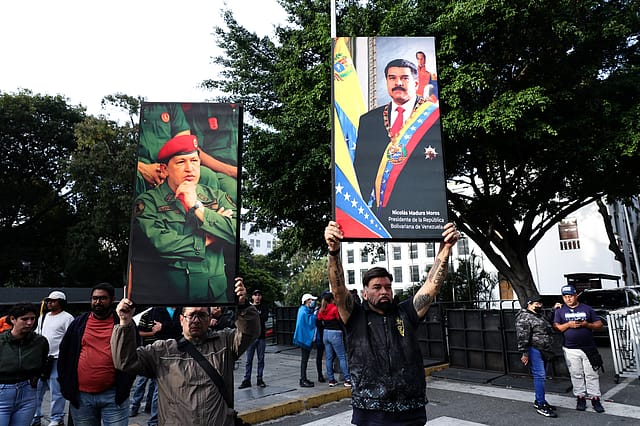
What has just happened in Venezuela is unprecedented because the capture of Panamanian leader Manuel Noriega in 1989—the last time the US had militarily intervened in Latin America—had been preceded by a short war between the two armed forces which was decisively won by the US. Noriega was a CIA asset, nurtured and empowered by the agency for over three decades, till he crossed several lines by shipping drugs to the US. The US has not proven that Venezuelan President Nicolás Maduro, who otherwise drove the oil-rich state to bankruptcy and turned it into a socialist tyranny, has been shipping drugs or facilitating such traffic. Yet Donald Trump and his administration were insistent that Maduro ran a narco-terrorist state. Washington had been escalating tensions with Caracas with the strikes on alleged drug boats.
No amount of political criticism, diplomatic warning or expert scepticism had deterred Trump from the course of action he seems to have had determined before, or at least soon after, he returned to office in January 2025. While he seeks the Nobel Peace prize and negotiates ceasefires in Gaza or Ukraine, Trump has now joined the club of American presidents who have undertaken regime change abroad. Why does Venezuela matter so much to the Trump administration? The country’s oil reserves, supposedly the biggest in the world, would be an easy and lazy answer. Perhaps Venezuela was just there for the taking, but that doesn’t explain much either.

India's Action Hero
27 Mar 2026 - Vol 04 | Issue 64
Riding the Dhurandhar Wave
Maduro, as US Secretary of State Marco Rubio initially said, will have to stand trial in the US, having been indicted in the Southern District of New York on charges of “Narco-Terrorism Conspiracy, Cocaine Importation Conspiracy, Possession of Machineguns and Destructive Devices, and Conspiracy to Possess Machineguns and Destructive Devices against the United States”. But to understand the capture and removal of Maduro and his wife Cilia Flores, who has also been indicted, we need to take another look at the National Security Strategy (NSS) 2025.

Why did a president so keen on building a legacy as a peacemaker, or deal maker, buttressed by a base that would like to see America withdraw from the world and focus its attention at home, send the Delta Force in to capture another head of state? Arguably, this is a bigger achievement that getting Noriega in 1989 in the sense that there was no ground invasion involved. The key lies in the NSS and its reconceptualising of the planet’s spatial geography in geopolitical terms.
When President James Monroe framed what came to be called the Monroe Doctrine 1823, it was more a statement of American hope than capacity. Still, the doctrine laid down that the Americas were out of bounds for new European colonisation. The US would not intervene in Europe or its existing colonies—nor could did it have the means to—but the Western Hemisphere was ‘American’ and different from the old continent, and its political wishes ought to be respected. It was only in 1898, after the Spanish-American War that the Western Hemisphere would be truly American, or the lookout of the US.
In 1904, President Theodore Roosevelt added a so-called corollary to the Monroe doctrine with his eye on Venezuela which was often subject to European gunboat diplomacy or thuggery. Known as Roosevelt’s ‘Big Stick’ foreign policy (“Speak softly and carry a big stick and you will go far,” went the proverb), it advocated peaceful negotiation but backed by deterrent of a military threat. Before the US took on the role of policemen to the world, it was here, off the Venezuelan shore and in Teddy Roosevelt’s day, that America became the policeman of the Western Hemisphere.
Trump has now added a corollary to Roosevelt’s corollary in the NSS: “We will deny non-Hemispheric competitors the ability to position forces or other threatening capabilities, or to own or control strategically vital assets, in our Hemisphere.” Commentators and analysts have noted the use of the word ‘our’. The US, for all practical purposes, owns the Western Hemisphere; it is denied to all else as their hunting ground; and the US will not be shy of reshaping it in the light of its national interest. The aggression in the wording and tone of the NSS is deliberate and is not meant to be subtle or ambiguous at all. This is now the so-called ‘Donroe Doctrine’—the Monroe Doctrine as rewritten by Donald Trump.
The bus driver and union leader who succeeded Hugo Chávez as Venezuelan president after Chávez’s death in 2013 quickly ran Venezuela aground, squandered its oil revenues, invited US sanctions and turned governance into a tyranny. As Venezuelan refugees kept crossing into Colombia and the economy of what once was South America’s richest country and biggest success story collapsed, Maduro doubled down. Perhaps there was a premonition of Saturday, January 3 in the operation that smuggled Nobel Peace laureate María Corina Machado out of the country and facilitated her travel to Oslo to collect the prize. Maduro must have known his days in office were numbered, with both the US and EU refusing to acknowledge his legitimacy after the controversial July 2024 presidential election which was allegedly won by the opposition’s Edmundo González. But dictators fall only when they refuse to admit reality.
Maduro’s fall, however, has triggered the next round of difficulties. What happens now in Venezuela? The military and paramilitary had remained loyal to Maduro and his government was left in control of Caracas and the country. There is no guarantee the opposition can take power at this stage, nor is there any guarantee of electoral restoration soon. Without further US interference, it’s difficult to envision a peaceful transition in Venezuela. Moreover, now that Trump 2.0 has blown away the non-intervention line of Trump 1.0, might he be emboldened to stage something similar in Iran, another country his administration hadn’t hesitated to strike militarily? But where Venezuela and Latin American may be there for America’s taking or remaking, Iran rests in a qualitatively different region of the world where the Donroe Doctrine doesn’t apply. Not yet.