RFK Jr under fire for saying Arabs Muslims don’t produce science or win Nobel Prizes
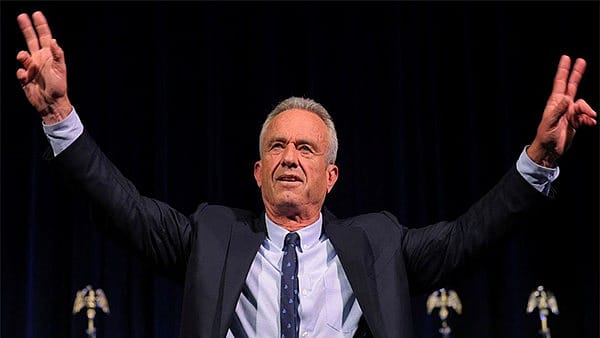
Can a community’s scientific and literary achievements be erased by a political speech? US Health Secretary Robert F. Kennedy Jr. is facing that question after claiming that Arabs no longer produce major scientific work, win prestigious awards or contribute literature as they once did. His remarks, made while campaigning in Michigan, triggered criticism from academics, Democrats and civil rights groups.
Kennedy reportedly made the comments on Monday while campaigning for Republican Senate candidate Mike Rogers. He blamed the Muslim Brotherhood, an Islamist movement founded in Egypt in 1928, for what he described as the decline of contributions from Arab societies.
“There are 500 million Arabs in the world, and yet they don’t produce science, they don’t win the Nobel Prize, they don’t win the Field [s] prize, they don’t win the Wolf Prize, they don’t produce the literature they used to produce,” Kennedy said.

Look Who's Talking Regime Change
23 Oct 2026 - Vol 05 | Issue 43
Why are Kennedy’s claims about Arab scientists being challenged?
The historical and contemporary record contradicts his sweeping assertion. Egyptian American chemist Ahmed Zewail won the Nobel Prize in Chemistry in 1999 for his work on ultrafast chemical reactions. Yemeni journalist Tawakkol Karman shared the Nobel Peace Prize in 2011, while Egyptian writer Naguib Mahfouz won the Nobel Prize in Literature in 1988.
More recently, Palestinian-Jordanian scientist Omar Yaghi received the 2025 Nobel Prize in Chemistry. Lebanese-born mathematician Michael Atiyah was awarded the Fields Medal, a major international distinction in mathematics.
The examples were highlighted in fact-checking by the Associated Press and in responses from scientists and other commentators. They directly challenge Kennedy’s claim that Arabs do not win the prizes he named.
What did critics say about RFK Jr’s remarks?
Nirav Shah, a former principal deputy director at the US Centers for Disease Control and Prevention, called Kennedy “unserious and incurious about the world” and argued that attempts to defend the remarks did not reflect what he had actually said.
Samer S. Shehata, an associate professor of Middle East studies at the University of Oklahoma, described the comments as “incredibly disappointing” and “bigoted,” according to The Washington Post. He pointed to both the historic Arab scientific tradition and contemporary contributions to science and literature.
Reuters also reported condemnation from the Council on American-Islamic Relations, which characterised the remarks as racist and warned they could fuel anti-Arab and anti-Muslim hostility.
Why is the Muslim Brotherhood part of Michigan’s Senate race?
Kennedy’s comments came as Republicans campaign against Democrat Abdul El-Sayed, a physician and former public health official challenging Rogers for Michigan’s open Senate seat. Rogers has repeatedly alleged links between El-Sayed and the Muslim Brotherhood. El-Sayed has denied any affiliation, and The Washington Post reported on October 23 that Rogers had produced no evidence that the Democrat had pledged support to the organisation.
The distinction matters: Arab identity is ethnic and linguistic, while Muslim identity is religious. Arabs can be Muslim, Christian or belong to other faiths, and most Muslims worldwide are not Arab.
What happens next?
The controversy has widened scrutiny of rhetoric around Arab and Muslim communities as the US midterm elections approach. The Department of Health and Human Services had not immediately responded to a request for comment, according to The Washington Post.
For now, the debate is about more than one campaign speech. It raises questions about the use of historical claims in modern politics—and what happens when sweeping statements about an entire population collide with documented evidence.
(With inputs from ANI)