Quad summit in Manila: India, US, Japan and Australia push back against economic coercion
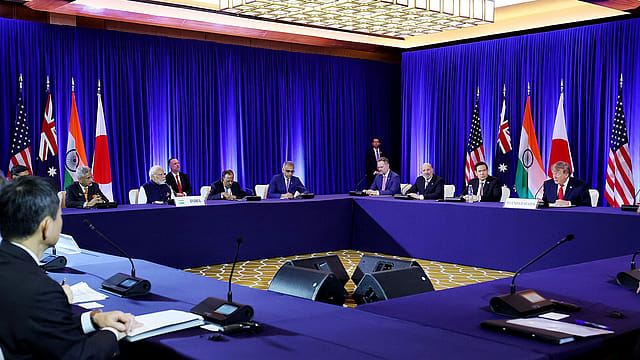
Can the Indo-Pacific remain open and stable when trade, technology and maritime routes are increasingly caught up in geopolitical competition? That question ran through the Quad leaders’ meeting in Manila on Tuesday, November 17, where India, the United States, Japan and Australia issued a strong message against coercion and unilateral attempts to alter the regional status quo.
In their joint statement, Prime Minister Narendra Modi, US President Donald Trump, Australian Prime Minister Anthony Albanese and Japanese Prime Minister Sanae Takaichi opposed actions that seek to change the status quo through force or coercion. They warned that such moves could heighten tensions and undermine regional peace.
The leaders also expressed concern over economic coercion, particularly arbitrary export restrictions, and called for stronger critical supply chains, freedom of navigation and safe maritime transit corridors.

The Wealth Issue 2026
06 Nov 2026 - Vol 05 | Issue 45
Portraits of Dreamers and Doers under 35
Quad warns against economic coercion as critical minerals take centre stage
The statement reflects a growing recognition that regional security is no longer confined to military activity. Access to critical minerals, resilient supply chains and secure trade routes has become equally important.
The four countries said they would work to reduce vulnerabilities arising from dependence on individual suppliers. This is particularly relevant for minerals used in semiconductors, electric vehicles, batteries and defence technologies.
Reuters reported that the leaders' warning on economic coercion came amid concerns over the use of trade and export restrictions as instruments of geopolitical pressure. For India, the emphasis creates an opportunity to deepen cooperation with partners in technology, manufacturing and resource security without giving up its strategic autonomy.
Quad Business Leaders’ Forum: Can private investment strengthen the partnership?
One of the major announcements was the inaugural Quad Business Leaders’ Forum, scheduled for early 2027. It will bring together business leaders, government representatives and policy experts from the four countries to encourage commercial partnerships and strengthen private-sector engagement.
The initiative builds on the idea that the Quad should deliver economic benefits alongside its security objectives. Stronger business links could help companies diversify supply chains, identify investment opportunities and develop trusted networks across the Indo-Pacific.
AI Accelerator and maritime surveillance: Quad expands its security agenda
Artificial intelligence is another priority. The leaders welcomed progress under the Quad AI Accelerator, an initiative designed to support access to trusted AI systems, technical assistance and deployment across the Indo-Pacific.
Maritime security, meanwhile, received a significant operational push through the Indo-Pacific Maritime Surveillance Collaboration. The initiative aims to improve information-sharing and maritime domain awareness, helping the four countries build a clearer picture of activity across regional waters.
The leaders also announced plans for a joint maritime exercise in 2027 involving P-8 and P-3C patrol aircraft from the four countries. It will be the first exercise of its kind in a Quad context, according to the joint statement.
Cybersecurity and undersea cables: Why connectivity matters
The Quad also announced enhanced cybersecurity cooperation in response to the growing scale of cyber incidents. The objective is to promote a secure and open digital environment, particularly as critical infrastructure becomes increasingly dependent on connected systems.
The leaders welcomed progress under the Quad Partnership for Cable Connectivity and Resilience, which seeks to strengthen secure communications infrastructure. Australia’s expanded contribution will include electricity cables, adding an energy-security dimension to the initiative. Planned undersea cable projects in the Indian Ocean are also part of the wider effort.
Modi calls Quad a trusted partnership as Manila marks a milestone
The summit carried symbolic significance too. Manila was where officials from the four countries first met in 2007, and where their dialogue was revived in 2017. PM Modi described the Quad as a “constructive and trusted partnership” for India and said the meeting should set concrete goals for its next phase.
The leaders also reaffirmed support for ASEAN centrality and unity, condemned terrorism and violent extremism in all forms, including cross-border terrorism, and pledged to strengthen cooperation against these threats.
Nearly a decade after the Quad's revival, its agenda is widening. The Manila statement suggests that the four countries want the partnership to be measured not just by strategic declarations, but by practical cooperation in trade, technology, maritime security and regional connectivity.
(With inputs from ANI)