PM Modi in Manila: Singapore, Thailand talks deepen India’s ASEAN push
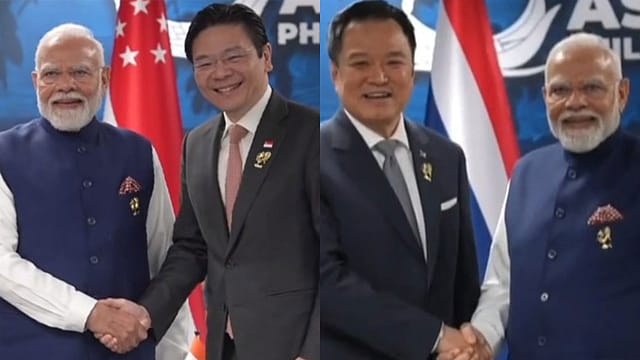
What does India want from Southeast Asia beyond trade and cultural connections? Prime Minister Narendra Modi’s engagements in Manila offer a glimpse. On the sidelines of the 23rd ASEAN-India Summit and the 21st East Asia Summit on November 17, Modi held bilateral talks with Singapore Prime Minister Lawrence Wong and Thailand Prime Minister Anutin Charnvirakul, focusing on expanding cooperation across several strategic sectors.
The meetings came as India sought to reinforce its influence in the Indo-Pacific and deepen partnerships with a region central to its economic and security interests. National Security Adviser Ajit Doval and Foreign Secretary Vikram Misri were part of the Indian delegation.
What did Modi discuss with Singapore’s Lawrence Wong?
Investment, infrastructure, innovation, semiconductors and advanced manufacturing featured prominently in Modi’s meeting with Wong. In a post on X, the Prime Minister described the discussions as productive and reiterated India's interest in strengthening the Comprehensive Strategic Partnership between the two countries.

The Wealth Issue 2026
06 Nov 2026 - Vol 05 | Issue 45
Portraits of Dreamers and Doers under 35
External Affairs Ministry spokesperson Randhir Jaiswal said the leaders reviewed the implementation of the partnership and exchanged views on regional and global developments. Modi also conveyed India's best wishes to Singapore as it prepares to take over the ASEAN chairmanship.
The emphasis on semiconductors and advanced manufacturing is significant. Singapore is an important financial, technological and investment hub, making it a valuable partner as India seeks to strengthen its manufacturing ecosystem and attract investment into emerging technologies.
What were the key takeaways from the Thailand meeting?
Modi and Anutin reviewed the India-Thailand Strategic Partnership, with discussions covering trade, investment, defence and security, connectivity, digital technologies, culture and tourism.
Jaiswal described Thailand as a key partner in India's Act East Policy and Indo-Pacific Vision. The relationship also has a strong historical foundation, shaped by centuries of religious, cultural and commercial exchanges.
Thailand's geographical position makes it important to India's connectivity ambitions in Southeast Asia. Projects such as the India-Myanmar-Thailand Trilateral Highway are intended to improve links between the Indian Northeast and the wider ASEAN region.
What did PM Modi announce at the ASEAN-India Summit?
The bilateral meetings were part of a broader diplomatic push. Addressing the 23rd ASEAN-India Summit, PM Modi proposed a long-term maritime cooperation plan covering connectivity, scientific research, disaster management, Coast Guard cooperation and maritime-domain awareness.
Other proposals included joint cyber-forensics training, technical exchanges on nuclear energy, an ASEAN-India space hackathon and cooperation on critical minerals. He also proposed free e-visas for tourists from ASEAN countries and greater scholarship opportunities at Nalanda University.
According to the Prime Minister's Office, the leaders adopted a joint statement on cooperation in disaster management.
Why is the Act East Policy central to these discussions?
Launched in 2014, the Act East Policy expanded India's earlier Look East approach into a broader strategy involving economic engagement, connectivity, defence and regional security.
PM Modi said India had undertaken more than 100 initiatives to strengthen people-to-people ties, launched nearly 250 Quick Impact Projects and provided over 10,000 scholarships for skill development since 2014.
He also highlighted the growing importance of direct flights and tourism. India and ASEAN together represent nearly a quarter of the world's population, making closer economic and strategic cooperation significant for both sides.
What happens next in India-ASEAN relations?
The partnership is entering an important phase. The ASEAN-India Plan of Action for 2026-2030 provides a framework for future cooperation, while 2027 will mark 35 years of dialogue relations and five years of the Comprehensive Strategic Partnership.
Singapore's upcoming ASEAN chairmanship could provide another opportunity to advance the agenda. For India, the challenge will be turning summit proposals into projects, investments and stronger regional connectivity.
PM Modi's message in Manila was clear: India's development and ASEAN's prosperity are interconnected. The task now is to translate that diplomatic message into lasting economic and strategic outcomes.
(With inputs from ANI)