Record Rain Batters Japan: People Killed, Thousands Stranded at Narita Airport
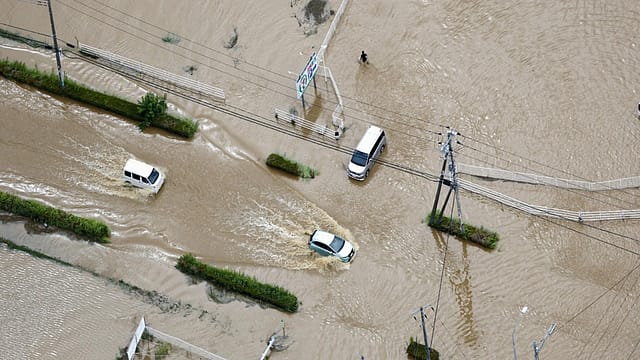
Imagine landing at one of Tokyo’s busiest airports — only to discover that the roads, railways and highways outside have effectively disappeared under floodwater.
That was the reality for thousands of travellers in eastern Japan overnight Thursday.
Record rainfall hammered Chiba prefecture, east of Tokyo, flooding homes, paralysing transport and cutting power as one of Japan’s busiest holiday travel periods got underway. Reuters reported on Friday that at least eight people had died, while around 7,000 travellers were stranded at Narita International Airport.
And the rain was not merely heavy. It was record-breaking. How much rain fell? According to weather authorities cited by Reuters, 367 mm of rain fell in Chiba over 24 hours, comfortably surpassing the previous record of 309 mm set in October 2013. More than 360 mm fell in parts of the wider Chiba area.

Losing Memory
16 Oct 2026 - Vol 05 | Issue 42
The making of a medical and social emergency
The Japan Meteorological Agency described the rainfall as unprecedented, while Chiba Governor Toshihito Kumagai called the situation “extremely unusual”, according to Reuters. “I have responded to many disasters in the past, but I have never experienced a case like this,” Kumagai said.
The result was chaos across the prefecture.
Roads disappeared under muddy water. Railway services were suspended. Highways were shut. Homes were flooded. And people who had expected to be travelling during the holiday week found themselves looking for somewhere — anywhere — to spend the night.
Then there was Narita. Narita Airport became an overnight shelter for thousands. Around 7,000 people were stranded after flooding disrupted the transport links connecting the airport to the surrounding region, Reuters reported. Airport staff distributed sleeping bags, water and snacks to passengers, many of whom slept inside the terminal.
One stranded traveller told Reuters he had waited four hours for a taxi, only to discover that the hotel he had booked could not accommodate him. He eventually returned to the airport. It was not quite the airport experience anyone had planned for. Flights, however, were expected to operate normally on Friday, an airport spokesperson told Reuters. Some rail services between Narita and Tokyo also resumed, although several lines remained suspended.
What happened on the ground?
The flooding was widespread. Reuters reported that major highways in Chiba were closed, forcing traffic onto alternative routes and creating further congestion. Railway lines were also disrupted.
The Ground Self-Defense Force was brought in to help with the emergency response. According to AP, troops sent buses to pick up around 4,000 people stranded overnight at Soga railway station, which also serves passengers travelling to Tokyo Disney Resort.
Chiba city was among the hardest-hit areas, with hundreds of people spending the night at makeshift evacuation centres in government buildings, Reuters reported. And the danger did not disappear when the rain began to ease.
Authorities continued to warn about flooding and landslides as conditions remained hazardous.
What about power and other services?
The rain also knocked out essential infrastructure. More than 20,000 homes were without electricity in the early hours of Friday after floodwater affected a power substation, according to Tokyo Electric Power cited by Reuters. Gas supplies to nearly 13,000 households were also temporarily disrupted.
The numbers had been even higher during the height of the storm. AP reported that power outages peaked at around 68,000 homes before falling as conditions improved.
How many people were evacuated?
The scale of the weather emergency prompted authorities to issue their highest-level heavy-rain warning in parts of Chiba.
Early reports said roughly 220,000 residents were advised to evacuate, while later reporting put the number of people under evacuation orders or advisories at a higher level. The warnings covered the risk of both flooding and landslides.
The Japan Meteorological Agency later downgraded its highest warning as the rain eased on Friday morning, although further rainfall was forecast.
Japan is used to disasters. This still caught people off guard.
Japan has some of the world's most sophisticated disaster-preparedness systems. But even a country accustomed to typhoons, earthquakes and torrential rain can be overwhelmed when record rainfall arrives in a matter of hours.
This time, the numbers tell the story.
367 mm of rain. Eight reported deaths. Around 7,000 travellers stranded at Narita. More than 20,000 homes without power. Highways and railways disrupted. And for thousands who spent Thursday night sleeping under airport lights or in emergency shelters, the storm turned an ordinary holiday journey into something very different.
The rain may have eased. The disruption is still being cleared.
(With inputs from yMedia and agencies)