PM Modi in Israel: How Netanyahu’s Iron Alliance Plan Signals a Strategic Shift
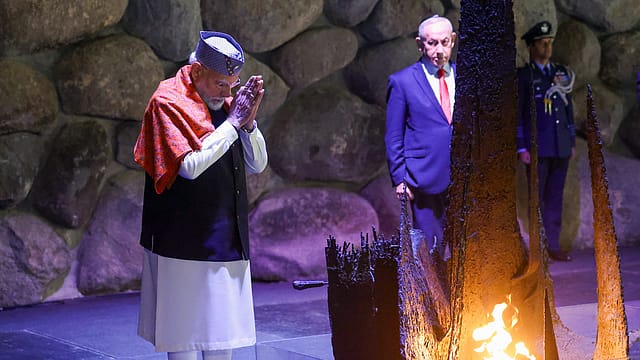
The PM Modi-Benjamin Netanyahu meeting in Israel this week moved beyond ceremonial diplomacy, placing a new strategic idea at the centre of bilateral talks. Israeli Prime Minister Benjamin Netanyahu proposed an “Iron Alliance,” potentially redefining the next phase of India–Israel cooperation.
Here’s a more detailed insight.
Why did the Modi Netanyahu meeting draw global attention?
Prime Minister Narendra Modi’s February 25-26 state visit marked his second trip to Israel as Prime Minister and included the first-ever address by an Indian leader to the Knesset. Prime Minister Benjamin Netanyahu used the visit to formally propose the Iron Alliance framework.
The announcement shifted discussions from ceremonial diplomacy toward long-term security coordination, signalling a possible expansion of India-Israel relations into a structured regional partnership.
What exactly is the proposed Iron Alliance?
Netanyahu introduced the Iron Alliance as a coalition of democratic nations committed to security cooperation and technological resilience. He described it as a response to extremist threats, positioning India and Israel as anchor partners within a broader strategic framework.
How does the Iron Alliance reshape India-Israel relations?
The Iron Alliance signals movement from transactional defence cooperation toward institutional alignment. Netanyahu referred to India as a “real friend,” indicating a partnership that extends to intelligence sharing, advanced defence systems, and long-term regional coordination rather than isolated agreements.
Survival Instinct
22 May 2026 - Vol 04 | Issue 72
India navigates global economic turmoil with austerity and smart diplomacy
What defence cooperation lies at the core of the alliance?
Defence cooperation centred on integrating Israeli missile defence expertise into India’s proposed Sudarshan Chakra air defence network. Discussions included adapting technologies comparable to Iron Dome and the laser-based Iron Beam system to counter missiles, drones, and emerging aerial threats.
Why is technology and cybersecurity central to the partnership?
Beyond conventional defence, both sides examined cooperation in counter-drone systems and cybersecurity infrastructure. According to Breaking The News, joint responses to drone warfare and digital threats reflect changing battlefield realities, where technological superiority increasingly determines national security outcomes.
How does the Iron Alliance connect to regional geopolitics?
Netanyahu linked the Iron Alliance to a wider “Hexagon” involving Greece, Cyprus, and selected Arab partners. The framework aims to create a stabilising axis across West Asia and the Mediterranean amid ongoing regional instability and security realignments.
What economic and connectivity goals support this vision?
The alliance also aligns with the proposed India-Middle East-Europe Economic Corridor. According to Firstpost, Netanyahu emphasised that trade corridors require politically stable partners, positioning India and Israel as reliable endpoints supporting investment and infrastructure flows.
How does India balance this alignment with its wider West Asia policy?
India continues to maintain a de-hyphenated approach in West Asia, engaging Israel while supporting diplomatic initiatives concerning Gaza and regional peace. Analysts cited by Moneycontrol note that New Delhi seeks strategic cooperation without compromising relations with Arab partners.
Why was PM Modi’s address to the Knesset symbolically significant?
PM Modi became the first Indian Prime Minister to address Israel’s Parliament, the Knesset, during the visit. He was also conferred the Speaker of the Knesset Medal.
It’s Israel’s highest parliamentary honour, underscoring growing political trust at a time when both countries were advancing discussions around the proposed Iron Alliance and defence cooperation.
What does the PM Modi Netanyahu engagement signal going forward?
The meeting suggests an evolution from bilateral warmth to structured strategic alignment. If institutionalised, the Iron Alliance could deepen defence manufacturing, technology exchange, and geopolitical coordination, placing India more visibly within emerging security architectures linking Asia, Europe, and the Middle East.
(with inputs from yMedia)