Phumzile Mlambo-Ngcuka (1955-2026): The Teacher Apartheid Never Wanted
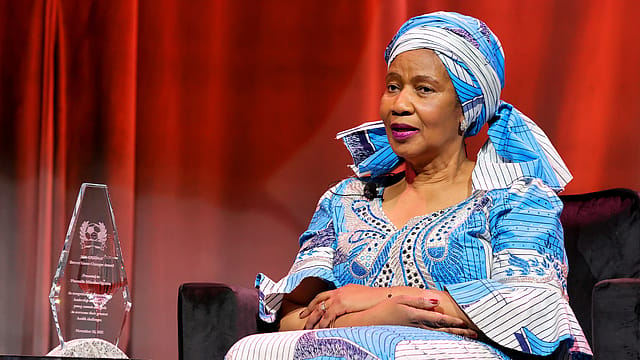
Phumzile Mlambo-Ngcuka wanted her father’s job. He was a teacher. The difficulty was that she wanted very little to do with the education her country had in mind for children like her.
A fair amount of her own education took place in the family dining room. Her mother, a nurse, used it to teach people to read. The children were expected to help. Other visitors came looking for her father. Often they were parents who had summoned the nerve to tell their child’s teacher that they could not pay the school fees. Phumzile grew up thinking this was what a house was for. Only much later, she recalled, did it occur to her that people could choose how much of their lives to give to their neighbours.
In 1976, her first year at university, the Soweto uprising forced a choice on her own generation. With schools closing and young people considering what the struggle required of them, a slogan caught on: “liberation first; education last”. Years afterwards, she admitted to having doubts about the wisdom of that one. She was fairly certain what the parents would have thought of it. At the time, though, how was a young South African supposed to settle down to her studies while her friends were leaving the country?

The Wealth Issue 2026
06 Nov 2026 - Vol 05 | Issue 45
Portraits of Dreamers and Doers under 35
She was expelled from university and went to Lesotho. There she discovered one advantage of studying abroad: some of the very people she needed to see were in exile. She could earn her degree and meet fellow activists to make plans. In 1980 she qualified as a teacher. Within a year she was back at her old high school, Ohlange, near Durban, this time on the other side of the classroom.
It was at Ohlange that Nelson Mandela chose to vote on April 27, 1994. People had been waiting outside since four in the morning. Mandela came because the school’s founder, John Langalibalele Dube, had been the first president of the African National Congress and was buried nearby. The photographs preserve the sight of Mandela with his ballot. There is another piece of South African history in that frame, if you know the school: one of its former pupils and teachers was about to enter the Parliament that the voters were electing.
South Africa’s presidency announced Mlambo-Ngcuka’s death on November 20. She was 71. She had become the country’s first woman deputy president and served eight years at the head of UN Women.
The question that drew one of her most revealing answers, though, came from an interviewer in Rwanda who asked if there was a career decision she regretted. Yes, she said. She wished she had stayed involved in South African politics after leaving office. She doubted she would have worked particularly well with the people who came next. She could still have found something to do in the background.
THE LETTER THAT TOOK TWENTY YEARS
In December 2003, South Africa’s national director of public prosecutions appeared before the Hefer Commission. Among the things Bulelani Ngcuka told the inquiry was that he had recently read a love letter from his wife. She had written it some twenty years earlier. It ran to nine pages.
They had meant to marry in December 1981. On November 30, the security police detained him. He was subsequently sentenced to three years in prison for refusing to testify against a comrade. Phumzile had trouble getting permission even to visit. His brother gave her a sworn affidavit confirming that the family wanted her to see him. It got her nowhere. The couple began arranging a prison wedding, but Bulelani needed to make an application to the head of the prison. The letters explaining that to him never reached him.
An aunt who lived near the prison proved rather more resourceful than the authorities had allowed for. Phumzile could telephone her. The aunt could pass a message to the relatives of other prisoners. In this fashion a man and woman hoping to get married managed to keep in touch. While he was inside, she and her family also helped pay for his law studies. They married in 1985, twelve days after his release.
The nine-page letter had been sent from Switzerland, where Phumzile worked for the World YWCA. The security authorities intercepted it and put it in Bulelani’s surveillance file. By the time he applied to see that file, he was the country’s chief prosecutor and the woman who had written to him was its minister of minerals and energy. The men who kept the letter had been able to read it before the man she loved. His testimony explains how it finally reached him. What she wrote in those nine pages was theirs.
THE JOB MANDELA HAD NEVER LEARNT, EITHER
By the time she entered Parliament in 1994, Mlambo-Ngcuka had spent years organising women in Natal, working with young women in Geneva and supporting literacy and rural development programmes in Cape Town. These were jobs she understood. The one Mandela offered her two years later, deputy minister of trade and industry, was another matter. She had never worked in the field.
Mandela’s answer, as she remembered it, was to draw her attention to a gap in his own professional training. He had spent a considerable part of his adult life in prison. Who exactly did she suppose had taught him to be president? He had decided he would learn. She could do the same at trade and industry. Then came the part of the conversation worth remembering whenever a senior man congratulates himself for giving a younger woman a chance: “You will learn. We are all here. We will support you.”
She took the job. In 1999 she became minister of minerals and energy. In June 2005, President Thabo Mbeki appointed her deputy president. Among her responsibilities was an unusually awkward question for a government born of liberation: what good was a growing economy to the South Africans who could see little evidence of it in their own lives? The growth initiative she oversaw identified shortages of skills and weaknesses in the state itself among the obstacles. She had come a considerable distance from her father’s house. A parent who could not pay a school bill would have understood her brief perfectly well.
There was a reason she resisted letting the word first do too much work in accounts of her career. She could name women who had made it possible for her to be first. One was Brigalia Bam, whom she had admired at the World Council of Churches. Bam could hold her own in a roomful of important men and still laugh at herself. Mlambo-Ngcuka also remembered the less visible women of her generation who had done the preparatory work for victories that someone else would live to enjoy. Being the only woman to have done something struck her as an odd distinction to want to keep.
She had a particular affection for the moment a younger person questioned her advice. A mentor could explain a decision, trace its consequences and tell a young colleague what to expect. Then the colleague might suggest an alternative that had never occurred to the supposedly more experienced woman. What interested her was the point at which the lesson began to travel in the other direction.
WHAT A MAN WILL PROMISE IN PUBLIC
Mlambo-Ngcuka left the deputy presidency in September 2008. In August 2013 she took office as executive director of UN Women. That same year, she completed a doctorate at the University of Warwick. For her research, the former deputy president had studied a mobile-learning programme for teachers in four South African schools short of resources. Her name was going up on a door at the United Nations; the work she submitted to examiners concerned what a teacher could do with a mobile device.
At the UN, one of the campaigns most closely associated with her was HeForShe. Emma Watson gave it a famous face. Its proposition would have made sense in the house where Phumzile grew up: men had some responsibility for the kind of world their daughters entered. Writing the foreword to a report on fathers, she credited her own with encouraging her to go into politics. A girl could get a fair idea of what a man believed about women from what he was willing to let his daughter attempt.
Years later, an interviewer gave her an opportunity to pronounce HeForShe a success. She offered a more interesting answer. The campaign had brought men’s responsibilities to the attention of the UN. It had also attracted powerful men astute enough to recognise a question to which they could hardly answer no in public. She thought her organisation had underestimated how many might sign up on those terms.
She had a practical criticism, too. Women had spent decades building local organisations. They knew how to find one another, bring people to meetings and keep going when a fight outlasted public interest in it. Where was the equivalent among men? Recruiting a prominent man secured access to somebody with the authority to change things. It did considerably less to organise the men who would have to live differently for anything to change. She was willing to say this about her own campaign, on the record, after the applause.
Her years at UN Women ended in 2021. The following year, she served on the African Union mediation team that helped bring the Ethiopian government and the Tigray People’s Liberation Front to an agreement to end hostilities. It was signed in Pretoria on November 2, 2022. When the African Union paid tribute to her after her death, that was the work its chairperson singled out. She had once wondered whether she might still be of use in the background. In Pretoria, she had found an answer.
THE PEOPLE WHO COULD STILL BOSS HER AROUND
In 2026, aged 70, Mlambo-Ngcuka had another education project under way. At the Robert Bosch Academy, she was looking at how Germany prepared young people for work and which of those lessons might be useful back home. More than half a century after she and her friends had debated whether education could wait until after liberation, here was the question in its next form: what was a young person supposed to do on leaving school, now that liberation had come?
On October 27, she spoke at the UN Day commemoration in Pretoria. The South African staff who put out a statement after her death had heard her speak less than a month before. They had a photograph of her at the event. It is a fitting public image of a woman still turning up for work in the last weeks of her life.
There is a more intimate picture, and she supplied it herself. In Rwanda, after the questions about apartheid, political regret and the shortcomings of powerful men, Joanna Socha asked her what she did in her free time. Mlambo-Ngcuka told her about the grandchildren in the family. She liked how freely they spoke to her. Her former titles carried no weight with them whatsoever. Here was an arrangement the former deputy president thoroughly approved of: the children got to boss their grandmother around.
Socha suggested she must be their favourite person to play with. The teacher’s daughter had one condition.
“Absolutely. As long as they don’t make me run.”