Trump claims ‘total control’ of Strait of Hormuz as Iran sets terms for reopening it
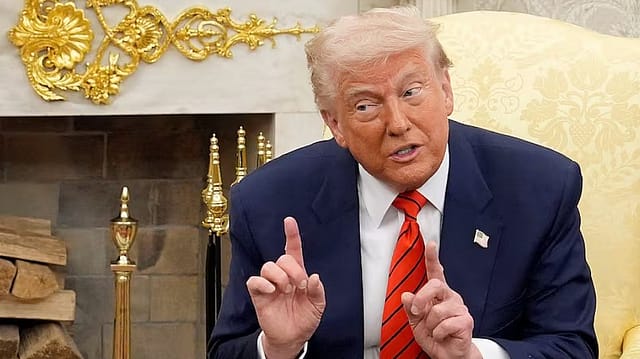
US President Donald Trump claimed on Friday that the US Navy had “total control” of the Strait of Hormuz and accused Iran of seeking a deal on terms Washington could not accept. Tehran gave a different account of who could reopen the waterway. Iranian Foreign Minister Abbas Araghchi said Iran was willing to act within hours, provided the United States first honoured its commitments.
“Last week, we took out record amounts of oil from the Hormuz Strait. Our navy has a blockade,” Trump told reporters at the White House on November 20, after returning from the APEC summit in China. “We have total control over the Hormuz Strait.”
Iranian authorities continue to insist that vessels follow Tehran’s rules for passage or risk coming under attack. In an interview with an Iranian state-run newspaper on Thursday, reported by Al Jazeera, Araghchi said Iran and the US were still exchanging proposals through Qatar and Pakistan. The obstacle, in his account, was what Washington would do in return for reopening the strait, and what assurance Tehran had that fighting would not resume once it agreed.

The Wealth Issue 2026
06 Nov 2026 - Vol 05 | Issue 45
Portraits of Dreamers and Doers under 35
Trump links US gasoline prices to an Iran deal
Trump entered the briefing room with Vice President JD Vance and Secretary of State Marco Rubio. Treasury Secretary Scott Bessent, Pentagon chief Pete Hegseth and White House Chief of Staff Stephen Miller were also present. Asked about gasoline prices, Trump tied what Americans pay at the pump to the outcome of negotiations with Tehran.
“The prices of gasoline now, that also depends on how we settle up with Iran. They want to make a deal, but they don’t want to make a deal that’s acceptable to me,” he said. He accused Iran of misleading negotiating partners for decades, saying, “They’ve been bullshitting people for 51 years.”
On the flight home from China a day earlier, Trump had given a more measured answer about the prospect of renewed US military action. “I am not rushing into any decision,” he told Axios aboard Air Force One. “We will see what happens after the beginning of the year.”
Israeli Prime Minister Benjamin Netanyahu has been pressing Washington to consider another round of strikes, according to Axios. Trump had described a major new offensive as “quite unlikely” the previous week, although his administration has kept military options under consideration.
At Friday’s briefing, Trump repeated his position on an Iranian nuclear weapon. “Iran will never have a nuclear weapon, ever,” he said. Asked about a possible Iranian “dirty bomb”, he described the report as a rumour and said the US would investigate. Earlier in the week, he had warned of retaliation if Iran used such a device or a chemical weapon against members of his administration in Washington.
Why Tehran says the Islamabad agreement fell apart
Araghchi traced the dispute over Hormuz to a memorandum of understanding reached in Islamabad. He said the presidents of both countries had signed it, but accused Washington of subsequently violating an important provision. In his assessment, the memorandum itself was “no longer on the table”.
Some of its terms, however, survived in Iran’s next proposal. Araghchi said Tehran carried forward the commitments it expected Washington to fulfil and added a demand for the lifting of new sanctions. Iran initially proposed reopening Hormuz over seven days. After two months of consultations, that period came down to two days, with Washington expected to act on the first.
“Even if the timetable is reduced from two days to one day or two hours, we have no problem with that. What matters is that Iran’s demands are met,” Araghchi said.
His concern was how long any agreement would hold. By his account, fighting resumed just 15 days after the June ceasefire agreement. “What is the point of reaching an agreement today if it is violated two months later and war resumes?” he asked. Tehran wanted to end the state of “neither war nor peace”, he said, but would require assurances against another conflict.
Iran offers talks on uranium but rejects a transfer abroad
Araghchi said mediators had put forward several proposals for Iran’s stockpile of uranium enriched to 60 per cent. Tehran was willing to negotiate over the material but would not agree to send it out of the country. He argued that a settlement on enrichment should form part of a wider agreement covering sanctions and Iran’s security.
Iran’s official nuclear doctrine remained unchanged, Araghchi said. Any proposed agreement would go before the negotiations committee of Iran’s Supreme National Security Council for review and then to the council for final approval.
“We are people of diplomacy, and we still have hope in diplomacy,” he said. He also called for neighbouring countries to take greater responsibility for regional security, arguing that outside military forces could not guarantee a lasting settlement.
Washington goes after the money from oil Iran has already sold
While the discussions through Qatar and Pakistan continued, the US Treasury announced fresh sanctions under Operation Economic Outcast. Its immediate focus was money Tehran was trying to recover from earlier oil sales. Treasury said Iran had relied on intermediaries it called “oil trustees” to sell crude overseas and that some had kept the proceeds for themselves. It put the outstanding sums in the billions of dollars.
Bessent, who announced the operation on August 24, accused Iran’s leadership of putting its own finances ahead of citizens facing shortages of bread and fuel. “The regime has exhausted its seaborne oil supply, and it may never see the revenue from the oil it has already sold,” he wrote on X.
Treasury said no Iranian oil remained at sea outside the US blockade and that no new cargo had been loaded since the operation began. Trump’s separate claim about record volumes moving through Hormuz did not identify the origin of the oil he was referring to.
According to Treasury, US agencies have worked with the European Union, the United Kingdom, Gulf governments and other partners to identify the intermediaries and financial channels involved in Iranian oil sales. The latest designations target four men whom the department accused of helping Tehran sell oil, collect payments abroad or direct proceeds to entities already under US sanctions.
Who the US Treasury sanctioned
Treasury identified Mohammad Javad Bavand, whom it described as a former Islamic Revolutionary Guard Corps intelligence officer, as a central figure in the effort to recover oil revenues held in third countries. It said Bavand entrusted some of that work to personal contacts, including Majid Taj, the brother of the president of the Iranian Football Federation.
The department alleged that Tehran continued to rely on their network even though its members owed the government billions of dollars from earlier transactions. It designated Bavand and Taj under Executive Order 13902 for operating in Iran’s petroleum sector.
Treasury also designated Mohammadhossein Servati, son of IRGC Brigadier General Mohsen Servati. It said he had held executive positions at companies linked to Sepehr Energy Jahan Nama Pars Company, which the US identifies as a front for oil sales on behalf of Iran’s Armed Forces General Staff. One of those companies, Treasury alleged, handled Iranian oil shipments for independent refineries in China.
The fourth man was Mojtaba Arabnejad, son of Mahan Air chief executive Hamid Arabnejad. Treasury accused him of using family and IRGC connections to procure aircraft parts for the airline and weapons for the Iranian military. It also alleged that he oversaw oil sales whose proceeds supported Mahan Air. The department designated Servati and Arabnejad under Executive Order 13224, citing alleged support for Sepehr Energy and Mahan Air respectively.
What the sanctions cover
According to Treasury, the designations block property belonging to the four men in the US or under the control of US persons. They also cover entities in which one or more blocked persons hold a combined stake of at least 50 per cent, directly or indirectly. US persons generally cannot conduct transactions involving that property without authorisation or an applicable exemption.
Foreign banks that knowingly facilitate significant transactions for designated individuals could face restrictions on the US accounts they use to process payments. Treasury also warned that civil penalties can apply even without intent to violate the sanctions. It said information leading to a successful enforcement action with monetary penalties exceeding $1 million could qualify for a whistleblower award.
For Tehran, the financial restrictions reach beyond its ability to ship another cargo. Even where the oil has already been delivered, Washington is targeting the people Iran relies on to bring the money home. Those measures bear directly on one of the conditions Araghchi set for an agreement over Hormuz: relief from new US sanctions.
With inputs from ANI