Pakistan’s Iran Compulsions Are Not India’s
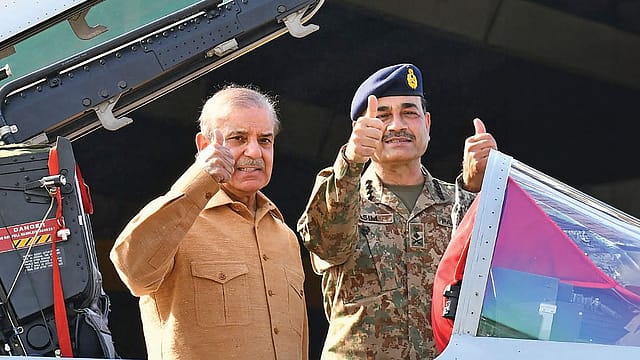
Pakistan’s bid to insert itself into “peace talks” between Iran and the United States has sparked a lively discussion on whether Islamabad scored a diplomatic success and if it comes at India’s expense. Comparisons have been made with Yahya Khan’s role in under the radar exchanges between Richard Nixon’s secretary of state Henry Kissinger and Mao’s China. Inevitably the usual suspects – commentators keen to read every development as an embarrassment for the Modi government – concur with Congress communication in-charge Jairam Ramesh’s claim that Pakistan’s diplomacy is a “colossal failure” for Indian foreign policy.
To begin with, the parallels drawn to the Nixon-era US opening to China are misplaced. For one, the negotiations with secret unlike Pakistan’s repeated public claims as regard to the Iran conflict. Secondly, Pakistan is one of four nations involved in attempting to find a path forward. The foreign ministers of Pakistan, Saudia Arabia, Egypt and Turkey met in Islamabad on Sunday. So far, the specific outcomes are not known. But in any case, the efforts hardly bear any resemblance to the back channel that led to Kissinger’s historic meetings with Mao and Zhou Enlai.
Interestingly enough, Ramesh pays the Modi government a compliment when he notes that Operation Sindoor was a “striking military success.” Though he excludes the political executive, his assessment is unlikely to be shared by the Congress leadership which does not regard any aspect of the Modi government’s actions as a “success.”

Open Minds 2026
26 Jun 2026 - Vol 05 | Issue 26
The power of ideas and arguments in 50 portraits
Iran’s warning to Pakistan
So far, Iran ambassador to Pakistan has limited himself to stating that Pakistan’s self-declared initiative is intended to explore a potential dialogue. He negated claims that Pakistan is actively mediating a ceasefire proposal saying no such discussions have taken place between Iran and the US. It is, of course, likely that all sides are being economical with the truth. In a situation where it may face a land invasion, Iran would not want to rub more nations the wrong way even though its leaders have taken a very dim view of Pakistan allowing its airspace to be used by US military, warning of missile attacks. If Iran chose to ignore India’s reluctance to criticize US and Israeli attacks, it has a bigger grouse with Pakistan.
Pakistan’s bid to present itself as a mediator is in keeping with the constant efforts of its elites to assert their country’s relevance on the international stage. Pakistan’s political class, the military and its upper crust are continuously engaged in anxiously assessing if the country’s “stock” has risen or fallen, particularly vis a vis India. The diminution of the importance of its geography that once ensured a steady supply of arms and US dollars has been further compounded by Taliban’s gruff rejections of any claim that Afghanistan provides Pakistan “strategic depth.” Rather the Taliban has refused to act against the Pakistan Taliban who are bound by ties of blood and ethnicity with Kabul’s rulers.
Aligning India’s interests
Indian foreign minister S Jaishankar’s remark that India cannot be a “dalal,” a Hindi word that is much more disparaging than the English translation of “broker,” is as much political as factual. There is no reason for India to present itself as a mediator when neither side is willing to consider such options and the war in the Middle East is showing every sign of worsening. Any negotiation needs conditions where parties to the conflict have incentives to reach a truce. This is not the case at present and there is urgent need to discard conventional reasoning in assessing Iran’s likely responses and actions even as it has taken a fearful aerial pounding.
It would indeed make sense for Iran to seek an end to the conflict in a manner that leaves its regime structure intact. Though the Islamic Revolutionary Guards Corps and the clergy that have survived assassination have shown ideological resilience and an ability to manage missile and drone stockpiles, continued damage at the hands of the US and Israeli militaries is avoidable. Tehran could play on US President Donald Trump’s palpable eagerness to declare victory and retreat as opposed to Isreal’s determination to dismantle Iran’s ruling apparatus to its advantage. Yet, a combination of deep distrust, highly radicalized minds and inflamed nationalism can hinder rational choices. Iran does not sufficiently feel the need to end hostilities. At least not yet.
Growth Pangs
There is nothing untoward about Pakistan trying to secure its interests just as every other nation wanting to minimize the adverse impact of the war on oil and gas supplies. If it gets a pass for ships headed to Pakistan it would be well the effort. Whether the yet to fructify mediation is a coup a section of opinion in India makes it out to be is another matter. Debates on whether India needed to have reduced its fossil fuel imprint will shape future choices. While India has upped the share of renewables and non-fossil fuels in its energy mix, easy availability of Middle East oil and gas along side other sources made cooking gas and auto fuel shortages a thing of the past.
The Indian economy will continue to consume prodigious amounts of energy as the country’s infrastructure growth accelerates. India is very much work in progress and will grow rapidly for decades. It can increase the use of electricity and Piped Natural Gas (PNG) but the scale and volume of India’s consumption means the use of fossil fuels, including coal, is not going to reduce drastically.