Pakistan Blames India’s Diwali Fireworks for Lahore’s Smog. Can the Smoke Be Traced?
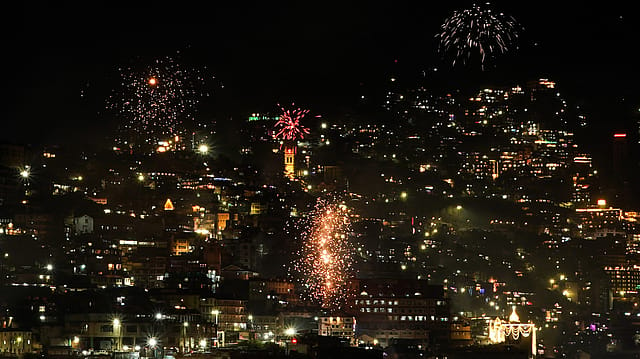
A day after Diwali on 8 November, Lahore woke up to a sharp jump in air pollution. Marriyum Aurangzeb, the environment minister of Pakistan’s Punjab province, blamed polluted air carried in from India. Her department had flagged two possible sources across the border, fireworks and burning crop residue. By Tuesday, Lahore had topped IQAir’s live ranking of major cities for a second day. The dispute is over what was in the air people were breathing and how much of it came from across the border.
Did smoke from India reach Lahore?
The wind made it possible. HamariHawa, an air-quality monitoring project, used weather data to run a model backwards from Lahore. The idea is to take the air arriving in the city and estimate where it was a few hours earlier. The model pointed towards Indian Punjab for part of Sunday evening and overnight. Amritsar, about 50 km away, is one of several Indian cities near Lahore.

The Wealth Issue 2026
06 Nov 2026 - Vol 05 | Issue 45
Portraits of Dreamers and Doers under 35
The result depends in part on the height at which you start tracing the air. Air travelling a few hundred metres up may stay above the layer people breathe in. The model suggests a route for pollution to travel. A measurement of what arrived at street level would be a separate piece of evidence.
How bad did Lahore’s air get?
At 9 am on Monday, 9 November, IQAir’s Lahore figure was about 399 micrograms of fine particles per cubic metre of air. At the same hour on Diwali morning it was 219. HamariHawa saved the hourly figures from the platform, which draws on a network of monitors. These are readings at two points in time. The air quality index, or AQI, is a separate scale that translates pollution readings into a number people can use to gauge the severity.
The particles in those readings are called PM2.5. They are generally no more than 2.5 micrometres across, about one-thirtieth the width of a human hair. They can get deep into the lungs. That makes the rise important whether the particles came from traffic down the road or smoke across the border.
Why was Lahore’s air already so dirty on Diwali morning?
Lahore already has a pollution problem from sources such as road traffic, industry and agricultural burning. Pakistan’s Punjab government has a clean-air programme that targets those sectors. This time of year, farmers in both Punjabs also burn what is left in the fields after harvest. The pollution already present on Sunday morning is part of the story. Any extra smoke that night entered air that already carried a substantial load of particles.
How can a wind carry smoke in while pollution builds up?
Air can move sideways even when it mixes poorly upwards. On some nights, the ground cools and a colder layer of air forms below warmer air. That is called a temperature inversion. It works like a lid, keeping pollution close to the ground. A light wind can carry smoke through that shallow layer while exhaust and smoke from nearby sources accumulate in it. The depth of the layer helps determine whether the same amount of pollution disperses or builds up around street level.
Can satellites tell which side burned more?
They can show where they detected unusual heat. HamariHawa counted 2,859 satellite heat spots across the two Punjabs on 8 November, the highest daily count of the season up to that point. Of those, 1,716 were in Indian Punjab and 1,143 in Pakistani Punjab. NASA cautions that a detection can represent a small, intense fire or heat spread across a wider area. Clouds can obscure detections. The map helps investigators decide where to look. To estimate the contribution to Lahore’s air, they still need to know what burned, how much smoke it released and where the wind took it.
Do fireworks leave a fingerprint?
They can leave a telltale mix of metals in the air. Researchers led by IIT Delhi found that fireworks accounted for an estimated 95% of the metal fraction of fine particles in the air they sampled during Diwali. Their estimate applied to the metals in those samples. In the days that followed, the researchers found a stronger influence from the burning of plant material.
That Delhi study shows why the hour of sampling matters. A burst of fireworks can leave a clear signal on festival night, while a different source can dominate as the haze lingers. To apply the same approach to Lahore, scientists would need samples taken there during the spike and comparisons with what was in the air before it.
What would prove the fireworks came from India?
Researchers would need to match the chemistry to a route and a time. Imagine an increase in firework-related metals first recorded near the Indian side of the border, then at sites farther west and finally in Lahore, at intervals that fit the wind speed. That sequence would strengthen the case. Scientists would still have to account for fireworks or other emissions nearer each monitor and check how well the model reproduces the readings. Monitors on both sides would give them a much better test than one monitor at the end of the route.
What should Punjab’s comparison tell us?
Punjab’s environment department expected comparative findings on 10 November, according to local reporting on its handout. Reuters reported that India’s foreign ministry had yet to respond to its request for comment. As of publication, a public breakdown that puts a number on the contribution from Indian fireworks could not be verified. The finding to look for is an estimate for the hours around Monday’s spike, with the monitor locations, wind data and particle samples behind it. That would help distinguish what Lahore can tackle itself from what requires action across the border.