Trump Won on Prices. Now Only 21% Trust Him on the Cost of Living
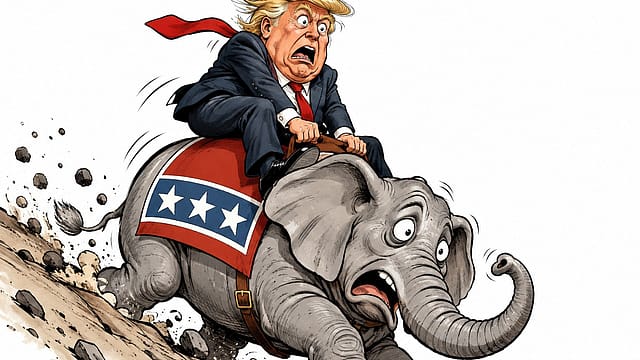
Donald Trump returned to the White House by asking Americans a question that had destroyed many governments before Joe Biden’s.
Are you better off?
Two years later, voters have delivered their answer to Trump.
His approval rating stands at 32 per cent, close to the lowest Reuters/Ipsos has recorded during his political career. Only 25 per cent of Americans approve of his stewardship of the economy. On the cost of living, the issue that helped return him to power, approval has collapsed to 21 per cent.
Those numbers arrived days after Republicans lost control of both chambers of Congress in the November 3 midterm elections. Democrats recorded their strongest House performance since at least 2008 and captured Senate seats in states including Texas, Kansas and South Carolina.
The poll did not discover the political damage. The election had already counted it.

The Wealth Issue 2026
06 Nov 2026 - Vol 05 | Issue 45
Portraits of Dreamers and Doers under 35
Trump promised cheaper energy, lower inflation, successful tariffs and an end to costly foreign entanglements. His second term instead brought a war with Iran, an energy shock and household anger over prices that never returned to their pre-pandemic level.
The president who made affordability his weapon has become its target.
WHY IS 21 PER CENT MORE DAMAGING THAN 32 PER CENT?
An overall approval rating gathers every argument about a president into one number. The cost-of-living figure identifies the broken promise.
Reuters/Ipsos found 32 per cent approving of Trump’s job performance, unchanged from two polls conducted between late October and early November. The result was one point above the 31 per cent recorded in mid-October. His immigration approval stood higher at 38 per cent. His economic approval was 25 per cent. Cost-of-living approval fell to 21 per cent.
The partisan split is even more revealing. Some 81 per cent of Republicans approved of Trump’s immigration policy. Only 50 per cent approved of his handling of living costs.
Trump continues to command his base on deportations and border enforcement. He no longer commands the same confidence when Republicans pay for petrol, groceries, rent or healthcare.
Immigration can sustain enthusiasm among committed supporters. Household economics decides whether a political coalition can extend beyond them.
Trump’s 2024 victory depended on that extension. He improved among Latinos, young men, non-college voters and households frustrated by inflation. Those voters did not need to embrace every part of MAGA. They needed to believe Trump could make daily life cheaper.
The 21 per cent score says that transaction has broken down.
TRUMP WON BY MAKING BIDEN OWN EVERY PRICE TAG
Inflation peaked well before the 2024 election, but the political damage survived the statistical improvement.
Prices were rising more slowly. They had not fallen back to where consumers remembered them. A family buying food or renewing its lease did not experience inflation as a chart showing a lower annual rate. It experienced the higher bill that remained.
Trump understood that difference better than most Democratic campaigners.
He made Biden and Kamala Harris responsible for the accumulated increase in household costs. He promised to unleash American energy, punish unfair trade, reduce government waste and deliver prosperity through tariffs and domestic production.
The offer reached beyond traditional Republican voters. Pew’s analysis of the 2024 electorate found that Trump assembled a more racially and ethnically diverse coalition than in either 2016 or 2020. He won the popular vote by approximately 1.5 percentage points and secured 312 electoral votes.
It was a victory built partly on retrospective economics. Voters compared their memory of prices during Trump’s first term with the bills they paid under Biden. Second-term Trump no longer controls the comparison.
DID THE IRAN WAR BREAK THE AFFORDABILITY PROMISE?
It turned an existing vulnerability into a visible daily cost.
The United States began military action against Iran on February 28, 2026. Disruption to Middle Eastern energy exports and the de facto closure of the Strait of Hormuz drove crude oil and petroleum-product prices sharply higher.
By March 30, average US petrol prices had reached $3.99 a gallon. Diesel averaged $5.40, according to the US Energy Information Administration. Both were the highest in real terms for more than two years.
The increase travelled far beyond the fuel pump. Diesel powers trucks that carry food and consumer goods. Jet fuel affects travel and freight. Higher transport costs reach supermarkets, warehouses and factories.
Brown University’s Iran War Energy Cost Tracker estimates that additional petrol and diesel costs since the conflict began have exceeded $1,100 per US household. It is a model rather than an official government calculation, but it conveys the size of the potential burden.
The political irony is severe.
Trump spent years presenting himself as the president of cheap energy and accusing his opponents of financing distant wars while Americans struggled at home. His own war then appeared on petrol-station signs across the country.
Iran was not the sole cause of Trump’s economic decline. Affordability had troubled voters before the strikes, and Reuters/Ipsos found weak cost-of-living ratings months before the midterms.
The war made the problem harder to explain away. A president can blame inherited inflation for only so long after his own decisions begin adding to the bill.
DID TARIFFS MAKE MATTERS WORSE?
Politically, many voters believe they did.
Trump sold tariffs as payments imposed on foreign countries and incentives for companies to manufacture in the United States. Economists repeatedly warned that importers and consumers often absorb a substantial share through higher costs.
The 2026 midterm exit polls suggest that the economic argument moved from academic debate into household experience. Most voters surveyed by CBS News said Trump’s tariffs had hurt the economy. ABC’s voter polling found 63 per cent blamed his policies, rather than forces beyond his control, for unusually high prices.
Tariffs can protect selected domestic industries and form part of a broader industrial strategy. They do not offer painless revenue. When applied widely, the costs can surface in appliances, electronics, vehicles, construction materials and everyday goods.
Trump’s difficulty is not proving that every price increase came from a tariff. It is that voters no longer give him the benefit of the doubt.
In 2024, he converted dissatisfaction with Biden into permission to experiment. In 2026, he owned the experiment.
WHICH VOTERS LEFT TRUMP?
The groups that made his 2024 victory look like a Republican realignment.
Trump had made historic gains with Latino voters. He attracted young men through a campaign built around podcasts, masculinity, cryptocurrency and hostility towards the political establishment. He improved among voters without college degrees and households that felt culturally ignored and economically squeezed.
The midterms reversed much of that expansion.
AP’s national voter survey found young people moving sharply towards Democratic House candidates. CIRCLE at Tufts University estimated that young men, who had supported Trump over Harris by 56 to 42 per cent in 2024, backed Democratic House candidates by 59 to 37 per cent in 2026.
Democrats won more than six in ten Hispanic votes in one large preliminary voter survey. Independents backed Democratic candidates 58 to 38 per cent. The Republican advantage among voters without college degrees was erased. Men, normally a Republican-leaning group, divided almost evenly.
These movements should not be read as permanent ideological conversions. Midterm electorates differ from presidential electorates, and the president’s party usually loses ground. Democratic candidates also benefited from unusually intense anti-Trump turnout.
The scale and direction still matter.
CBS exit polling found majorities of young voters, Latinos and women supporting Democrats after Trump had gained among all three groups in 2024. The cost of living was central to each group’s decision.
Trump’s coalition had broadened when economic dissatisfaction overrode cultural and partisan reservations. It contracted when the promised improvement failed to arrive.
WAS THE MIDTERM REALLY A REFERENDUM ON TRUMP?
Voters said it was.
ABC’s post-election analysis found around six in ten House voters disapproved of Trump, including 54 per cent who strongly disapproved. Some 44 per cent said their vote was intended to express opposition to him, compared with 16 per cent who voted to support him.
Two-thirds believed he had the wrong priorities. A similar share said he placed his personal interests above the country’s.
Economic pessimism magnified that rejection. Three-quarters rated the economy negatively. Around eight in ten said inflation had caused their family moderate or severe hardship. Voters whose finances had worsened supported Democrats heavily.
The result cannot be reduced to one poll, one price or one war. It was an accumulation: the cost of living, Iran, tariffs, healthcare, aggressive immigration enforcement and exhaustion with Trump’s governing style.
Republicans lost because a large share of the electorate wanted to obstruct the president.
IS 32 PER CENT REALLY TRUMP’S LOWEST?
It is close enough that the precise ranking matters less than the pattern.
Reuters/Ipsos recorded Trump at 31 per cent in October and 32 per cent after the election. Pew measured him at 30 per cent in a survey conducted from September 28 to October 4. AP-NORC and CNN polling also placed him in or near the low 30s during the autumn.
Pollsters use different samples, weighting and question wording. Reuters/Ipsos surveyed 1,705 adults through its probability-based KnowledgePanel and reported a margin of error of approximately two percentage points. A movement from 31 to 32 therefore does not demonstrate a recovery.
The trend is the story.
Trump began his second term with Reuters/Ipsos approval around 47 per cent. It fell to the upper 30s by early 2026 and then towards 30 as economic dissatisfaction deepened.
Pew’s 30 per cent figure was comparable with the 29 per cent it recorded in January 2021, after the attack on the US Capitol and shortly before Trump left office.
He has returned to the popularity level associated with the most chaotic end of his first presidency, this time while still controlling the executive branch for more than two years.
HOW DOES TRUMP COMPARE WITH OTHER MIDTERM PRESIDENTS?
Low approval has historically produced severe congressional losses.
Presidents below 50 per cent approval have lost an average of roughly 35 to 37 House seats in post-war midterm elections, depending on the period and method used. Barack Obama stood near 45 per cent when Democrats lost 63 House seats in 2010. Trump was around 40 per cent when Republicans lost 41 seats in 2018.
The closest political parallel is George W Bush.
Bush won re-election in 2004 but saw his approval eroded by the Iraq war, Hurricane Katrina and growing dissatisfaction with Republican government. His approval fell to approximately 32 per cent after the 2006 midterms, when Democrats captured both chambers of Congress.
Trump now confronts a similar landscape: an unpopular second-term president, an overseas war, household economic anxiety and an opposition-controlled Congress.
Bush’s experience also shows why one catastrophic midterm does not automatically destroy a party. Republicans regrouped and returned to the White House in 2016.
The immediate damage was nevertheless real. Congressional investigations intensified, legislative ambitions narrowed and the president’s authority within his own party weakened.
CAN IMMIGRATION STILL SAVE TRUMP?
It can hold his core supporters. It has not rebuilt his national majority.
Immigration remains Trump’s strongest issue in the Reuters/Ipsos poll at 38 per cent approval. Among Republicans, the figure is 81 per cent. His administration has expanded deportations and elevated Stephen Miller, the central architect of its immigration policy, to White House chief of staff.
That signals a decision to answer electoral defeat with greater ideological concentration.
The strategy may energise voters who remain loyal to Trump. It also carries evidence of overreach. Midterm exit polling found most voters believed the administration’s immigration enforcement had gone too far.
The broader problem is arithmetic. A policy approved by 38 per cent cannot easily compensate for an economic record approved by 25 per cent. Elections are rarely won by persuading voters that border enforcement matters more than every monthly bill.
Trump can intensify immigration messaging. He cannot order Americans to stop caring about prices.
WHAT DOES LOSING CONGRESS CHANGE?
Trump’s low approval now has institutional consequences.
A Democratic House can control committees, issue subpoenas, investigate the administration and block legislation. A Democratic Senate can obstruct nominees, influence judicial confirmations and force negotiation over spending and foreign policy.
Trump retains extensive executive authority. He can issue orders, shape enforcement, conduct foreign policy and dominate Republican media. Yet his ability to enact major legislation has narrowed dramatically.
The White House must also prepare for relentless scrutiny of the Iran war, tariffs, deportations, executive spending and possible conflicts of interest.
Presidential weakness can become self-reinforcing. Members of the president’s party become less willing to defend unpopular decisions. Potential successors begin creating distance. Foreign governments calculate that the president has limited time and diminished congressional support.
The 32 per cent approval rating is therefore not merely a report card.
It is a measure of declining leverage.
CAN TRUMP RECOVER?
His career warns against declaring him finished.
Trump survived two impeachments, criminal prosecutions, the January 6 attack, an election defeat and sustained predictions that Republican voters would abandon him. He then returned to the White House with a broader coalition.
Approval ratings can improve if fuel prices fall, the Iran conflict ends, inflation eases or Democrats overplay their congressional mandate. Voters who rejected Republican candidates in a midterm may still choose a Republican president in 2028.
Trump faces a constraint he did not confront after 2020. The Constitution prevents him from seeking another term. His remaining political power depends on whether Republican candidates believe his endorsement helps them and whether voters accept his chosen heir.
The midterms have broken the assumption that Trump can transfer his coalition automatically.
Young men and Latino voters may have voted for Trump personally rather than joining the Republican Party. Working-class support may have depended on an economic promise rather than permanent cultural allegiance. MAGA may remain powerful without being portable.
That makes every falling point on Trump’s chart a question about succession.
THE PRICE OF THE TRUMP PRESIDENCY
Trump’s political genius has often been his ability to make somebody else own the consequences.
Immigration was the failure of previous presidents. Inflation belonged to Biden. Factory closures belonged to China. Wars belonged to the Washington establishment. Republican defeats belonged to weak candidates.
The second term has reduced the available distance between the president and the result.
The war in Iran is his. The tariffs are his. The deportation strategy is his. The Republican Congress that lost both chambers spent two years implementing and defending his agenda.
Americans were asked in 2024 to compare Biden’s record with their memory of Trump’s first presidency.
In 2026, they compared Trump’s promises with Trump’s results.
They looked at the prices. They looked at the petrol pump. They looked at the war. Then they removed his party from power in Congress.
A 32 per cent approval rating will not end Trumpism. It will not instantly release the Republican Party from his control. It does establish that the coalition behind his restoration was conditional.
Trump won the White House by asking whether Americans were better off. His falling chart records their answer.