Modi & Merz Will Aim to Amp up India-Germany ties
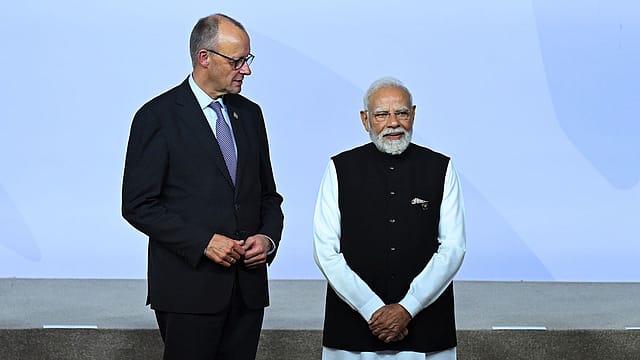
When Prime Minister Narendra Modi and visiting German Chancellor Friedrich Merz inaugurate the international kite festival in Ahmedabad on Monday, they will hope that India-German ties soar as well by strengthening bilateral cooperation in trade, defence, climate change, industrial manufacturing, science and culture at a time when US President Donald Trump’s abrasive diplomacy is upending global institutions.
The meeting in Ahmedabad had top billing given the India-Germany strategic relationship and that Germany accounts for roughly one-fourth of India’s trade with the European Union. But the unprecedented flux in India-US ties makes the discussion even more critical. Even as countries look to reach a trade deal with the US to stabilise ties, they are working urgently to increase other avenues for commerce, security and multi-lateral action on shared concerns.
Shared Security Concerns in Indo-Pacific
The turbulence has led to questions about the future of NATO (North Atlantic Treaty Organisation) and the US stance towards the Indo-Pacific. These concerns have brought India and Germany closer and on Monday, Modi and Merz can be expected to be on the agenda as their engagements begin with a visit to the Sabarmati Ashram. This is the German Chancellor’s first visit to India and Asia after the formation of the new government in Germany in May, 2025.

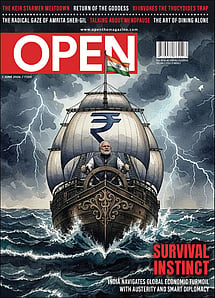
Survival Instinct
22 May 2026 - Vol 04 | Issue 72
India navigates global economic turmoil with austerity and smart diplomacy
The two sides have identified new areas of cooperation though the inter-governmental consultation that both nations share with only select countries. The fine-tuning of national positions in multi-lateral fora has become more pronounced in recent years. Modi spoke to Merz on May 20, met him at the sidelines of the G 7 summit in Canada in June, 2025, and then again in Johannesburg where the two leaders attended the G 20 summit in November, 2025.
While German foreign minister Johann Wadephul and other German dignitaries have visited India, external affairs minister S Jaishankar and commerce minister Piyush Goyal been to Germany.
Maritime Security
The defence cooperation has seen German participation in Exercise Malabar, 2025, the first bilateral air exercise Tarang between the German Air Force and the Indian Air Force and the expected deployment of a German Navy liaison officer at the Integrated Fusion Centre – Indian Ocean Region (IFC-IOR). The IFC-IOR, based at Gurugram, is a key institution that monitors maritime security, pools information, regularly producing reports and helping curb piracy and armed robbery, contraband smuggling, IUU (Illegal, unreported and irregular) fishing and irregular human migration on the high seas.
Germany shared India’s concerns over security in the maritime corridors that are conduits for international trade and important in the context of global energy flows.
2000 German Cos in India
The India-German bilateral trade reached USD 51.2 billion in 2024-25 with trade in services rising 12.5% in FY24-25, touching a record USD 16.65 billion. In contrast to greater restrictions on incoming students in the US, Germany remains a welcoming destination for higher studies and there are 60,000 Indian students in the European nation. There are more than 2,000 German companies in India – the number will surprise many – and these include BASF, DHL, Hapag Lloyd, Siemens, Schneider, Carl Zeiss and automakers like BMW, Mercedes and Volks Wagon. There are 215 Indian companies in Germany, particularly in IT, automotives, pharma, bio-technology and manufacturing contributing to jobs and innovation.
India and Germany signed a comprehensive migration mobility agreement in December, 2022, and inter-governmental cooperation (Centre and State) has been growing in areas such as setting up cluster-oriented structures (systems and data systems) and strengthening industrial application of dual VET (Vocational Education and Training) that has been successful in skilling young people and reducing unemployment. The model is particularly useful in the Indian context where employability is a concern and requires a blend of practical and theoretical learning.
India-German development partnership
India and Germany have forged an important partnership in clean energy and development with joint projects in renewables, urban development, forests, water and agriculture. The two nations are also offering inclusive projects to support SDG (sustainable development goals) in Africa and Latin America.
India-Germany cooperation has been aligned with India’s national priority areas such as advanced manufacturing (Make in India), embedded system and ICT (Digital India), sustainable bio economy (food security) and water and waste water technology (Clean India). Bilateral research and development is growing in medical technologies, artificial intelligence and waste to wealth initiatives. Design of enhanced antennae system using “substrate integrated waveguide technique” for 5G technology helps achieve higher gains, low and wider bandwidth.
With the number of Indian students in Germany doubling over five years, India and Germany are rapidly expanding dual, joint and integrated degree programmes with seven MOUs between Indian institutions like IIT Madras, Bharatiya Vidyapeeth and Jawaharlal Nehru Technological University in Hyderabad and leading German universities. Overall, there are close to 3 lakh Indian passport holders and Indian origin persons in Germany. It is a largely skilled diaspora comprising professionals, researchers, scientists, business persons, nursing staff and students.