No Country for Ice Men: How Global Powers Are Carving Up Greenland
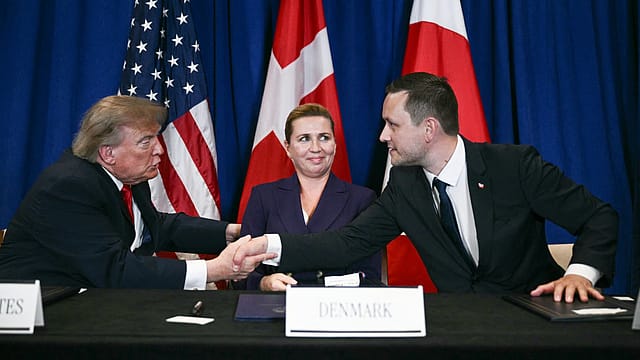
The signing of the recent agreement between the US, Denmark, and Greenland brings down the curtain on what has been among the coldest and most far-flung reality shows in the history of international relations. The central attraction was watching two of the world’s heavyweights squabble over Greenland like divorced Beverly Hills parents fighting for the custody of a neglected child neither has any interest in raising properly. On one side, we had Denmark—a country so small you could miss it while adjusting your car radio on a drive through Europe—desperately clinging to a frozen landmass eighty times its size. On the other, the US—a nation that has never met a piece of real estate it didn’t want to stick a flag in, strip-mine, turn into a golf course, or cover in fast food billboards. And caught in the middle were the Inuit people of Greenland, who have been living there for roughly 4,500 years.
Denmark is charming. They invented Lego and pastries that will kill you in the most delicious way possible. Then there is the concept of hygge—the idea that if you light enough candles and buy enough throw cushions, you can ignore the fact that the sun sets at 3PM for half the year. But behind the pastries lurks a colonial history, rather like that kindly, widowed old uncle who indulged you with chocolates at family get-togethers but was a bit of a wife-beater in his younger days.

Hot Pursuit
27 Nov 2026 - Vol 01 | Issue 02
The Shah Doctrine of Internal Security
The Danes arrived in the 18th century with the colonial starter pack: absolute certainty in their superiority, Christianity, and no understanding of why locals might be uninterested. Lutheran missionary Hans Egede landed in 1721, determined to convert Greenlanders, and centuries of systemic marginalisation followed, punctuated by the Scandinavian flair for better interior design. Post-World War II, they suddenly decided the real problem was that Greenlanders weren’t Danish enough. Children were forcibly separated from their families and sent to Denmark for “re-education”, a polite euphemism for cultural erasure.
This was happening at the time Mao was doing something similarly massive but in a more crowded turf this side of our planet—a troubling East-West jugalbandi of oppression entirely missed by Western ivory towers and Scandinavia-enamoured Third World activists.
These decades of forced assimilation and discrimination carried out by Danes convinced them that they were civilising the natives. Except that the Inuit were already a civilisation—one that had figured out how to survive in the hostile Arctic for millennia when Europeans in kinder climes were still labelling and burning women as witches.
Even today, Greenland is stuck in this weird quasi-colonial relationship with Denmark. Their “self-rule” is politician-speak for “you can decide, as long as we approve”. Denmark still controls foreign policy and defence, and provides about $600 million annually to Greenland—a generous gesture until you remember that the Danish government is essentially paying token rent on a property they stole.
And then the US barged in with a giant plastic shopping bag, led by an orange-haired man with an uneven studio tan whose record includes bankrupting hotels and casinos. In short, a leading light of post-’80s American business. For years, the US has operated the Pituffik Space Base (formerly Thule) in northern Greenland, built back in 1943 without asking the local Inuit people, and then forcing them from their ancestral lands for their own good and humanity’s, or so the media PR insisted.
When Donald Trump first demanded to buy the whole island during his first term, Denmark’s Prime Minister, Mette Frederiksen, called the idea “absurd”. Trump responded by cancelling a state visit—the geopolitical equivalent of scuttling a mohalla cricket match in a Delhi bylane by taking your bat and going home.
But as of late 2026, the strategy has evolved. Why buy the cow when you can lease the pasture, access the udders and not hassle about the cow dung?
The newly minted trilateral security agreement approved by Greenland’s parliament in November 2026 paves the way for new US defence areas at Narsarsuaq and Mestersvig, a massive upgrade to Pituffik, and the deployment of a futuristic “Golden Dome” missile defence system. Trump immediately declared victory: “We just got Greenland.”
Not exactly. Denmark gets to keep the constitutional receipts, Greenland gets to wave its red-and-white Erfalasorput flag, and the US military gets to turn the Arctic into an episode of Star Wars: Arctic Warfare Edition. But the man with the uneven studio tan has certainly opened the doors to Texas-based oil exploration firms, whose sun-tanned men are now drooling over East Greenland’s resource potential.
American interest in Greenland is beautifully transparent: like that overpriced hotel in the Srinagar valley or a crowded bar near a north Goan beach. It’s all about location. Greenland sits between North America and Europe, prime real estate for missile shields and listening posts. It is also melting—which, in more innocent times, would have been the face that launched a thousand ships, albeit of the wind-powered variety, such as the carbon-neutral transatlantic yacht that a Scandinavian teen once took to make her global activist debut with that “How dare you?” speech at the UN.
But Greta has moved on—from dirty energy to dirty geopolitics. The placards have the same fonts, but different indignation. Greenland, always distant and cold, now feels warm and welcoming to global powers—a giant slot machine that might pay out in rare earths as the ice retreats, revealing strategic minerals and new shipping lanes. Climate change is no longer a preserve of green activists, or a lip-service line item for industrialists; it’s cold calculation even for the most cold-hearted, orange-haired climate sceptic—pun very much intended.
For the people of Nuuk, Danish rule has historically meant the robbery of reproductive rights, cultural erasure, and worse. Suicide rates remain among the highest in the world, and alcoholism is rampant—the predictable outcomes of cultural genocide and colonial oppression wrapped in the Nordic model’s pretty packaging. Respecting indigenous agency would require empires on either side of the pond—hygge-loving or otherwise—to try something historically unfamiliar: respecting the autonomy and dignity of the indigenous people.
This show is now over—or has at least reached the season finale. The only thing more entertaining than watching empires squabble over colonies is watching them do it while pretending they’re not empires and these aren’t colonies. It’s a relief compared to the family feud between powerful Western cousins George, Nick, Wilhelm, Constantine, and Ferdinand—the much-lionised brood of Queen Victoria—whose ego-tussles a century ago snowballed into World War I, leaving 10 million dead, 21 million wounded, and colonies like India bled dry for a party it didn’t start. Among the dead in that dubious 1914–1918 battle of clashing cousins were 74,000 Indian soldiers. Another 67,000 were wounded, who returned home only to bring the Spanish flu, which killed 12 to 17 million more across India. Hagiographers of the British Empire forget to mention that we were even billed for it—£73 million at the time in money, men, and material contributions (over ₹650 billion adjusted for inflation).
This time around, the Western cousins didn’t blow up the continent; they just figured out a frictionless way to carve up the ice sheet together. The rest of us did well to ignore it, or grab a tub of masala popcorn and watch the tamasha from the sidelines.