The Rohingya Aftershock
For some people Philippe Sands might seem an unlikely advocate for a Muslim minority in Southeast Asia. A French-British barrister and a Jew whose grandfather fled the city once called Lemberg (Lviv), he spent seven years as counsel for The Gambia, a small, mostly Muslim country in West Africa, arguing that Myanmar had committed genocide against the Rohingya. On November 19, the International Court of Justice (ICJ) agreed with that argument. Sands told BBC Radio 4 that the judgment was “right up there with the great moments of international justice”. In the New York Times, he wrote that the testimony in the courtroom had been “as shocking to me as anything I have heard over three decades” (‘Can a Country Be Guilty of Genocide? Finally, the Answer Is Yes’, November 20).
The symmetry is hard to miss. Sands’ best-known book, East West Street (2016), tells how two Jewish lawyers from the same Galician city, Hersch Lauterpacht and Raphael Lemkin, gave the world the vocabulary of crimes against humanity and genocide. Sands—their legal and intellectual heir, with family roots in Lviv—has now used it for a people the world long preferred not to look at. There was also, as he said, “the elephant in the room” while he argued the Myanmar case: Gaza. (There isn’t any irony about Sands even if there is about Gaza: George Steiner, the legendary critic and philosopher, had made it a moral imperative for Jews and Israel to never become oppressors and perpetrators of violence on another people.)
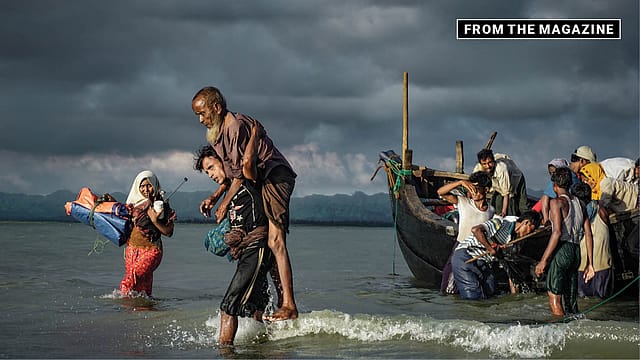
On November 19, by nine votes to six, the ICJ found that Myanmar’s security forces committed genocide against the Rohingya in northern Rakhine State during the “clearance operations” of 2017. It established three of the five acts listed in the Genocide Convention: killing, causing serious bodily or mental harm, mass rape included, and imposing measures to prevent births. It put the dead at about 10,000 and the number targeted at some 815,000. More than 700,000 fled to Bangladesh. Nearly 400 villages were wholly or partly destroyed. The court added that Myanmar failed to prevent genocide by civilians fighting alongside its troops, failed to punish it, failed to legislate against it, and destroyed evidence. It ordered reparations, including safe return for the displaced. It did not order citizenship, and it rejected the charge of incitement.
The verdict is a first. The court had twice declined to hold a state responsible for genocide: in 2007, when Serbia was found to have failed to prevent the Srebrenica massacre but not to have committed it; and in 2015, when Croatia’s claim was rejected by the court. Sands had argued that case too. While individuals have been convicted of genocide before, a state is another matter, since it requires proof that a government, rather than a band of killers, set out to destroy a people. Myanmar is the first found to have done so.
For the Rohingya, justice may change little. In Bangladesh about 1.2 million live in the Cox’s Bazar camps, barred from work, on rations periodically cut. Aid workers say gangs rule the camps at night

The standard the case met is the product of a quarrel between those two men from Lemberg. Born within three years of each other, both studied law there, and both lost family in the Holocaust. Lauterpacht, later a Cambridge professor, held that the individual was law’s proper concern, and gave the Nuremberg charter “crimes against humanity”: murder, torture and persecution on a vast scale. Lemkin, a Polish Jewish émigré, saw that people were being killed for the group they belonged to, and coined “genocide” in 1944 for the destruction of the group itself. Each man thought the other was too narrow. Lauterpacht feared the new word would shift attention from individual rights to group identity. Sands, in a 2016 Irish Times essay explaining the central legal tension of East West Street, put the resulting duality down to “our own double identities—as individuals and as members of groups”.
Nuremberg took Lauterpacht’s crime and gave Lemkin’s coinage a walk-on part. And yet, the tribunal never used it in its rulings, largely from American worries that it could be turned on the US. Lemkin called the day of judgment “the blackest” of his life. Three years later, in 1948, he got his Convention, but with a bar higher than he had proposed: not mere killing but acts committed with intent to destroy, in whole or in part, a national, ethnical, racial or religious group. Atrocity, however monstrous, is not enough. And that explains the gap between popular and legal meanings of genocide.
That gap also explains why the word ‘genocide’ has become so contested. In September 2025, a UN commission chaired by Navi Pillay found Israel responsible for genocide in Gaza. Israel rejects this, refused to co-operate, and alleges bias. A commission is not a court and the ICJ has just underlined the difference: it attaches no probative value to the legal assessments of UN fact-finders, though it relied on their facts. Pillay’s dual role compounds the awkwardness too. She sat in the Myanmar case as The Gambia’s ad hoc judge, and the US’ UN ambassador, Mike Waltz, accused her of seeking to lower the threshold for genocide. But if we take out the two ad hoc judges (Pillay for The Gambia, Claus Kress for Myanmar), the court’s own members still split eight to five. Evidently the court was not cowed by an apparent US threat of sanctions, and President Yuji Iwasawa, in a separate opinion, stressed that the court had not departed from its test.
So what does Myanmar mean for South Africa’s case against Israel, which is not expected to be argued until 2029? Had The Gambia lost, as Sands said, the Gaza case would have been over. It did not, so the door stays open. It does not mean South Africa will win. It means the standard is now clear and each party must meet it—and South Africa carries the same burden of proving intent. The six dissenters complained that the majority had quietly lowered the bar, but Sands finds that unpersuasive. Meanwhile, political scientist Janina Dill argues that the Rohingya should not be treated as a dress rehearsal for anyone else’s trial.
But who are the Rohingya? About a million of them lived in Myanmar at the start of 2017, mostly in Rakhine, the coastal strip on the Bay of Bengal that was once the kingdom of Arakan. They are Muslim, have their own language, and say they descend from Arab traders and others. Successive governments have called them “Bengalis” and illegal immigrants. The ICJ disagreed: the Rohingya have lived there for generations and are a distinct ethnic group. The other people of Rakhine are the Arakanese, Buddhists who chafe at rule by the Burman majority and now fight the junta as the Arakan Army, but with scant affection for their Muslim neighbours. The 1982 citizenship law left the Rohingya off the list of recognised peoples. Exoduses followed in 1978 and 1991. Then communal riots in 2012 hardened everything and everyone. Couples faced marriage permissions and two-child limits, and birth certificates stopped being issued.
At that point, social media stepped in and did the rest. Hatred was packaged and amplified. The court found that a military network on social media dehumanised the Rohingya as a threat to Buddhism. Troops were joined by Buddhist mobs. Yet “Buddhist” is a lazy label for the culprit. This was evidently a state project, run by an army that has since turned its guns on the Buddhist majority too. Thus, the (Buddhist) Karen and other democratic groups inside Myanmar have welcomed the verdict.
The violence came in two waves. After the Arakan Rohingya Salvation Army (ARSA) killed nine border policemen in October 2016, some 87,000 Rohingya fled the army’s response. On August 25, 2017, ARSA attacked about 30 police posts and the clearance operations began the same day. ARSA itself is accused of mass murder but the world looked away from it for long. Amnesty International found its fighters massacred up to 99 Hindu villagers, women and children among them, in two villages that week, and called its abuses “largely under-reported”. In fact, foreign media did report the killings at the time but the junta’s refusal of independent access and its escorted press tour of a mass grave bred scepticism. The ICJ accepted that ARSA attacked civilians and that its commander ordered non-Rohingya villages burned.
Aung San Suu Kyi is Still revered by Buddhists but condemned by younger activists. Defending the army that held her Lost her goodwill in the West
Even so, the Myanmar army’s response dwarfed everything else. Médecins Sans Frontières counted at least 6,700 Rohingya dead in a month, 730 of them under five; the government claimed 400. Satellite imagery showed Rohingya villages burned while Rakhine ones beside them still stood.
That is where ‘intent’ was proved. Governments do not announce extermination, so the court had to infer it, helped by Myanmar’s refusal to admit UN investigators, which allowed freer inference. As the judgment Iwasawa read out put it, genocidal intent must be “the only reasonable inference that can be drawn from the evidence”. Myanmar offered three alternatives in its defence. Counter-insurgency failed because troops did not distinguish civilians from fighters, executed men and boys, targeted babies, and shot at the fleeing. Forced displacement failed because no plan to evacuate was found. Punishment failed because the scale and methods “went well beyond what would be required to punish the population”. Dill makes the point that genocide can coexist with other aims; what mattered was that the totality of the evidence could not be explained without it. Ten thousand dead, 1.2 per cent of those targeted, did not preclude intent.
The evidence was gathered against a government whose advocate in 2019 was a Nobel laureate. Aung San Suu Kyi, held for some 15 years by the same generals, told the judges that “genocidal intent cannot be the only hypothesis”. Seven years on, the court found it was the only reasonable one. Her fall in Western eyes had begun earlier: Amnesty withdrew its Ambassador of Conscience award in 2018. Fourteen months after her speech, the army overthrew her. Now 81, under house arrest after trials the UN called a sham, Suu Kyi is still revered by many Buddhists but condemned by younger activists. Defending the very army that held her may be Suu Kyi’s own tragic irony.
For the Rohingya, justice may change little. In Bangladesh about 1.2 million live in the Cox’s Bazar camps, barred from work, on rations periodically cut. Aid workers say gangs rule the camps at night, and tens of thousands of new arrivals, fleeing the Arakan Army and conscription, are swelling the camps. Those who risk the Andaman Sea for Malaysia, the second-largest host, find that the welcome has worn thin: a petition in June-July this year to ‘Remove Rohingya from Malaysia’ drew 420,000 signatures and schools were raided. Malaysians do not want the Rohingya around any longer.
But the Rohingya cannot go home again. Min Aung Hlaing, whose speeches the court examined, seized power in 2021, triggered a civil war that has displaced almost four million, and became president in April after elections widely criticised by observers. The Arakan Army now holds most of Rakhine and, UN investigators say, conscripts Rohingya and blocks their return.
The Rohingya crisis and civil war in Myanmar haven’t been good news for India which has a 1,643-km border with Myanmar and no easy answers. The Centre told the Supreme Court that some Rohingya have militant links. New Delhi’s fears are not imaginary: the court noted that ARSA’s leaders were partly abroad, its victims included Hindus, Mizoram shelters 40,000 Chin refugees from the civil war, and free movement is suspended. When India hosted Min Aung Hlaing at the turn of June, stability in the neighbourhood was Delhi’s main concern along with Act East and a hedge against China. That remains so, even as India balances being strict and humane at the same time.
Myanmar must report back within two years but where exactly do things go from here? The ICJ’s powers end with the judgment. It cannot jail the generals. Enforcement runs through the UN Security Council where China, Myanmar’s patron, and/or Russia can use the veto. Even Iwasawa had reservations, finding it “difficult to see how The Gambia can legitimately make such choices” about compensation.
As Sands noted, the “court did not break”. That fact matters. The Rohingya now have a judgment. They still lack a country. And there is very little chance of their case not being used as a dress rehearsal for others.
THE GENOCIDE TEST
› Srebrenica (1995)
Nearly 8,000 Bosnian Muslim men and boys killed. The ICTY convicted Bosnian Serb leaders Ratko Mladic and Radovan Karadzic; the ICJ confirmed genocide in 2007.
› Rwanda (1994)
Around 800,000 people, mostly Tutsis, massacred in 100 days. The ICTR established genocide through landmark convictions.
› Cambodia (1975-79):
The Khmer Rouge rule left 1.7 million dead. The Cambodian tribunal convicted regime leaders of genocide against Cham Muslims and ethnic Vietnamese.
› Darfur (2003 onwards):
Around 300,000 deaths. The ICC issued a genocide arrest warrant against Sudanese President Omar al-Bashir in 2010; no conviction followed.
› Sri Lanka (2009):
Tens of thousands of Tamil civilians died in the civil war's final phase. Genocide allegations remain unadjudicated by an international court.
› Myanmar (2017):
More than 700,000 Rohingya fled to Bangladesh following the military crackdown; at least 10,000 were killed. On November 19, 2026, the ICJ ruled 9-6 that Myanmar had committed genocide.
› A Historic First
The ICJ’s landmark judgment in The Gambia vs Myanmar is the first in which the court has held a state directly responsible for committing genocide.
THE HUMANITY DEBATE
› Raphael Lemkin (1900-59)
Polish Jewish lawyer who coined “genocide” in 1944, combining Greek genos (group) and Latin cide (killing). He campaigned for its recognition as an international crime.
› Hersch Lauterpacht (1897-1960)
Polish-born British jurist who developed the concept of “crimes against humanity”, placing the individual, rather than the group, at the centre of international protection.
› Two Visions
Lauterpacht sought to protect the individual; Lemkin, the group’s right to exist. The two Jewish lawyers from Lemberg (Lviv) shaped the legal foundations of the Nuremberg trials.
› Nuremberg Legacy
Crimes against humanity entered the Nuremberg Charter; genocide featured in the indictment but was not a separate Charter offence. Lemkin subsequently helped secure the 1948 UN Genocide Convention.
› High Bar
Genocide requires specific intent to destroy, wholly or partly, a protected national, ethnic, racial or religious group. Mass killing alone is insufficient.
› Three Legal Elements
1. A protected group; 2. At least one prohibited act—killing, serious harm, destructive living conditions, preventing births or transferring children; 3. Specific intent to destroy the group.
› Myanmar Test
The ICJ examined killings, serious bodily and mental harm (including sexual violence), and birth-prevention measures. It assessed the context, selective targeting, attacks on the group’s foundations and systematic nature of operations to establish genocidal intent.