The Globetrotter: Are Russia’s Dead Betraying Putin?
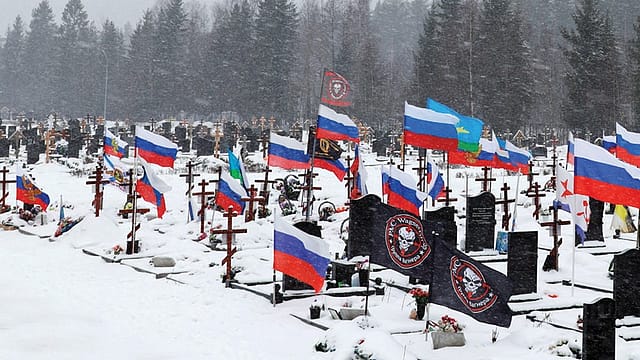
Leaked records from Rosstat, Russia’s statistics agency, put registered military deaths in Ukraine at about 490,000 by end-September. Mediazona, a Russian media outlet, is confident the data dump is genuine. After correcting for registration lags and the missing, Mediazona and Meduza, another media outlet, think the true toll exceeds 700,000. The last time the defence ministry offered a figure was in 2022. It was fewer than 6,000. That’s the ledger of Vladimir Putin’s war. Set it against what the Russian president wanted: Kyiv in days, a pliant government, a weaker NATO. He got a Ukraine more hostile than ever, an alliance enlarged by Finland and Sweden, and a front that advances by villages at ruinous cost. Few armies have buried so many for so little ground. While Ukraine’s suffering is real and immense—cities shattered, power grids targeted, a generation scarred, and Washington’s wavering under Donald Trump making things harder still—Kyiv endures. That endurance is the thing Moscow cannot buy. Russia’s larger costs also compound quietly: a war economy kept going by spending and punishing interest rates, a shrinking workforce, and a society trained to avoid the question. Silence suits dictators until the numbers leak. They always do.
All about Infantino’s Scheme

Ninety-six years would be the lifespan of the World Cup to date. Documents seen by the Athletic show FIFA boss Gianni Infantino was prepared to lease the tournament’s money-making machinery for 96 years to a $20bn vehicle, with a stock-market flotation pencilled in and fat bonuses for its managers. No tender. No warning for the council. Member associations, whose approval was required, learned all from the leaks. Infantino shelved the idea and apologised. Yet he remains the favourite for re-election. The stain isn’t the scheme though but the secrecy, showing how football’s custodian treated the game as his private property.
A Kingpin Falls but Nothing Changes
The arrest of Fausto Isidro Meza Flores aka El Chapo Isidro in Guasave, Sinaloa, on November 20 is a trophy for the US and Mexico. But it must not be mistaken for a victory. Soldiers died, as did over a half-dozen suspected gunmen. Decapitation, whether enemy-state leadership or cartel, breeds a vacuum and then comes the scramble. Meza Flores, allied with Los Mayos against Los Chapitos since 2025, has left lieutenants hungry for his territory. His fentanyl pipeline will not stay dry for long. Border towns and Texas crossings expect turbulence before any lull. The larger lesson comes from Joaquín Guzmán aka El Chapo himself. His fall and extradition did not shrink the trade; it splintered it into warring factions, each harder to negotiate with, and none easier to police. Meanwhile, the narcotics business has changed. Cartels now behave like shadow bankers. They funnel proceeds through remittances and lend to struggling shopkeepers at ruinous rates: microfinance without the mercy. Evidently, lending is quieter than shooting and far more profitable. Thus, policy must follow the money. Arrests please audiences but audits starve cartels. Until Washington and Mexico City raid loan books as keenly as hideouts, the next capture will merely auction the old one’s customers.