Nepal Floods, Two Months On: A Lost Home, a Register of Names & a Rose
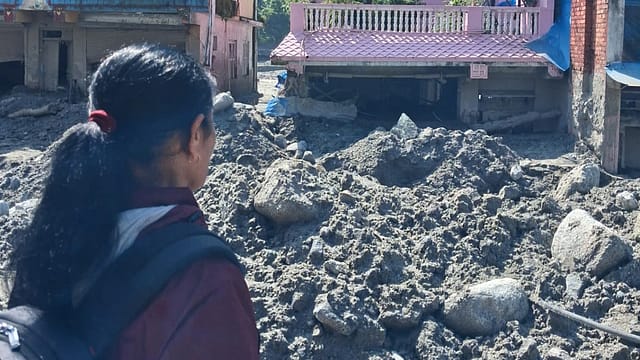
Usha Rijal sat with a register, writing down the names of the missing and the dead.
Around 70 people were sheltering in the relief camp. Many had arrived by helicopter. They needed food, medicines and news of people they could no longer find. Usha, an auxiliary health worker who had served their community for more than 25 years, helped distribute supplies and recorded names in the register.
She knew almost every family. Her own house lay almost buried in mud and debris.
Her son, Srijal, remembers watching her. He had spent hours fearing she was dead. Four days after the flood, he finally set out to reach his parents. Now they were together in a camp, surrounded by neighbours whose losses were still becoming clear.

Look Who's Talking Regime Change
23 Oct 2026 - Vol 05 | Issue 43
“She lost her own home, but she was still taking care of everyone,” he recounts.
Two months after the August 26 floods, Usha and her husband, Arjun Prasad Rijal, live in a rented room near their village in Nepal’s Nuwakot district. Their son has returned to his studies in Kathmandu. Each day, Usha walks to the health post where she has delivered babies, handed out medicines and looked after the sick for much of her working life.
The journey takes an hour and a half each way. Damaged roads and bridges have made it harder.

THE CALLS THAT WENT UNANSWERED
At around 10 am on August 26, Srijal was in his room in Kathmandu when a relative called.
“The flood has come,” the relative said. “Everything is gone. Go and check on your parents quickly.”
Srijal, a 23-year-old computer science student, called his father. No answer. He tried his mother. Her phone went unanswered too.
He called again.
Then he opened Instagram and X. On his screen, muddy water poured through a valley, swallowing houses and roads.
“I was shivering,” he recounts. “I thought my parents were gone. I thought they were not alive.”
For an hour, he kept trying their phones.
The family lived in Tupche, ward 7 of Bidur Municipality, above the Trishuli River. Arjun, 58, was a government primary school teacher. Usha, 55, worked at the Tupche health post. After years in rented rooms, they had built their own house about 16 years earlier.
It was the house Srijal grew up in. When his father finally called, Srijal wanted to leave Kathmandu at once.
“Don’t come here,” Arjun said.
He said it again.
“All the bridges are gone. All the roads are gone. There is nothing left.”
Srijal asked about his mother.
“Your mother is safe.”
But his father did not put her on the phone. Srijal begged to speak to her. Without hearing her voice, he could not believe the reassurance.
“I thought my mom was not alive. I broke down,” he says.
At around 2 pm, his phone rang again.
This time it was Usha.
“That was the moment I was relieved,” he says. “It has been two months, but even now, when I think about it, I start to shake.”
THE WAY BACK
Four days after the flood, Srijal set out for home. The journey took 12 hours. Bridges had been swept away, and mud and landslides blocked stretches of the road.
His parents were waiting in a relief camp.
He ran into their arms. The three of them stood together and cried.
“All our hard work is gone,” Usha told him.
Then she began reassuring her son.
“I am alive. Your father is alive. We will restart our lives. Don’t worry.”
Arjun held to the same thought.
“We have our lives. A house can be built again.”
Around them were friends, neighbours and relatives. Srijal embraced them one after another. At first, there was little to say.
The news came in names. One of his maternal uncles had died. A friend had lost his mother. Another had lost his father.
These were people from the landscape of his childhood: relatives he had visited, parents of friends, familiar faces around the village.
A friend asked if he remembered the place where they used to play marbles and wander around.
“How did life take such an ugly turn?” the friend said.
The place they remembered was under mud.
For Usha, there was work to do. She had spent years caring for these families. Now she was writing their names down and handing out the food and medicines sent by NGOs.
During the pandemic, she had kept working at the health post. She fell ill with Covid, and the infection spread through the family. They all survived.
This time, they were together again.
They had lost the place to which they could return.
WHAT WAS LEFT OF HOME
Srijal went to see the house.
The mud, sand and debris had dried into a grey crust. He moved through what remained of his room, the kitchen, his sister’s room and the hall.
He knew where everything belonged.
The house held his school years and birthdays, festivals and family gatherings. His parents had spent years working towards it. Before the flood, he had begun planting a small fruit garden beside his room, imagining the saplings growing tall enough to bear fruit and shade the house.
He could find no trace of them.
He walked away from the wreckage and sat on a rock. For a long time, he looked at what remained.
Then he noticed the rose.
Srijal and his sister, Srijana, 29, had planted it during the Covid years. The pot had gone in the flood, but the plant had survived.
A single red flower stood in the grey debris.
He took a piece of its stem back to Kathmandu and planted it in a pot in his room.
“It reminds me of my home,” he says.
He also found a child’s doll in the wreckage. He photographed it and posted the picture on Instagram.
A few days later, a girl from across the Trishuli contacted him. The doll was hers, she said.
THE WALK TO WORK
After the relief camp came a rented room near the village. Sixteen years after building their house, Usha and Arjun are starting again.
Usha still has her patients. The health post stands on higher ground, and she walks there every day. She had always travelled far to reach it. Now she must make that journey along a route damaged by the flood.
Across the affected communities, families face different kinds of loss. Some are mourning relatives and friends. Others are still waiting for news of the missing. Those whose families survived must find somewhere to live and work out how to rebuild. Survival brings relief, but the fear can return in an ordinary moment: a familiar place buried in mud, or a call that goes unanswered.
Flood And Fury: Five days, no photos, no answers — Nepal’s endless search after the flood
Srijal continues his studies in Kathmandu and phones his parents every day. When he cannot reach them, he remembers those hours when he feared they were dead.
“I loved my home, but I only understood how much I loved it after it was gone,” he says. “I miss my home very much.”
In Tupche, mud fills the rooms where he grew up. In Kathmandu, Srijal has planted a cutting from the rose in a pot in his room.