Flood And Fury: Five days, no photos, no answers — Nepal’s endless search after the flood
Kedar Basnet, a resident of Dakshinkali, Kathmandu, has been visiting Tribhuvan University Teaching Hospital every day. His five relatives went missing from the Timure area while they were on their way to Kailash Mansarovar. “For the last five days I have been visiting this hospital, looking at the photographs updated daily and pasted on the hospital building walls, to see whether my relatives are there. I have not been able to find their photographs to date,” Basnet told me on September 1. Like him, hundreds have been visiting hospitals and police stations in Kathmandu, Chitwan and Dhading to get updates about their loved ones who remain out of contact after the floods, said Abhi Narayan Kafle, spokesperson and deputy inspector general of Nepal Police.
“I have never seen that kind of flood, it’s a kind of tsunami,” said Tara Man Shrestha, who lives on the other side of the Trishuli River near Trishuli Bazaar. “We were scared and scrambled uphill to save ourselves,” he recounted. “We can’t even imagine what would have happened if such a ‘water bomb’ had struck us in the night,” the 56-year-old father of three said. He added that they managed to reach a forest about 700 metres uphill to survive the flooded Trishuli. “We got a second lease of life but lost everything, as my three-storey house turned into rubble,” he said.

Losing Memory
16 Oct 2026 - Vol 05 | Issue 42
The making of a medical and social emergency

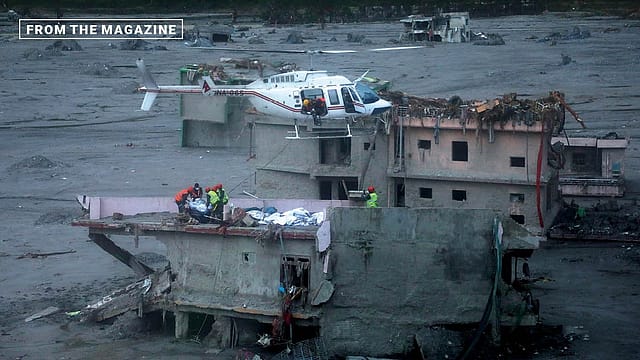
On August 26, a wall of water and debris tore down the Bhote Koshi river through Rasuwa, Nuwakot and Dhading, swallowing villages, bridges, and hydropower stations in minutes. At the time of writing, more than 1,200 people were confirmed dead in Nepal, and over 4,500 remained missing, including hundreds of foreign nationals. Chinese authorities also shared that more than 600 people, including foreign nationals, were still unaccounted for on the Tibet side following the devastation.
The floods devastated human settlements and infrastructure at Timure, Syabrubesi, Betrawati, and along the Trishuli corridor on the Bhote Koshi and Trishuli rivers. Kerung, the major trade route to China, is completely damaged. The Automobile Association said more than 1,000 electric vehicles (EVs) and containers carrying spare parts were also swept away by the flood. While the damages are being assessed, Finance Minister Swarnim Waglé estimates Nepal needs $4-$5 billion to rebuild the flood-hit area.
Besides massive human loss, hydropower projects with a combined capacity of 669MW were completely damaged. As per TN Acharya, general secretary of the Independent Power Producers Association of Nepal, Upper Trishuli 1 (216MW), Rasuwa-Bhotekoshi (120MW), Rasuwagadhi (111MW) and Upper Trishuli 3A (60MW) are among 12 hydropower plants that were damaged in the floods. “At least 897 hydropower workers, including both Nepali and foreign nationals, are still missing,” he said. Most of them are believed to have been trapped inside hydropower tunnels.
Rescuers, especially security personnel, have been racing against time since the first day. Some were searching for bodies along downstream riverbanks, while thousands were already in the flood-hit area to conduct search, rescue and recovery missions. According to the National Disaster Risk Reduction & Management Authority, more than 20,000 security personnel from the Nepal Army, Nepal Police and Armed Police Force had been mobilised in the flood-hit area for rescue and recovery operations. To date, more than 10,000 people have been rescued safely from the area, while more than 4,500, including 600 foreigners, are still missing.
Most of the foreigners missing in the Bhote Koshi floods are Indian nationals on the Kailash Mansarovar Yatra.
Sagar Pandey, president of the Trekking Agents Association of Nepal, said that many Indian pilgrims who were in the Timure area on August 26 are still missing.
At least 92 pilgrims, all NRIs from Sadhguru’s Isha Foundation, remain missing, added Jitendra Basnet, managing director of Trekkers Society. Trekkers Society runs Sadhguru’s Kailash Yatra tour every year from Nepal. “Nearly 700 pilgrims who were stranded on the Tibet side after the incident are being rescued using alternate routes,” Basnet said.
All political parties have joined hands to support the government in rescue and recovery work. The government also allowed international teams, especially from India and China, to carry out search and rescue in the region. The government has also mobilised the Nepal Army and private helicopters to expedite search and recovery missions. Specialised teams from India, China and Korea are on the ground to search for hundreds of hydropower workers believed trapped inside tunnels.
Senior experienced mountain guide Jenjen Lama, in the flood-affected area on a search and rescue mission, described how all settlements along the river have turned into a graveyard. “The scene is quite pathetic and we can hardly find standing houses in the Timure area,” he told me.
The terrain is difficult for search and rescue, says Lama. “We were assigned by Chilime Hydropower to search for six people trapped in a tunnel. Using a fixed-line system with anchors, we progressed about 120 metres, but found no signs of life. Looking further, we saw that the tunnel was completely blocked by mud and debris, and we had to turn back from that point,” he said. Lama added that delays in allowing foreign search and rescue teams into the hydropower tunnels had made the situation more complicated. There is no progress made in other hydropower tunnels to date.
It has now been a week since the devastating floods, and although funds are being raised through the Prime Minister’s Disaster Relief Fund, the reality on the ground is deeply concerning, said Laxman Dangol, a resident of Betrawati village. “Nearly 115 from my own family circle from Betrawati are still missing in the floods,” Dangol, who visited his native village which has now turned into rubble, said, adding that those who survived the floods and are now taking shelter in other villages are deprived of relief. Many villagers who reached uphill areas are also awaiting rescue as they cannot cross the flooded area, he explained.
There are many homeless and displaced families who have lost their houses and livelihoods. Many do not even have money to buy food, drinking water and essential supplies. People are standing in lines waiting for food, water, medicines and other necessities. “These are not demands for luxury. These are basic human necessities.”
More than 200 school-going children have lost their parents in the flood. “They have become orphans now,” said Bikash Gurung, a rescuer in the field. For instance, at least 900 students were saved from Tribhuvan Trishuli Secondary School in Nuwakot as its head teacher, Rajendra Dawadi, evacuated them just 10 minutes before the flooding. “But most of their parents, who were at home, could not survive the tragedy,” Gurung said.
As per preliminary data from the concerned district education offices, 241 students and 15 teachers went missing, while eight school buildings collapsed in the Bhote Koshi and Trishuli floods. Many children are traumatised and immediately need counselling, Gurung added. UNICEF, in a public notice, said it needs additional resources to reach the 17,000 children now in immediate need of humanitarian assistance.
In Nuwakot, in Trishuli Bazaar, Betrawati Bazaar and surrounding affected areas, people are still waiting for relief, and in many places it appears no relief has reached them in the last six days. “This is extremely disappointing and unacceptable,” Suman Pandey, a local leader and social activist, said, citing a lack of coordination among state agencies.
According to Pandey, many affected families from these areas have been forced to seek shelter around Trishuli District Hospital. But even at the hospital, there was no electricity, no internet and no proper drinking-water supply for many days. Rescuers, however, said reaching the affected area was itself fraught with barriers and difficult access.
Pastenji Sherpa, a senior captain with Heli Everest, flew multiple times to the devastated area for search and rescue operations. “It was quite difficult to reach the area on foot as all roads and bridges have collapsed,” Sherpa said. Circulation of misinformation through social media is another issue that directly impacts first responders, he added.
The government is collecting and raising millions through disaster relief funds, but the people who are actually suffering on the ground are asking: Where is the relief? Where are the government bodies? Where are the local representatives? Who is responsible for reaching these affected families? More than 6 billion rupees has already been collected in the Prime Minister’s Disaster Relief Fund. Not only funds but the area is also flooded with relief materials collected locally and provided by the international community. “The main problem is coordination among the agencies,” Pandey observed.
In a social media post, Prime Minister Balendra Shah stated that the government is still primarily focused on search and rescue operations and that, at the same time, the collection and distribution of relief materials for affected citizens remains a government priority. Relief materials received from organisations and members of the public in Kathmandu and various parts of the country are being collected and delivered to affected citizens, Shah claimed.
Besides all this, many children, senior citizens and women displaced by the floods have already fallen ill. “The condition of diabetic senior citizens who were on regular insulin doses is deteriorating, and so is the condition of pregnant women,” Padam Shrestha, a local volunteer, told me.
Madhav Prasad Aryal, chairperson of Uttargaya Rural Municipality in Rasuwa, admitted that a lack of coordination among the three tiers of government—local, provincial and federal—has created confusion among responders. “We feel helpless as the federal government undermined our presence at the local level,” he bemoaned. Aryal also asked police to step up security, surveillance and intelligence gathering in flood-affected areas and downstream to prevent theft, looting, fraud and other criminal activities that could exploit the chaotic situation. “Rescue, relief and rehabilitation are the urgent needs for now,” he added.
A public health emergency driven by pathogen exposure, decaying remains, and dilapidated infrastructure also looms large in the flood-affected area. Disaster response in the Himalayan region has historically suffered from a recurring flaw: prioritising immediate rescue while treating secondary public health risks as an afterthought. Following the recent deluge, medical specialists are issuing urgent warnings that time is running out to prevent the outbreak of infectious diseases.
The risk of waterborne and communicable diseases is growing in affected areas, as bodies of people and livestock carcasses remain unaccounted for or are scattered across a large stretch of riverbanks and flood-hit settlements, said senior infectious disease specialist Dr Sher Bahadur Pun from Sukraraj Tropical and Infectious Disease Hospital.
The prevailing situation could create conditions conducive to the spread of diseases, including cholera, diarrhoea, typhoid, hepatitis A and E, leptospirosis, scrub typhus, dengue, malaria, and respiratory and skin infections, he said. Pun also warned that failure to take immediate public-health measures could trigger a serious crisis. “Not only people but thousands of livestock have died. They are now beginning to decompose. We need to be extremely cautious,” Pun said. “The flood was unexpected, but the risk of disease outbreak is predictable. The government and civil society must act before it is too late.”
He said displaced survivors living in temporary shelters are particularly vulnerable because of overcrowding, inadequate sanitation and exposure to mosquitoes and other disease vectors. The risk is especially high for waterborne and vector-borne diseases in places where people share drinking water, food and sanitation facilities, he said.
Pun urged authorities to ensure safe drinking water through boiling or chlorination, regular washing of hands with soap and water, proper toilets and waste management in temporary shelters, and immediate medical attention for people developing fever, diarrhoea, vomiting or skin infections.
The Timure area, bordering Tibet and Nepal, had also witnessed a flash flood in July 2025 which killed more than 20 people working in the customs yard at Kerung port. Although it was later confirmed that the flood resulted from a Glacial Lake Outburst Flood (GLOF), authorities on neither side focused on precautions. Sharing of trans-boundary information, as well as setting up early warning systems, was all ignored despite experts’ warnings.
Sudeep Thakuri, senior glaciologist and researcher at Tribhuvan University, pointed out that the August 2026 flood is more than just a regular flash flood. Early investigations by the US Geological Survey found that an unusually fast-moving mass of glacial ice along the upper slopes of Langtang Himal triggered an avalanche of ice, rocks and other material that entered the valley and the river, causing catastrophic flooding downstream. The scale and suddenness of the 2026 disaster are horrifying, especially as it comes barely a year after another devastating flood struck the same region.
“Early indications are that this particular disaster was more than a run-of-the-mill flash flood event. There was a massive collapse in the high mountain near Langtang, which then triggered a downstream flood. While the warming of the region associated with climate change has not been identified as the sole cause of the disaster, it is changing the context in which the glaciers, snow, slopes, and rivers function,” Thakuri said.
The initial impact of the disaster in Rasuwa is assessed in terms of the death toll and the number of people missing. But the local impact does not stop there. The damage caused to transport links and bridges can lead to the isolation of communities from food, medical care, and other forms of help. Lack of electricity and telecommunications can add to the problem of evacuation, say experts.
“The Himalayas constitute a trans-boundary physical system. Glaciers, rivers, and atmosphere cannot be restricted by political boundaries. Exchange of information on observations, satellites, rivers, and hazards by neighbouring countries will cut down the response time for early detection to protection,” Thakuri added.
Climate change cannot yet be considered the sole reason for the incident; however, fast warming, receding glaciers and other changes in the cryosphere create a new environment for these hazards. Pointing to climate crisis vulnerability, Thakuri concludes, “It must be understood that the next flood will likely not start with rain; it will start with a mountain.”
Senior research scientist on hydrology and water resources at the University of Arizona, Jeffrey Kargel, told this correspondent Nepal and the world urgently need an open discussion by government, the hydroelectric industry, infrastructure investment funders, residents, and scientists about the realities in the Himalayas.
“India and Nepal, as well as Pakistan, China, and Bhutan, are in the same situation: automatic approvals for hydroelectric and other development projects have to cease. Scientists need to do better with hazard and risk determinations for complex multi-hazard process chains.
“Residents need to express their views but not give in to conspiracy theories about automatic weather stations causing climate change and so on. Scientists need to talk to residents about exposure reduction. Government needs to make some difficult choices.
“A grand conversation is needed. Very serious risk considerations and risk reduction are needed. We can’t go on with a construction-destruction repeat cycle. Nepal and India need to decarbonise their economies (and for sure the US and China do, too, massively so), and hydroelectric power must be a major part of that—but not automatic approvals made regardless of the hazard landscape. I think if this disaster has one positive legacy, it is that this discussion might begin,” the scientist observed.