Uber Quit Building Robotaxis. Now It Wants Every Robotaxi on Uber
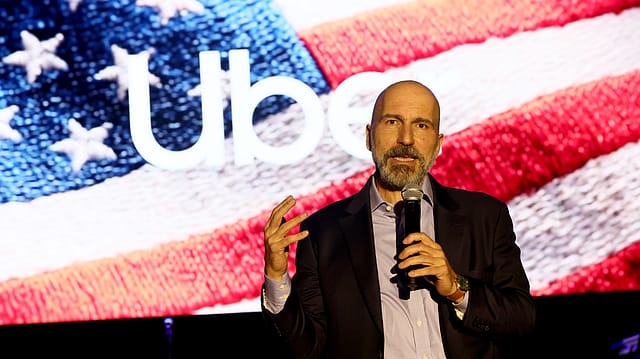
Dara Khosrowshahi needed three short paragraphs to describe what may become Uber’s most consequential strategic reversal.
Zoox, the robotaxi company owned by Amazon, has begun accepting passengers through Uber in Las Vegas. It will continue operating its own app, but riders requesting several regular Uber categories may now be matched with a Zoox at no additional cost. Los Angeles follows in 2027.
The immediate announcement concerns a limited fleet in one American city. The larger proposition reaches much further. Zoox built its own autonomous-driving system, manufactured a purpose-designed vehicle without a steering wheel or pedals and created a consumer app. It has now opened that carefully controlled ecosystem to Uber’s marketplace for the first time.

The Wealth Issue 2026
06 Nov 2026 - Vol 05 | Issue 45
Portraits of Dreamers and Doers under 35
Uber once believed it had to invent the autonomous driver to survive a driverless future. Khosrowshahi is pursuing the opposite strategy. He wants autonomous developers to compete over the car while Uber controls the passenger, the booking, the dispatch, the payment and much of the commercial machinery surrounding every trip.
Uber quit building robotaxis. It now wants every robotaxi on Uber.
Zoox built the vehicle. Uber built the crowd
Every autonomous vehicle company must eventually solve two different problems. The first is technological: teaching a machine to drive safely through unpredictable streets. The second is commercial: finding enough paying passengers to keep an extraordinarily expensive vehicle moving.
Zoox has spent more than a decade on the first problem. Its box-like, bidirectional robotaxi was designed around passengers rather than adapted from a conventional car. Four occupants face one another inside a cabin with no traditional driver’s position. Amazon acquired the company for about $1.3 billion in 2020, giving Zoox the financial backing to keep developing its system while competitors disappeared or retreated.
Uber offers an answer to the second problem. It already knows where ride demand forms, when airports become congested, which events produce sudden surges, where pickups fail and how prices influence the behaviour of riders and drivers. Zoox can bring the autonomous driver. Uber can bring the next passenger.
That matters because an idle robotaxi still incurs financing, depreciation, insurance, charging, depot and maintenance costs. A technically brilliant vehicle cannot become a viable business if it spends too much time waiting for work. Uber’s marketplace can place additional demand in front of Zoox without requiring every rider to download another app or form a new habit.
The arrangement is, therefore, larger than distribution. It is an admission that autonomous technology does not automatically create a mobility network.
Dara wants Uber to become the Booking.com of robotaxis
Hotels operate their own websites and still list rooms on Booking.com. Restaurants accept direct orders and continue using delivery aggregators. Airlines sell tickets themselves while relying on marketplaces to reach additional travellers.
Khosrowshahi expects autonomous vehicles to develop along similar lines. Some companies will maintain first-party apps because they want direct customer relationships. The same companies may place spare capacity on Uber because fuller vehicles produce better economics.

Uber calls its role the “commercialization layer”. The phrase sounds modest until its components are assembled. The company wants to aggregate demand, dispatch vehicles, supply mapping intelligence, manage depots, arrange charging, provide insurance, finance fleets, handle customer support, work with regulators and design parts of the in-car experience. Its Autonomous Solutions division is packaging those capabilities for companies that can build an autonomous driver but cannot easily reproduce Uber’s global operating network.
Uber says partners have committed approximately 120,000 autonomous vehicles to its network over the coming years. Across equity investments, infrastructure and vehicle commitments, it expects to deploy more than $10 billion to accelerate the industry. Its goal is to facilitate autonomous trips in as many as 15 cities by the end of 2026 and become the world’s largest facilitator of such journeys by 2029.
The company expects roughly 700 fully driverless vehicles on its platform by the end of 2026 and more than 2,000 by the end of 2027. It is preparing for tens of thousands after that. Zoox joins a roster that includes Waymo, Motional, WeRide, Baidu, Pony.ai, Nuro, Wayve, Avride, Waabi and others across mobility, delivery and freight.
Uber does not need every partnership to become enormous. It needs enough credible suppliers to make its platform indispensable to the ecosystem.
The MGM deal reveals the hidden moat
The Zoox launch includes a second agreement that could easily be dismissed as promotional decoration. Uber and Zoox have become the official rideshare and robotaxi partners of MGM Resorts International in Las Vegas.
The three companies will work on pickup and drop-off infrastructure, on-property directions, app guidance and traffic flow across MGM properties. That operational detail explains why Uber may remain valuable even when a robotaxi can drive perfectly.
A Las Vegas resort is not a simple dot on a map. It contains multiple entrances, taxi queues, parking structures, service lanes, crowds, luggage and changing traffic restrictions. The autonomous system must navigate the road. The commercial network must determine where the passenger should stand, guide that passenger through the property and prevent dozens of vehicles from converging on the wrong entrance.
Uber has spent years accumulating this unglamorous knowledge at airports, stadiums, hotels and entertainment districts. Its moat may lie as much in the kerb, depot and pickup zone as in the smartphone app.
Zoox is also insurance against Waymo
Uber’s alliance with Zoox comes with an obvious warning. The best autonomous companies may use Uber while they need its demand and then try to reclaim the customer.
Waymo provides the clearest example. Alphabet’s autonomous-driving company partnered with Uber in Phoenix, Austin and Atlanta. In Austin and Atlanta, Waymo rides were made available exclusively through Uber, with Uber handling fleet management functions such as cleaning, repairs and depot operations.
That exclusivity will not last indefinitely. Waymo plans to introduce its own app in Austin and Atlanta in January 2028. Its leadership has argued that riders who specifically want a Waymo should not face uncertainty over which vehicle Uber will send.
The disagreement exposes the central struggle in autonomous mobility. The vehicle developer wants its brand, data and customer relationship. Uber wants riders to open one app and allow its marketplace to choose the most efficient supplier.
Khosrowshahi’s answer is not to defeat Waymo in autonomous driving. It is to ensure that Waymo never becomes Uber’s only autonomous option. Zoox, Motional, Nuro, Wayve, WeRide and Baidu give Uber negotiating leverage and reduce its dependence on any single developer.
This also explains why Uber celebrates the number of partners. The figure is not merely a measure of technological enthusiasm. It is an anti-dependency strategy.
Why Uber still needs human drivers
Khosrowshahi’s LinkedIn post carefully placed Zoox beside “the drivers who keep cities moving”. The wording acknowledges the people powering Uber’s present business while describing the machines it hopes will supply more trips in the future.
Robotaxis remain geographically restricted. They cannot yet serve every neighbourhood, passenger requirement, road condition or period of extreme demand. A fixed autonomous fleet can provide steady capacity, but it cannot instantly multiply after a concert, during a rainstorm or on a holiday evening. Human drivers give Uber the flexible supply required to absorb those peaks.
Uber, therefore, describes its future as a hybrid network. Autonomous vehicles can operate for long hours in the zones they understand. Human drivers can cover the wider city, complicated pickups and abrupt changes in demand. Combining the two may produce shorter waits and higher utilisation than either could achieve alone.
The coexistence will not remove the employment question. As autonomous fleets become cheaper and more capable, Uber will have an incentive to direct predictable, high-volume journeys towards vehicles that do not require a driver payment. Airport transfers, business districts and repeated urban corridors are attractive precisely because they can keep an expensive autonomous asset occupied.
Human drivers may retain the journeys that machines cannot yet perform, but the distribution of work could gradually become less favourable. The hybrid model is an operating strategy and a way of managing a politically difficult transition.
India has the problem robotaxis solve. It does not yet have the economics
The Zoox announcement lands as Uber confronts a supply problem in India. During its latest results, the company acknowledged that driver-supply growth had lagged rider demand. Higher fuel costs have placed further pressure on drivers, while passengers remain sensitive to fare increases. Uber has responded with investments in driver acquisition, retention and engagement.
The shortage appears in longer waiting times, cancellations and inconsistent availability around airports and technology corridors. India has plenty of potential passengers. Uber cannot always place enough viable vehicles in front of them at the price both sides will accept.
Robotaxis seem designed for this problem. A driverless vehicle does not reject a short journey, switch to a competing platform after receiving a better incentive or log off when fuel costs make the next trip unattractive. Uber could position autonomous fleets near airports, business districts and transport hubs before demand rises.
Khosrowshahi has nevertheless ruled out a quick commercial solution. During an India visit in 2026, he said robotaxis cost well over $100,000 and that he did not expect the economics of the Indian market to support profitable deployment for at least five years. India would also need a regulatory framework before commercial driverless services could operate.
The arithmetic is unforgiving. Removing an American driver can eliminate a large labour cost. Indian fares and driver earnings are much lower, reducing the savings available to repay a vehicle costing more than ₹90 lakh, along with its sensors, computing, insurance, charging and remote-support infrastructure.
Indian roads add another layer of difficulty. Autonomous systems would have to negotiate dense two-wheeler traffic, autos, pedestrians, informal stopping points, construction diversions, inconsistent lane markings and rapidly changing road conditions. India has no dedicated legal framework resolving the testing, certification, insurance, data and accident-liability questions created by fully driverless passenger vehicles.
India may eventually become one of Uber’s most important robotaxi markets because its cities contain enormous demand. It is unlikely to become one of the first.
Uber’s Indian robotaxi strategy begins with drivers
For the immediate future, Uber must solve India’s supply problem by making human-driven vehicles more economical and easier to finance.
The company is broadening its relationships with organised fleet operators so that it is not dependent on individual drivers purchasing cars. It has also tried to reduce concentration around a small number of large fleet suppliers. More fleet partners give Uber additional vehicles, professional management and a faster route to supply expansion.
Electrification is another part of the answer. On the same day that Zoox joined Uber in Las Vegas, Mahindra Last Mile Mobility and Uber announced an Indian programme supporting the deployment of 5,000 electric three-wheelers over 12 months. The partners will work on financing and other barriers that prevent drivers from adopting EVs.
An electric auto still requires a driver. Its lower operating cost can nevertheless make more trips worthwhile, improve driver retention and keep vehicles active for longer. In India, the practical bridge towards autonomy may be a financed electric fleet rather than an imported robotaxi.
When autonomous experiments eventually begin, they are likely to remain inside controlled or predictable zones. Airports, technology campuses, planned business districts and fixed connections between transport hubs offer clearer operating conditions than an entire Indian metropolis. Human drivers would connect those zones to the rest of the city.
The Indian version of Uber’s autonomous strategy will therefore begin as a multi-vehicle supply strategy. Cars, electric autos, bikes, fleet vehicles, buses and eventually robotaxis can all compete for journeys inside the same marketplace.
The announcement contains its own caution
Las Vegas riders cannot yet select a Zoox with certainty. Customers requesting UberX, Comfort, Electric, Comfort Electric or Wait & Save may be matched with one when a vehicle is available. They can indicate a preference for autonomous rides, but the app does not guarantee the outcome. Uber plans to create a dedicated autonomous category only after supply and reliability improve.
That limitation matters. Zoox on Uber is a commercial milestone, but it is not evidence that robotaxis have reached mass scale. Autonomous journeys still represent a tiny portion of the trips facilitated by global ride-hailing platforms. Fleets remain limited, capital costs high and deployment city-specific.
Uber is also taking financial risk. Although Khosrowshahi ultimately wants third-party investors to finance large autonomous fleets, he has acknowledged that Uber may have to carry some vehicles on its balance sheet during the early years because robotaxis lack an established resale value.
The platform strategy reduces Uber’s technology risk. It does not eliminate capital, regulatory or utilisation risk.
Dara’s second attempt at the driverless future
Uber sold its Advanced Technologies Group to Aurora in December 2020 and invested $400 million in the combined company. The transaction ended its attempt to fund and control an in-house autonomous-driving programme.
That exit once looked like a retreat from the industry’s future. Khosrowshahi is now trying to turn it into an advantage.
Waymo can perfect the driver. Zoox can redesign the vehicle. Nuro, Wayve and Baidu can pursue different technical systems. Uber does not need to predict which one will dominate every country. It needs riders to continue opening Uber when those vehicles arrive.
Amazon has spent years financing a robotaxi that looks unlike anything else on the road. On November 16, that vehicle went looking for passengers inside Dara Khosrowshahi’s app.
That is the bet hidden inside his short LinkedIn post. Uber may have lost the race to build the autonomous car. It is now trying to own the marketplace every autonomous car must enter.