Naked, Gilded and Carrying a Golf Club: Trump Satire Arrives at European Parliament
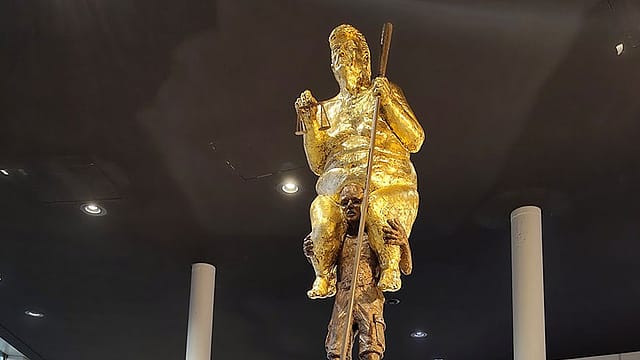
Donald Trump has arrived at the European Parliament in copper and 23-carat gold leaf, naked and perched on the back of a frail man.
The 2.6-metre sculpture, titled The Orange Plague, is Danish artist Jens Galschiøt’s deliberately provocative portrayal of the US president. Installed at the Parliament’s Strasbourg premises, it depicts Trump with his eyes closed, holding a golf club and the scales of justice while the smaller figure struggles beneath his weight.
Galschiøt calls his subject a “King of Injustice”. The work challenges what the artist sees as the concentration of wealth and power, the weakening of international rules and the retreat from climate action.
Its presence in the building, however, does not constitute an official European Parliament or European Union endorsement. The exhibition was sponsored by Danish MEP Per Clausen, a member of Denmark’s socialist Red-Green Alliance and the Parliament’s Left group, according to CNN.
The Modi Years
02 Oct 2026 - Vol 05 | Issue 40
A Nation Rebuilt
THE EMPEROR GETS A GOLD COAT
The sculpture draws on Hans Christian Andersen’s The Emperor’s New Clothes, in which a vain ruler parades naked while those around him pretend to admire his magnificent clothing. A child eventually exposes the deception.
Galschiøt gives that story a contemporary political subject. Gold covers Trump’s body without concealing his nakedness. The artist says it represents wealth and privilege concentrated around a ruler and his inner circle.
The smaller man provides the sculpture’s central image of inequality: one figure carries the burden while the other remains comfortably seated.
In the artist’s description, the sculpture declares: “I am sitting on the back of a man. He is sinking under my burden. I will do anything to help him. Except stepping down from his back.”
The golf imagery extends the satire. A world-shaped golf ball links Trump’s familiar pastime to the global consequences of his decisions, while the scales represent what Galschiøt regards as the president’s attempt to define justice on his own terms.
CLIMATE POLICY IN THE FRAME
Galschiøt says climate change is a central concern behind the work. He argues that Trump’s policies threaten international cooperation and efforts to reduce emissions.
“Trump represents one of the greatest threats to the rule-based world order, democratic values and our common effort to solve the climate crisis. We must address this issue and stand together against such destructive influence,” the artist said.
He also contends that governments and organisations can be reluctant to challenge Washington because of possible consequences for trade, funding and political relations. The sculpture is intended to provoke a debate that, in his view, institutions sometimes struggle to conduct openly.
Those are the artist’s arguments. The exhibition gives them a platform without making them the Parliament’s position.
AN EXHIBITION, NOT AN EU DECLARATION
According to CNN, European Parliament members can host exhibitions on parliamentary premises, subject to approval and restrictions on material considered offensive, inflammatory or inconsistent with EU values.
Galschiøt had expected the sculpture’s provocative imagery might prevent its admission. Its approval therefore carries significance for him, placing his criticism directly before European lawmakers.
The distinction remains important: permission to exhibit an artwork does not mean the institution adopts its message.
A PROTEST THAT TRAVELS
Strasbourg is the latest stop for the sculpture, which was previously displayed in Belém, Brazil, during the COP30 climate summit in November 2025. It has also appeared at demonstrations supporting Greenland in Copenhagen and at events in Munich and Rebild, Denmark.
Galschiøt plans to take it to Turkey for the COP31 climate conference in November 2026. He has also produced miniature, 3D-printed versions for distribution as protest tokens, allowing the image to circulate beyond the full-sized installation.
For now, the work confronts visitors in Strasbourg with a simple physical imbalance: a gilded ruler sits above a man struggling to carry him. The gold attracts the eye. The burden supplies the argument.
(With inputs from ANI)