Milan, London, Dubai Routes Cancelled as Middle East Conflict Intensifies
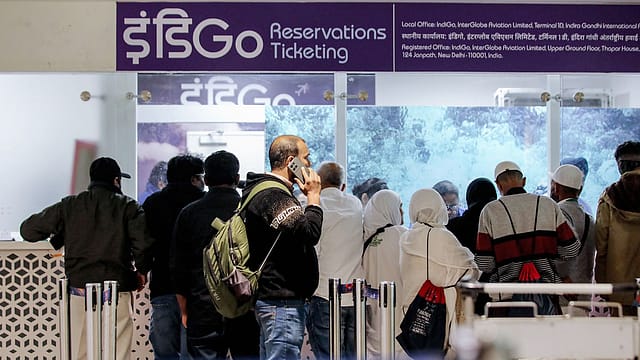
India’s major airports witnessed scenes of confusion and anxiety on Sunday as escalating hostilities in West Asia disrupted international air travel, leaving passengers stranded in Delhi, Chennai, Amritsar, Bengaluru and Kolkata.
Widespread airspace closures over Iran, Israel and parts of Iraq, following coordinated military strikes involving Israel and the United States targeting Iranian sites, have forced airlines to cancel or divert hundreds of flights. Retaliatory threats and mounting regional tensions have created what aviation authorities describe as a high-risk operating environment.
India’s Ministry of Civil Aviation said 410 flights were cancelled on February 28, and 444 flights are expected to be cancelled on March 1 due to airspace restrictions over Iran and parts of the Middle East. The Directorate General of Civil Aviation (DGCA) remains in close coordination with airlines.

Losing Memory
16 Oct 2026 - Vol 05 | Issue 42
The making of a medical and social emergency
Against this volatile backdrop, airport terminals across the country turned into waiting zones filled with uncertainty.
Why Are Flights Being Cancelled Across India?
The disruptions stem from escalating conflict involving Iran, Israel and the United States. Following military strikes on Iranian targets, airspace closures across parts of West Asia forced global carriers to suspend or reroute services as a precautionary measure.
The DGCA’s urgent advisory followed a review of the Conflict Zone Information Bulletin (CZIB No.: 2026-03) issued by the European Union Aviation Safety Agency (EASA), warning of heightened risks to civil aviation in the Persian Gulf airspace.
Airlines have prioritised safety over schedules. Air India announced multiple cancellations after what it described as “close monitoring and careful assessment” of the situation. The airline reiterated that passenger and crew safety remains its highest priority.
In a statement, Air India said, "We regret the inconvenience caused and are making every effort to assist affected passengers with rebooking and alternative travel arrangements. Passengers impacted by the cancellations are being informed on their registered contact numbers."
The airline cancelled several March 1 international services, including routes connecting Mumbai, Delhi and Bengaluru with major European destinations such as London (Heathrow), Birmingham, Amsterdam, Zurich, Milan, Vienna, Copenhagen and Frankfurt.
How Are Passengers Coping at Airports?
At Indira Gandhi International Airport, frustrated travellers described long hours of waiting and a lack of clarity.
"I was supposed to fly to Saudi from Delhi, but my flight was cancelled. We have been waiting for 14 hours, but we have not heard anything yet. It is becoming very difficult," said one stranded passenger.
Another traveller, Rashid Khan, said, "The reason the airport authority gave me was the Iran-Israel war. My flight is cancelled." Scheduled to travel from Delhi to Bengaluru and onward to Abu Dhabi, he added, "They gave me the option of another city. I chose my city. My route was Delhi to Bangalore and Bangalore to Abu Dhabi. Now it is cancelled."
Uncertainty loomed large for many. "Authorities are saying that the flights will not be resumed until the ceasefire is in place there. We have to go there. Our office and everything are there. We are going to Italy directly from Bahrain. Now, there is no flight for Bahrain," another passenger said.
At Chennai International Airport, multiple Emirates flights were grounded, disrupting connectivity to Dubai and other Gulf destinations. A tourist from Hungary expressed disappointment after learning of further closures.
"Dubai airport is closed and we have no flights. We are now trying to change our flight tickets to another airline, like Lufthansa or some other European airline. I'm a little disappointed, but I hope we can go home soon. We came here for the puja," the tourist said.
Passengers scrambled to secure alternative routes via European carriers as Dubai — a major transit hub — became temporarily inaccessible.
At Sri Guru Ram Dass Jee International Airport, similar scenes unfolded. A passenger headed to Milan said, "I was going to Milan, but my flight has been cancelled because of the war."
In Bengaluru, operations at Kempegowda International Airport were also hit, while Kolkata saw outbound international flights cancelled without prior notice, affecting passengers travelling to Dubai, Doha and Abu Dhabi.
What Are Authorities Doing to Manage the Crisis?
The Ministry of Civil Aviation has established a 24x7 Passenger Assistance Control Room to review preparedness amid evolving airspace restrictions.
In a post on X, the ministry stated, "Due to airspace restrictions over Iran and parts of the Middle East, 410 flights of domestic carriers were cancelled on 28 February, and 444 flights are expected to be cancelled on 1 March. DGCA is maintaining close coordination with airlines to ensure full compliance with safety and operational regulations."
Airports are coordinating with airline representatives to facilitate rebooking and provide updates. Travellers have been advised to check their flight status before departure and stay in contact with airlines for further information.
As tensions in West Asia continue to evolve, global aviation remains on edge, with safety considerations outweighing operational normalcy. For now, thousands of passengers across India remain in limbo, waiting for the skies to reopen.
(With inputs from ANI)