Mass Arrests in Bangladesh As Police Crackdown Targets Opposition Supporters
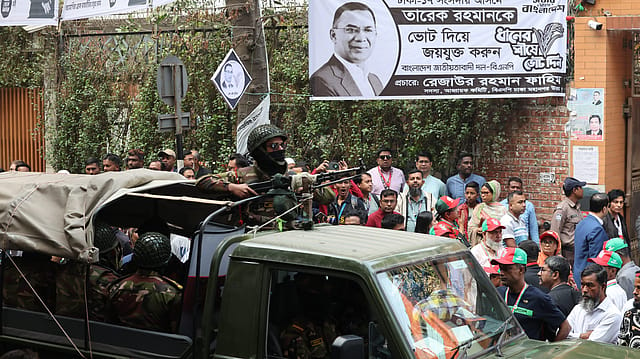
Bangladeshi police took around 290 supporters of a small left-wing party into custody at a meeting in Dhaka on September 26, in what Human Rights Watch (HRW) called the latest incident in the authorities' "ongoing assault on civil and political rights."
The US-based rights group said in a statement that the arrests followed claims by the Jatiyatabadi Jubo Dal, the youth wing of the ruling Bangladesh Nationalist Party (BNP), that the gathering of the Jatiya Samajtantrik Dal was a "secret" meeting of former Prime Minister Sheikh Hasina's Awami League, which is banned.
A court remanded 27 of those arrested to custody because they were alleged to have chanted "Joy Bangla" (Victory to Bengal), a slogan associated with the Awami League, HRW said.
WHO IS THE JATIYA SAMAJTANTRIK DAL?
The party, known as Jasad or JSD, was part of the 14-party alliance led by the Awami League that governed Bangladesh from 2009 until 2024. That government fell to student-led protests in which hundreds of people were killed by security forces. HRW describes it as a small left-wing party.
The Modi Years
02 Oct 2026 - Vol 05 | Issue 40
A Nation Rebuilt
Reports said the police detained the supporters at the party's office in Dhaka.
Police have repeatedly raided alleged gatherings of Awami League supporters, HRW said. On September 26, the day of the Jasad meeting, police in Barisal detained 12 Awami League activists for allegedly holding a "secret" meeting to "plan sabotage."
Two days later, 15 people were arrested in Dhaka under the 2009 Anti-Terrorism Act on similar allegations. In both cases, those held said they had gathered to mark Hasina's birthday.
HRW said the BNP, which took power after elections in February, has arbitrarily detained its perceived opponents. Hundreds of Awami League members are in jail, mostly without charge, it said.
"THE CYCLE OF POLITICAL REPRESSION"
"During Hasina's authoritarian rule, there were widespread and grave rights violations, including extrajudicial killings, enforced disappearances, torture, and the arbitrary detention of political opponents," HRW's statement said.
The BNP "came to power promising to restore human rights and the rule of law. Instead, the new government has arbitrarily detained perceived opponents and rolled back human rights safeguards the interim government proposed."
"Past violations of those rights committed when the Awami League was in power cannot justify the Bangladesh Nationalist Party's current violations of the same rights," it said, adding: "Bangladeshi history is rife with examples of where such repression can lead."
The BNP faced severe repression under the Awami League government, HRW noted.
HOW BANGLADESH GOT HERE
Hasina was ousted in August 2024 after weeks of student-led protests that killed an estimated 1,400 people and injured more than 20,000. She has been sheltering in India since.
A caretaker government led by Nobel Peace Prize winner Muhammad Yunus ran the country until this year. Hasina was later sentenced to death in absentia for crimes against humanity over the crackdown.
The February 12 election was the first since the uprising, and the Awami League was barred from contesting. The BNP won in a landslide, taking 212 seats against 77 for the Jamaat-e-Islami alliance, according to the Election Commission.
Tarique Rahman, the son of former prime minister Khaleda Zia and former president Ziaur Rahman, was sworn in as prime minister on February 17, after 17 years in self-exile in London. Hasina called the vote "illegal and unconstitutional." India praised the BNP's "decisive win," a shift after strained ties.
With inputs from ANI