The General and the Magician
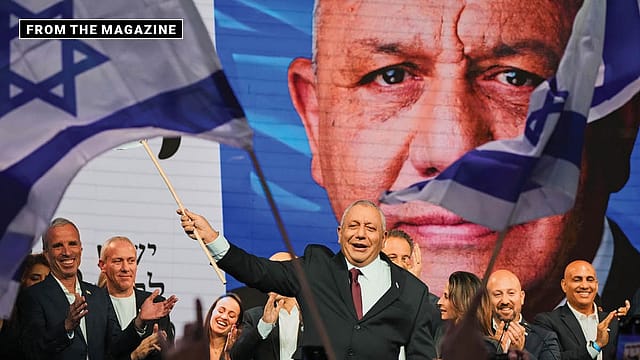
Election Day felt like a day of a local derby when two football teams from the same city play against each other. There was high tension in the air, and neighbours looked at one another with suspicion, wondering whether they supported the opposing team. This story could not have been written before the night of October 27. Until the last minute, the early polls and exit polls showed the two major blocs almost evenly matched: Benjamin Netanyahu’s rightwing bloc and the liberal alliance known as the “Change” bloc. The Change bloc consists of four parties that have worked as a united front and have largely avoided fighting one another. They have kept their bigger goal in mind: changing Israel’s leadership and sending Bibi home.
Before all the votes are counted, there is uncertainty. The opposition parties received 55 per cent of the votes while Netanyahu’s bloc, the current coalition, received only 45 per cent. However, Netanyahu has not lost the election, and the result feels like a deadlock. Of the 55 per cent of the votes received by the opposition, about 15 per cent went to the Arab parties. As a result, neither bloc can form a government with a majority of its own. Any attempt to form a government will require cooperation with others, and a partnership with the Arab parties remains highly controversial.
The final vote count is expected to be announced only in a week’s time. There may still be last-minute changes in the allocation of seats. About 10 per cent of voters did not vote at their usual polling stations, and those ballots will be counted within a few days. These votes could translate into as many as 12 seats, enough to change the balance between the blocs.
The Change bloc is led by Lieutenant General (retired) Gadi Eisenkot, a former Israel Defense Forces (IDF) Chief of Staff who recently lost his soldier son in the Gaza War. Eisenkot, 66, established his party only a year ago and has very little political experience. People probably connected with his modest manner and reserved tone. His personal tragedy may also have played a role in his sudden success.
The second pillar of this bloc is Naftali Bennett, an IT industry veteran who made his fortune through two successful exits. He served briefly as prime minister in 2021–22 and has positioned himself as the candidate who already knows what it takes to be prime minister.
Another strong pillar of the bloc, and perhaps its most experienced political figure, is Avigdor Liberman, a longtime political rival of Netanyahu. Early in his political career, Liberman served as director general of Netanyahu’s office, and later as defence minister and foreign minister in several Netanyahu governments. He has made it very clear that he will not form a government with Netanyahu.
Netanyahu turned 77 on October 21. This year, the occasion was not marked publicly and was instead kept quiet. His age does not work in his favour. Not only has Netanyahu had to manage Israel’s multiple fronts but he is also facing mounting challenges from within. Several lawsuits against him are still being dealt with in court. The ultra-Orthodox parties are demanding that he pass the ‘Recruitment Law’, which would exempt ultra-Orthodox young men from military service. At the same time, the media continue to press him to disclose information about his health. The recent endorsement he received from US President Donald Trump gave him a tailwind and may have brought him a few more votes.
In the current 120-seat Knesset, the Likud-led bloc holds 68 seats. It appears that the bloc has lost almost 15 seats in the next Knesset. But, as people like to call him, Netanyahu is a magician, and even with just 53 seats, he may still pull another trick out of his sleeve and find a way to form a government.
The Change bloc seeks to end Netanyahu’s nearly 20 years in power, arguing that this is the most important election since Israel’s founding and that the past four years have been devastating for the country. They believe that this period must come to an end with a change of leadership.
The year 2023 began with the judicial reform that Netanyahu’s government was trying to pass, an attempt that triggered large protests and strikes. Then came the Black Sabbath of October 7, 2023, which led to three years of war on several fronts: Hamas in Gaza, the Houthis in Yemen, Hezbollah in Lebanon, and Iran, with its heavy missile attacks.
The importance of this election made the turnout across the various sectors extremely high, at almost 78 per cent, an increase of seven percentage points since the previous election. This level had not been reached since 1999. It is estimated that about 11 per cent of Israeli citizens live abroad, making the current turnout unprecedented and demonstrating just how important Israelis considered this election.
Unlike many countries, Israel does not allow its citizens to vote from abroad or send their ballots by mail. Voters must be physically present in Israel and registered on the electoral roll. Diplomats are the only exception.
Some 80,000 Israelis flew in from all over the world to exercise their civic right and obligation, paying for the trip out of their pockets. Some flew in and out on the same day. When asked why they had come, they replied that even if they had lived abroad for years, they needed a place they could call home and return to: the only Jewish state in the world. My brother, who lives in Zurich, landed just a few hours before the polling stations closed. In our family WhatsApp group, he wrote: “Mission Accomplished. ”Those 80,000 Israelis living abroad represent almost two seats in the Knesset. With the blocs so evenly matched, their votes could make a difference.
This is the 26th election since 1948. The feeling was that this election would help determine how the country evolves: whether it remains liberal and secular or is increasingly driven by religious parties. This election is also about sharing the burden equally, including whether the ultra-Orthodox will serve in the army or continue studying the Bible while receiving government support instead of working and supporting themselves. It is also about finding a diplomatic solution to Israel’s military conflicts or continuing to fight until “Total Victory”, a term coined by Netanyahu.

It seems that the Arab parties will be the kingmakers this time, a role traditionally held by the ultra-Orthodox parties. Arab citizens with voting rights make up 17 per cent of Israel’s population. In this election, Arab citizens, who had been less engaged in previous elections, turned out to vote. Previously, only about 50 per cent of Arab voters exercised their right to vote; this time, the figure exceeded 73 per cent. This is a major change, with implications for the composition of the Knesset.
The Arab parties are expected to hold 18-19 seats, a record for Arab representation. It is also worth noting that not only Arab voters supported the Arab parties. Many Jewish supporters of civil rights voted for them, arguing that the Arab minority should have greater influence in parliament. Even a senior Jewish parliamentarian who had served as deputy minister of internal security joined the Ra’am (Arab) party in the No 2 position.
It is interesting to look at the voting patterns in different cities, which seem to correlate closely with each city’s socioeconomic profile and demographic. For example, Jerusalem, the capital, with its large ultra-Orthodox and other religious communities and relatively low socioeconomic ranking, gave 72 per cent of its votes to Netanyahu’s bloc. In contrast, Tel Aviv, considered the most liberal city in Israel and ranked among the highest in socioeconomic status, gave 83 per cent of its votes to the Change bloc and only 16 per cent to Netanyahu. I also checked the voting pattern in my own small village, with just over 400 eligible voters. Two-thirds voted for the Change bloc.
What happens next? The president of Israel, Isaac Herzog, will have to decide whom to task with forming the government. His role is to choose the candidate he believes has the best chance of forming a government, not necessarily the leader of the largest party.
What are the options for forming a government? The Netanyahu bloc will not have more than 60 seats, which means Netanyahu will be unable to form a government without bringing in the Arab parties or another party from the Change bloc.
The Change bloc has two options: invite the Arab parties to join a government, or join forces with a party from Netanyahu’s bloc. The only party close to the Change bloc is, in fact, Netanyahu’s own, the Likud. The problem is that the Change bloc, or at least most of its parties, has repeatedly declared that it will not form a government with Netanyahu. At the same time, its parties have also declared that they will not sit with the Arab parties, due to deep ideological differences, especially over the Palestinian cause.
If the Change bloc wants to form a government and end Netanyahu’s nearly 20 years in power, it will have to break one of these promises. Politicians are known to break promises; the question is which promise they will break, and which broken promise their voters will not forgive.
Another round of elections would be a very bad option for both sides. A turnout of 78 per cent is a record that may be difficult to surpass. The Change bloc could lose the two seats represented by Israelis who travelled from abroad specifically to vote. Those voters may not make the trip again. The Netanyahu bloc could also lose ground in a rerun. This has happened before, and Netanyahu knows that some of his voters might be less motivated to turn out a second time.
On November 10, the members of the Knesset will be sworn in. Regardless of who eventually forms the government, the current opposition plans to take several immediate steps before that happens: appoint a new speaker of the Knesset, announce the establishment of an inquiry committee to investigate the events that led to October 7, and repeal several laws passed by Netanyahu’s government as part of its judicial reform.
Both sides need to do their best to form a government now. The president is the key to breaking the deadlock. He is a politician himself who has faced such difficult situations before. Now is the time to unite the people and lead Israel into a new era.
(Anat Bernstein-Reich is chairperson of the Israel-Asia Chamber of Commerce)