Margaret Hamilton dies at 90: How her NASA software helped take Apollo 11 to the Moon
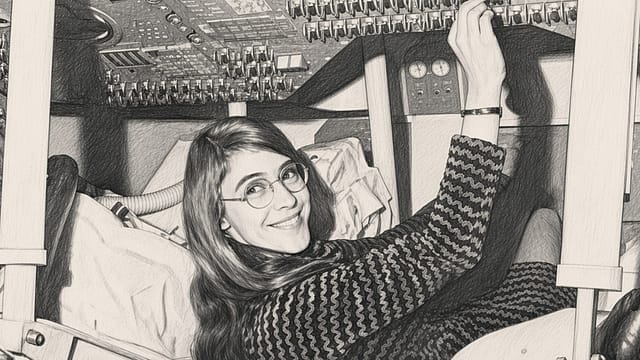
What happens when a computer starts running out of capacity just minutes before humans are supposed to land on the Moon? In 1969, that was not a hypothetical question.
As Apollo 11’s lunar module Eagle prepared to land, its onboard computer began flashing alarms. The system was overloaded. On Earth, mission controllers had to decide whether the landing should continue. The software held. Behind that software was Margaret Hamilton, the pioneering computer scientist who led the team developing Apollo’s onboard flight software at MIT. Hamilton died on September 30, 2026, at the age of 90, MIT said in an obituary published October 7.
Her death has renewed attention on a part of the Moon landing story that is often overshadowed by astronauts Neil Armstrong and Buzz Aldrin: the software that had to work when almost everything depended on it.
Who was Margaret Hamilton and what did she do for NASA?
Hamilton was a mathematician and computer scientist who joined MIT’s Instrumentation Laboratory in 1965 after seeing an advertisement seeking people to work on software that would help “send man to the moon.” MIT says she became the first programmer hired for the Apollo project and the first woman programmer on the project.
The Modi Years
02 Oct 2026 - Vol 05 | Issue 40
A Nation Rebuilt
She went on to lead the teams responsible for the onboard flight software used by Apollo spacecraft. By 1968, she was assistant director in charge of the Command and Service Module software team, with more than 400 people working on Apollo software under the broader programme.
At the time, software engineering was still a young field. Hamilton would later become one of the people most closely associated with establishing it as a recognised discipline.
What happened to Apollo 11 just before it landed on the Moon?
On July 20, 1969, as the Eagle descended towards the lunar surface, the Apollo Guidance Computer began issuing a 1202 alarm. The problem was that the computer was being overloaded by a hardware-related issue. But Hamilton and her team had designed the software to deal with exactly the kind of situation in which the computer had more work than it could handle.
Instead of simply collapsing, the system could identify lower-priority tasks, discard them and concentrate on the work essential to the landing.
MIT explains that the priority-driven software allowed the computer to shut down unnecessary background tasks while preserving mission-critical functions. Mission Control trusted the system and allowed the descent to continue. Armstrong and Aldrin landed safely.
Why was Margaret Hamilton’s Apollo software so important?
Because Hamilton’s approach was not simply about making the computer perform its planned tasks. It was about preparing it to handle the unexpected. That emphasis on reliability and error prevention became a defining feature of her work. MIT said Hamilton had developed an interest in software reliability even before Apollo, while working on the US Air Force’s SAGE air-defence system. During Apollo, that philosophy became part of a system that had to operate in an environment where there was little room for failure.
Her own description of the Apollo years was characteristically understated. Looking back, she said: “There was no choice but to be pioneers; no time to be beginners.”
Did Margaret Hamilton really coin the term ‘software engineering’?
Hamilton is widely credited with helping establish the term “software engineering” and with pushing for software to be treated with the same seriousness as hardware engineering.
In an interview cited by MIT, Hamilton said she began using the phrase because she wanted software and the people building it to receive appropriate professional recognition.
“When I first started using this phrase, it was considered to be quite amusing,” she recalled. “They liked to kid me about my radical ideas.”
The field eventually changed dramatically, but Hamilton’s insistence that software required rigorous engineering practices became part of that evolution.
What did Barack Obama say about Margaret Hamilton?
Hamilton’s contribution received one of its highest-profile official recognitions in 2016, when then-US President Barack Obama awarded her the Presidential Medal of Freedom. The White House citation credited her with defining new forms of software engineering and said her software architecture helped make it possible for America to reach the Moon.
At the ceremony, Obama summed up the Apollo connection with a line that has since become closely associated with Hamilton: “Our astronauts didn't have much time, but thankfully they had Margaret Hamilton.”
What tributes have followed Margaret Hamilton’s death?
MIT colleagues have described Hamilton as a foundational figure in computing and aerospace engineering. Olivier de Weck, the Apollo Program Professor and interim head of MIT’s Department of Aeronautics and Astronautics, said that calling Hamilton a pioneer would be “a dramatic understatement.”
He said she not only developed advanced software when the field was still in its infancy but also led a team working on one of the most complex systems humanity had attempted.
Jerry M. Wohletz, president and CEO of Draper, said Hamilton had left “an indelible mark on Draper”, crediting her work on Apollo’s onboard flight software with helping astronauts land safely and return home.
What did Margaret Hamilton do after Apollo?
Hamilton’s career did not end when the Apollo programme wound down. She remained at the MIT Instrumentation Laboratory into the 1970s and later founded Higher Order Software in 1976. A decade later, she founded Hamilton Technologies, continuing to work on software reliability, systems engineering and error prevention.
MIT says she authored more than 130 publications and received numerous honours, including the NASA Exceptional Space Act Award, the Computer History Museum Fellow Award and induction into the National Aviation Hall of Fame.
Her Apollo software also entered the digital age decades later: the code was released in its entirety on GitHub in 2015.
Why is Margaret Hamilton’s legacy bigger than Apollo 11?
The Moon landing made Hamilton famous, but her larger legacy is about changing how people think about software. She worked at a time when computers were enormous, programming was still emerging as a profession and software was often treated as secondary to hardware. Hamilton helped argue that software could be engineered, tested and designed to anticipate failure.
That philosophy — prevent errors, expect the unexpected and build systems that can recover when something goes wrong — reaches far beyond space exploration.
The woman photographed standing beside a towering stack of Apollo code eventually became an icon of computing. But perhaps the most fitting measure of her legacy is simpler: when Apollo 11’s computer faltered at the most critical moment, the software Hamilton and her team had built knew what to do.
(With inputs from agencies)