From Mao to the Brahmaputra: Why China still believes nature can be conquered
China is an enigma to many because not much about it ever makes it out of the mainland. So the odd insight, usually in the form of a video or social media post carrying commentary, that manages to escape the Matrix is almost as precious as gold dust. And so it was with a Chinese entrepreneur’s post circulating on LinkedIn.
The post by Joe Zhang was titled ‘China Breaks Ground On Massive Medog Hydropower Station’. It is a first-person account in which Zhang claims to have “witnessed a historic moment” on July 19, 2025 when China officially “broke ground on the Medog Hydropower Station.”
Any Indian passably acquainted with current affairs would be immediately interested. After all, the Medog Station forms the core of the Yarlung Zangbo River Lower Reaches Hydropower Project and has a direct bearing on India. The project is of staggering proportions, being built in a geologically unstable region on a river in Tibet that goes on to become the Brahmaputra in India.

Losing Memory
16 Oct 2026 - Vol 05 | Issue 42
The making of a medical and social emergency
With over 1.2 trillion yuan ($170 billion) in investment and 70 to 81 million kilowatts in installed capacity, the equivalent of three Three Gorges and five Baihetan projects all in one, it is an audacious technological leap.
Zhang puts it best: “As someone who has followed China’s infrastructure rise... this feels like more than just a power station, it’s a symbol of how national willpower can shape nature for progress.”
At any other time, the phrase “national willpower can shape nature” might have gone unnoticed. Zhang’s blithe assertion could have been seen simply as an affirmation of China’s great-power status.
But against the backdrop of a devastating glacial outburst in Nepal and China-controlled Tibet, it lands differently. The Himalayas have exacted a heavy price from those living in their shadow. For years, concerns have been voiced about Beijing “weaponising development” in Nepal and Tibet. Beijing has poured billions into building radars, roads, administrative buildings and dams. China may claim it is bringing the fruits of development to people abandoned to their fate in the wilderness. But as it sifts through the debris looking for survivors, it must ask whether untrammelled construction is worth the risk.
Introspection, however, is unlikely. Reports that videos, photographs and text referring to the calamity were removed from Chinese social media platforms only reinforce the impression of a state reluctant to confront inconvenient lessons.
Should we be surprised?
Not if you have read Judith Shapiro’s Mao’s War against Nature: Politics and the Environment in Revolutionary China. Shapiro’s thesis is that the belief that “Man can conquer nature” lies at the core of Communist Party ideology. Mao’s vision of revolutionary transformation, expressed most dramatically through the Great Leap Forward, encouraged the belief that human will, backed by mass mobilisation, could overcome ecological limits.
During the Great Leap Forward, local officials were under enormous pressure to demonstrate that their ‘will’ was prevailing over nature. That Beijing could overcome constraints imposed by geography, ecology and natural limits.
The word ‘Dazhai’ entered the lexicon: literally, to reshape the mountains. Another Mao fetish was to increase grain production by “encircling lakes and creating farmlands.”
The consequences were devastating. Between 1949 and 1998, eight major Yangtze flood-storage lakes lost 5,500 sq km, about one-third of their area, through reclamation, deforestation and siltation. The Yangtze’s connected lake area plunged from 17,198 sq km in the 1950s to just 6,000 sq km in 1998, sharply reducing flood absorption.
The 1998 floods killed 4,150 people, affected 186 million and caused about $70 billion in losses. Extreme rainfall was the immediate trigger, but human alteration of the landscape substantially amplified its severity.
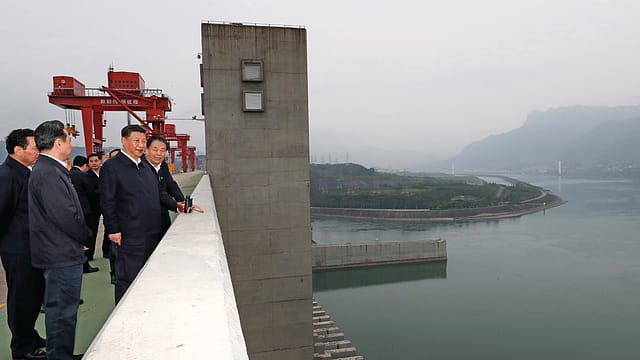
No lessons were, of course, learnt. Instead, the state became even more ambitious in engineering nature. Consider the Three Gorges Dam. It may not have been a Mao-era project but it reflected a continuing Chinese faith in engineering nature on a colossal scale. Its reservoir displaced vast populations, trapped 1.8 billion tonnes of sediment in its first decade and contributed to downstream riverbed erosion.
If the Yangtze protested a few decades ago, the Trishuli is revolting now. The Brahmaputra might be next.
Mao is long gone. Only his portrait hangs on the Gate of Heavenly Peace, overlooking Tiananmen Square in central Beijing. But that doesn’t mean he doesn’t live on.
Mao’s ideology still enthrals the rulers of modern China. And that is a matter of concern.