Killer Robots, Drone Swarms, and Deepfakes: How AI Is Running Modern Warfare
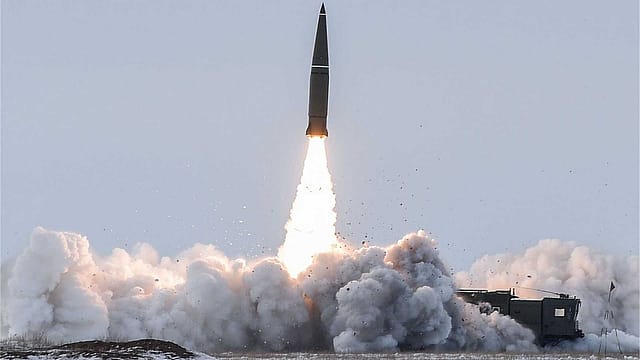
War has always evolved alongside technology, from the introduction of gunpowder to the development of nuclear weapons.
However, no innovation has accelerated this evolution quite like artificial intelligence.
AI is no longer a distant concept discussed in Pentagon boardrooms; it is actively operating on modern battlefields, making strategic assessments, predicting enemy movements, and in certain instances, executing lethal actions.
Here is a closer examination of the role AI is playing in contemporary warfare and the potential directions it may take in the near future.

Zeroing In on ECI
09 Oct 2026 - Vol 05 | Issue 41
Constitutional legitimacy versus political opportunism
What exactly is AI's role in modern warfare today?
Artificial intelligence acts as a force multiplier, significantly enhancing the speed, precision, and scale at which militaries can operate.
By processing massive volumes of satellite imagery, drone footage, and sensor data in real time, AI identifies patterns and insights that are invisible to the human eye and delivers actionable intelligence to commanders within seconds.
According to defence technology experts, AI-powered surveillance systems now achieve threat detection with accuracy rates exceeding ninety-four percent, fundamentally altering the tempo and conduct of military operations.
How is AI being used for surveillance and reconnaissance?
AI enables militaries to analyse enormous streams of data from satellites, drones, and ground sensors simultaneously, a task that would otherwise require thousands of human analysts working continuously around the clock.
Defence researchers point to the United States military's Project Maven as a prime example, demonstrating how machine learning can rapidly analyse drone footage to identify targets, track movements, and map enemy positions with minimal human intervention.
Tasks that previously required several days can now be completed in a matter of minutes, allowing commanders to act on intelligence far more swiftly than before.
What are autonomous weapons and where are they already deployed?
Autonomous weapons refer to AI-enabled drones and loitering munitions, commonly known as kamikaze drones, which can identify and engage targets with minimal human input.
Reports indicate that conflicts in Ukraine and Gaza have served as practical testing grounds for these systems, representing the first widespread deployment of AI-guided lethal weapons on contemporary battlefields.
How is AI shortening the "kill chain"?
Traditionally, the process of detecting a target and executing a strike, referred to as the sensor-to-shooter kill chain, could take several hours.
AI has dramatically compressed this timeframe, reducing it to minutes or even seconds in some cases.
By analysing complex and fast-moving battlefield environments, AI can recommend optimal strike strategies, enabling commanders to act on intelligence before conditions on the ground can change.
This speed and precision are increasingly regarded as decisive factors in modern conflicts.
Can AI predict equipment failures before they happen?
Indeed, AI-driven predictive maintenance systems are capable of monitoring military equipment in real time and flagging potential malfunctions before they occur.
This capability carries enormous financial implications, with estimates suggesting that it could save the United States Department of Defense approximately five billion dollars annually by reducing operational downtime, extending the service life of equipment, and optimising supply chains across global operations.
What is AI's role in cyber and electronic warfare?
Artificial intelligence plays a pivotal role in cyber and electronic warfare by detecting anomalies in networks, automating defensive measures, and disrupting enemy communications or weapons guidance systems at speeds unattainable by human operators.
In electronic warfare, AI is employed to jam signals, spoof navigation systems, and identify vulnerabilities in enemy networks in real time.
AI-powered cyber systems can simultaneously launch and defend against attacks, rendering electronic warfare an almost fully automated domain.
What are drone swarms and why do they matter?
Drone swarms consist of large, coordinated groups of AI-controlled unmanned vehicles that can operate collectively without continuous human oversight.
These swarms are designed to overwhelm enemy air defences through sheer numbers and coordination, rendering traditional point-defence systems largely ineffective.
The development and deployment of swarm technology is considered one of the most destabilising advancements in contemporary warfare.
How is AI being weaponised for psychological operations?
Artificial intelligence is also being used in psychological operations through the creation of deepfakes, synthetic audio and video content that is virtually indistinguishable from reality.
State actors have already deployed AI-generated propaganda to influence public perception, fabricate statements attributed to enemy commanders, and create confusion behind enemy lines.
This cognitive dimension of warfare operates without the need for conventional weapons, relying instead on the widespread dissemination of highly convincing disinformation.
What are the ethical and legal risks?
The increasing use of fully autonomous lethal weapons, which can select and engage targets without human intervention, has raised urgent ethical and legal concerns.
The United Nations Office for Disarmament Affairs has reported that a global push for the regulation of so-called "killer robots" gained significant momentum by 2026, with dozens of nations calling for binding international frameworks.
Critics warn that removing human judgment from decisions involving lethal force crosses a moral threshold that no algorithm should be permitted to breach.
What does the future of AI in modern warfare look like?
The future of military AI is shaping up as an accelerating arms race. Both the United States and China are investing hundreds of billions of dollars to achieve dominance in AI-driven military capabilities, ranging from autonomous combat systems to AI-directed strategic simulations and wargaming exercises.
Defence analysts suggest that the nation that secures decisive superiority in AI will control the tempo of future conflicts, making the competition for AI dominance the defining military rivalry of the twenty-first century.
(With inputs from yMedia)