Khaleda Zia (1945-2025): Restorer of Democracy or Legitimiser of Islamists?
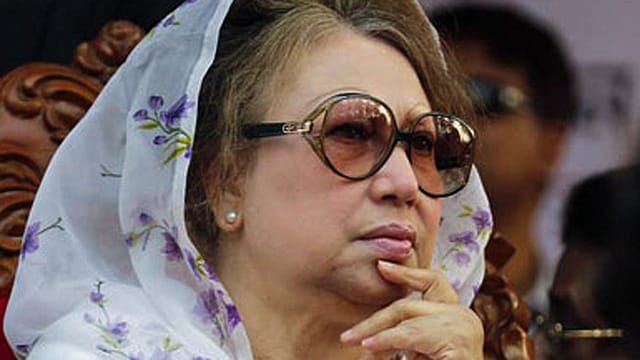
There’s no irony in the fact that Khaleda Khanam (1945-2025) was born on what would become the Indian side of the border after Partition. Nicknamed ‘Putul’, or doll, she was the daughter of Iskandar Ali Majumdar who worked his way up the tea trade to become a secretary of the Jalpaiguri Tea Garden Association. The claim that Khaleda was born to a family from western Bengal is erroneous as the Majumdar family hailed from Feni district in present-day Bangladesh. After Partition they moved back, with their tea business, but only as far as Dinajpur district in East Pakistan right across the Radcliffe Line from West Dinajpur in West Bengal. Khaleda had led an unremarkable life till the two defining events of her marriage to then Captain Ziaur Rahman, who became Bangladesh’s military ruler and then president, and his assassination in Chittagong in May 1981. The first would make her Bangladesh’s First Lady eventually. The second would propel her to politics, almost accidentally.
Street Politics of the Early Days
In many ways, the present crisis in Bangladesh owes its origins to the agitational brand of politics that Khaleda had practised, and stuck to, through most of her political career, her two full tenures as prime minister notwithstanding. But that does not take away from her significance as a warrior and restorer of democracy who helped bring the dictatorial rule of Hussian Muhammad Ershad to an end. In fact, Bangladeshis admired her tenacity and her uncompromising determination to stick to a maximalist position. In the eulogies pouring forth from Western media outlets it’s the romantic half of her legacy that alone is being praised, helped in no little measure by their antagonism towards Khaleda’s arch-rival Sheikh Hasina. However, those who were surprised by the victory of Khaled Zia’s Bangladesh Nationalist Party (BNP) in the 1991 elections, which made her Bangladesh’s first woman prime minister and the Muslim world’s second one after Benazir Bhutto, should have remembered 1986.
Zeroing In on ECI
09 Oct 2026 - Vol 05 | Issue 41
Constitutional legitimacy versus political opportunism
When Ershad called elections in 1986, there were two major political alliances on the stump: a bloc led by BNP and a 15-member alliance led by Hasina’s Awami League. Both groupings had initially called for a boycott of the polls which would have had no credibility. But the Awami League, the Jamaat (Khaleda’s subsequent ally), and the communists participated while BNP and Khaleda stuck to the boycott. Khaleda was vindicated when Ershad rigged the polls and jailed Hasina. More importantly, it was a moral victory for Khaleda as Bangladeshis never forgot her refusal to bend. That personal popularity despite later charges of largescale corruption and jail terms, had ensured that as long as she contested, Khaleda never lost from any constituency—be that in 1991, 1996, 2001, and 2008.
Khaleda’s India Problem
Khaleda’s first tenure as prime minister (1991-96) was one many firsts. It was revolutionary in the sense of necessary political, economic and social reforms. Politically, she reverted Bangladesh to a parliamentary form of government and would later introduce the caretaker system to oversee elections. She championed women’s education as well as accessible education. On the economic and financial fronts, her government framed Bank Company Act in 1991 and the Financial Institutions Act in 1993 and set up a board to oversee privatisation, also in 1993, as well as introducing VAT, or value-added tax.
It was her loss of power in the 1996 election and Hasina’s overtly India-friendly stance that turned Khaleda’s innate suspicions about India and fears about Bangladesh being dominated by its giant neighbour that made her bitter and, in retrospect even from BNP’s perspective today, perhaps unnecessarily hostile towards India. She turned her anti-India agenda into an article of faith and political instrument, calling, for instance, the bilateral friendship treaty dashotter chukti or a slavery treaty. Her return to power in 2001 heralded a challenging time in bilateral relations, especially as Bangladesh became the Pakistani’s Inter-Services Intelligence’s (ISI) happy hunting grounds where jihadists of various persuasions could operate and plot against India with impunity. When Hasina returned in 2008 and began her crackdown on both Islamists and Pakistani operatives as well as bringing the collaborators and mass murders of the liberation war to justice—many of the last having been granted amnesty and set free by Khaleda’s husband Ziaur Rahman—India was understandably relieved.
Nevertheless, the 2001-06 tenure of Khaleda did see some important positive developments in bilateral ties. There was, for instance, the revised trade pact of 2006, as well as a promise and mutual compromise to resolve matters through joint commissions, but the Land Boundary Agreement (LBA) had to wait for a change of guard in Bangladesh.
A Democratic but Destructive Legacy
It was Khaleda’s agitational mode of politics—first as democratic under Ershad and then as destructive against Hasina—that both made and unmade her. Her uncompromising street-fighting days restored democracy to Bangladesh but eventually it became boycott for the sake of boycott when she serially refused to participate in elections, although Hasina’s government had erred in doing away with the caretaker system and shot itself in the foot in the eyes of the world. And yet, as BNP allied with the Jamaat and other Islamist parties and/or their fronts in the street, it gave more and more ground to the latter, till Islamists running amok or beheading secular-liberal bloggers became normal in the country. Khaleda and BNP’s positions on such violence was always opportunistic and hardline Islamists among BNP’s ranks made it all the more difficult for the party and its leadership to dissociate itself from the blood of the liberals.
That sordid saga in Bangladesh’s recent history has been whitewashed by the Western media, just as it refuses to notice the fact that Hindus are being killed, their places of worship desecrated and destroyed, their homes attacked and Bangladesh’s largest but shrinking minority is being practically scared off the street. While Hasina’s mistakes and authoritarian turn, especially in her last years in power cannot be condoned or excused for the eruption in 2024 that overthrew her and plunged Bangladesh into its ongoing and worsening crisis, the role of Khaleda Zia and her BNP in legitimising Islamists and empowering them to take over the public space, even ultimately to the detriment of BNP itself, must not be forgotten.
Indian Imperatives
Given the criminally shambolic governance or the lack thereof under Muhammad Yunus, New Delhi took the pragmatic and generous step of moving on and reaching out to Khaleda’s surviving son Tarique Rahman and BNP. Prime Minister Narendra Modi had met Khaleda on his 2015 visit to Bangladesh and that cordial interaction is remembered in both Dhaka and Delhi. Modi’s condolence on X said: “I recall my warm meeting with her in Dhaka in 2015. We hope that her vision and legacy will continue to guide our partnership.”
Above all, it is Sheikh Hasina’s acknowledgement of the debt Bangladesh owes Khaleda Zia that puts the present crisis against a stark backdrop: “As the first woman Prime Minister of Bangladesh, and for her role in the struggle to establish democracy, her contributions to the nation were significant and will be remembered. Her passing represents a profound loss for Bangladesh’s political life and for the leadership of the Bangladesh Nationalist Party…” It is the admission that Khaleda’s death is a loss and that Bangladeshi politics would have been better off with her around from the deposed prime minister that gives the lie to the rhetoric of popular revolution and restoration of democracy from Yunus’ friends and patrons in Western capitals.
India must continue broadening and deepening its engagement with Tarique Rahman who has just returned to Bangladesh from exile. The Awami League will take a long time to regroup. Today, BNP is the only bet for the restitution of a legitimate, elected government to Bangladesh. As a political party, it hasn’t been too happy at the sinister turn things have taken since August 5, 2024. With a generational change in its leadership, perhaps Bangladesh could still be pulled back from the brink.