Jamaat-e-Islami’s wins in Bangladesh along India’s border a matter of concern: political scientist
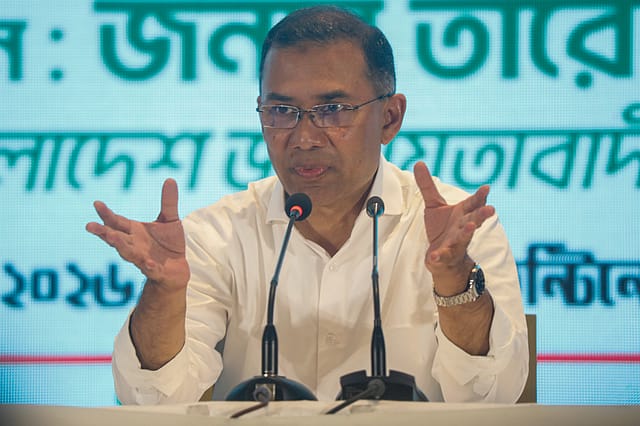
In the first elections held in Bangladesh after the so-called July Revolution of 2024 that ended the 15-year-rule of Awami League (AL) leader Sheikh Hasina, the Bangladesh Nationalist Party (BNP) secured a landslide win in the February 12 polls. The Tarique Rahman-led BNP trounced the 11-party alliance led by Jamaat-e-Islami and the student-led National Citizen Party (NCP), confirming that the majority of Bangladeshis chose a mainstream party over Islamist extremists, says academic and author Sumantra Bose.
An alumnus of Amherst College, Massachusetts, and Columbia University, Bose’s most recent books include Secular States, Religious Politics: India, Turkey, and the Future of Secularism (Cambridge University Press, 2018) and Kashmir at the Crossroads: Inside a 21st-Century Conflict (Yale University Press, 2021). Bose, formerly Professor of International and Comparative Politics at the London School of Economics, who currently holds a similar position at Krea University in Andhra Pradesh, is an expert on South Asia, nationalism and conflicts. "My sense is that the government headed by Tarique Rahman will try to pursue a cautious foreign policy that seeks to balance ties with India, China and Pakistan," says Bose. Edited excerpts:
What does the emphatic win of the Bangladesh Nationalist Party (BNP) mean for their country? Does it mean people voted for a familiar political entity? Does it also mean a rejection of Islamism?
The outcome means that most Bangladeshis have opted for a mainstream party over Islamist extremists. But the strong showing of the Jamaat-e-Islami is cause for concern, and not just in Bangladesh. Most of Jamaat's wins are in areas contiguous to the West Bengal border: Khulna, Jashore, Satkhira, Pabna, Rajshahi. Jamaat has won 25 of the 36 constituencies in the Khulna division and 18 of the 33 constituencies in the Rangpur division to the north.

Exclusive: To the Heavens and Back
19 Jun 2026 - Vol 04 | Issue 76
Shubhanshu Shukla relives the space odyssey that put India into orbit
What do you think are the main challenges for Tarique Rahman (who will swear in as the next prime minister on February 17) in terms of rebuilding trust in institutions that remained deeply politicised for far too long?
This is a moment of hope for Bangladesh but institutional renewal will require a lot of work. How Tarique Rahman behaves in office will have to be closely monitored in India. His (mis)conduct during his late mother's (the late Khaleda Zia) 2001-2006 term – when BNP governed in alliance with Jamaat – is not a good precedent.
Hopefully he is now older and wiser, sobered by 17 years in political wilderness and forced exile. Who his advisors are, and their role, will be crucial. Tarique and his advisors will also have to figure out how to best deal with the Jamaat, which is simultaneously emboldened and frustrated by the results and therefore even more dangerous.
It is good that the constitutional reform package put to referendum alongside the parliamentary election has passed with a 68% vote in favour. The BNP government must ensure its expeditious implementation.

How good are the opportunities now for both India and Bangladesh to reset relations?
There is a window of opportunity fraught with huge obstacles and complexities. Resentment against India is at an all-time high in Bangladesh. This is unlikely to abate as long as our government continues to harbour Sheikh Hasina (who fled to India in 2024) and she continues to make intermittent statements from our soil. There are long-pending issues such as the Teesta treaty, stalled for well over a decade due to Mamata Banerjee's intransigence (Hasina herself was deeply offended by Banerjee's attitude).
Then there is the stigmatisation of Bangladeshis and alleged Bangladeshis in our country. Amit Shah's 'termite' remark in 2018 drew a protest from even the erstwhile AL government. Just a few days ago, the RSS chief Mohan Bhagwat said in Mumbai that illegal migrants are easily identifiable by the language they speak: "Unki bhasha sey pata lag jata hai".
My sense is that the government headed by Tarique Rahman will try to pursue a cautious foreign policy that seeks to balance ties with India, China and Pakistan. A capable foreign minister should be appointed. Mirza Fakhrul Islam Alamgir, the BNP's elder statesman, has said that India-Bangladesh relations must move beyond Sheikh Hasina. He is absolutely right. It is in the vital national interest of both Bangladesh and India that relations improve from their present nadir. Both governments must act on this imperative.
Students were at the forefront of the protests against Sheikh Hasina and the wounds of July 2024 are not healed yet. What do you expect BNP to do in the form of reconciliation?
Bangladesh's students have always been a credit to their nation – whether in the bhasha andolan (language movement) of 1952, the muktijuddho (liberation war) of 1971, or the uprising against dictatorship in 2024.
Hasina's days in power were numbered once her goons lost control of the Dhaka University campus at the start of the July 2024 uprising. Any government in Dhaka can ignore and mistreat Bangladesh's Generation Z at its own peril. I wish India's students were such watchdogs of people's rights!
Do you think behaviorally Bangladeshi voters are similar to those in West Bengal?
Not at all. Quite the reverse! Sheikh Mujibur Rahman returned in January 1972 to a newly birthed nation-state of genocide survivors. His popularity collapsed by 1975 in large part due to his attempt to impose a one-party regime known as BAKSAL (Bangladesh Krishak Sramik Awami League). He was assassinated soon after.
Through the 1980s, Bangladeshis protested with more and more intensity against H.M. Ershad's military rule. After Ershad fell in 1990 and competitive elections became the norm, the BNP led by Khaleda Zia was elected in 1991, the Awami League led by Sheikh Hasina in 1996, the BNP again in 2001, and Hasina's AL in 2008. This is the exact opposite of the dismal pattern in West Bengal.
Hasina could not be removed peacefully because she first subverted and then destroyed electoral democracy. She could only be removed by force – either a military coup or the mass uprising that in fact happened. The new incumbents in Bangladesh should learn the lesson of this history. Hasina clearly learned nothing from her father's fatal misstep in the mid-1970s and went for total autocratisation.
But the AL, though badly damaged, may not be as finished as its enemies would like to think. The turnout in the just concluded election, at barely 60%, is nearly 30 points lower than the 87 percent turnout in the last contested election in end-2008. This suggests a de facto boycott by a substantial segment of the electorate. It is a ray of hope for future democratic cohabitation that the BNP disagreed with the Muhammad Yunus administration's decision to ban the Awami League.