Jaishankar, Rubio Review India-US Ties, Push Cooperation on Critical Minerals
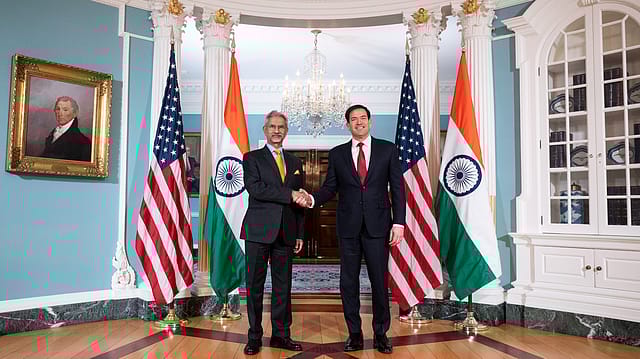
External Affairs Minister S Jaishankar, who is in the United States to attend the Critical Minerals Ministerial hosted by US Secretary of State Marco Rubio, said that India and the US carried out a detailed review of their bilateral cooperation, alongside wide-ranging discussions on key global and regional developments.
Speaking on the sidelines of the ministerial, Jaishankar said his meetings with Rubio covered the full diplomatic agenda, including expectations for joint engagement over the course of the year.
“It's natural when foreign ministers meet that you discuss the diplomatic agenda. Also, the calendar - what do we expect each one of us to do this year together, so a lot of our discussion was devoted to that, the bilateral side,” he said.
The Modi Years
02 Oct 2026 - Vol 05 | Issue 40
A Nation Rebuilt
“But again, foreign ministers meet, and we talk about our business: the Indo-Pacific, what is happening in West Asia, the Middle East, Gaza, and the Ukraine conflict. There was a kind of global review of what was happening in the Western Hemisphere. In a sense, we discussed the world, we discussed our relationship, and it was a very open sort of forthcoming conversation," he added.
The External Affairs Minister said his primary purpose in Washington was to attend the Critical Minerals Ministerial, which brought together representatives from nearly 50 countries.
Jaishankar flags risks of concentrated critical mineral supply chains
Addressing the ministerial earlier, Jaishankar warned that excessive concentration in critical mineral supply chains poses a major global risk.
He called for structured international cooperation to de-risk these supply chains as India deepens engagement with the US-led framework on strategic minerals.
In a post on X, the EAM said, “Spoke at the Critical Minerals Ministerial in Washington DC today. Underlined challenges of excessive concentration and the importance of de-risking supply chains through structured international cooperation."
He also highlighted India’s domestic initiatives to strengthen supply chain resilience, including the National Critical Minerals Mission, the creation of rare earth corridors and the promotion of responsible commerce in critical mineral resources.
The announcement of dedicated rare earth corridors in India’s 2026 Budget was cited as a key signal of a shift from strategic intent to industrial execution, with a focus on domestic processing, separation, magnet manufacturing and downstream capabilities.
India Positions Itself as Key Partner in Resilient Supply Chains
Critical minerals such as lithium, cobalt and rare earth elements are essential for sectors including clean energy, electronics, semiconductors and defence technologies.
Their supply chains have become a focal point of geopolitics, with growing efforts by countries to diversify sources and reduce vulnerabilities arising from concentrated production and processing.
The ministerial underscored broader international efforts to reduce dependency on limited sources of critical minerals amid concerns over supply chain chokepoints and geopolitical leverage.
Jaishankar said India aims to position itself not just as a consumer but as an active partner in shaping resilient global supply chains, particularly in collaboration with the United States.
Pakistan was not invited to the ministerial, despite efforts last year by Pakistan Army Chief General Asim Munir and Prime Minister Shehbaz Sharif to draw US attention to the country’s critical mineral reserves during engagements in Washington.
(With inputs from ANI)