Nobel Season, Trump Style: Self-Nominated & Waiting for the Call. Is Oslo Listening?
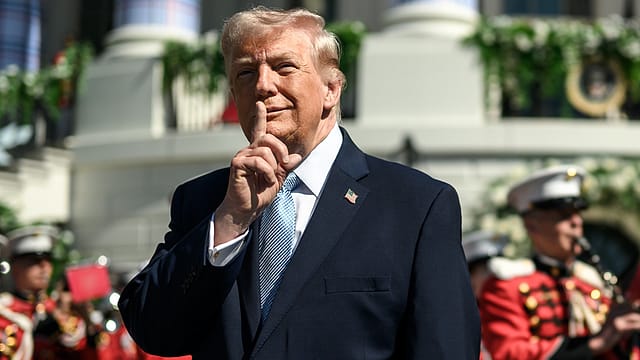
US President Donald Trump has once again made a public case for receiving the Nobel Peace Prize, arguing that his diplomatic record makes him deserving of the prestigious honour while acknowledging that the Norwegian Nobel Committee may ultimately overlook him.
With the announcement of the 2026 Nobel Peace Prize due on Friday, Trump used an appearance in the Oval Office on Wednesday to highlight what he described as an unprecedented record of conflict resolution during his second term.
“It is about that time,” Trump said when asked about the prize. He then referred to last year's Nobel laureate, Venezuelan opposition leader Maria Corina Machado, claiming that she had told him he deserved the award more than anyone else and had subsequently given him her medal.
The Modi Years
02 Oct 2026 - Vol 05 | Issue 40
A Nation Rebuilt
Trump also questioned whether the Norwegian Nobel Committee would be inclined to select him.
“But, whether I get it or not, I have done far more,” he said, arguing that failing to recognise his efforts would reflect poorly on the committee.
TRUMP CLAIMS 8 WARS SETTLED
At the heart of Trump's argument is his claim that his administration has played a decisive role in ending or resolving eight conflicts since he returned to the White House.
“I've done stuff that nobody else has ever done,” Trump said. “No president has probably ever settled any wars. I settled eight wars.”
The claim forms part of a broader effort by Trump and his administration to portray his second-term foreign policy as one centred on using American economic and diplomatic leverage to force adversaries towards negotiations.
Administration officials have repeatedly pointed to tariffs, threatened tariffs and other forms of economic pressure as tools that have helped bring hostile parties to the negotiating table.
Trump has also frequently argued that his approach differs from that of previous American presidents, portraying himself as a leader willing to apply pressure rather than rely primarily on conventional diplomatic channels.
"OBAMA GOT IT, AND HE DIDN’T DO ANYTHING"
Trump also revived his longstanding criticism of former President Barack Obama, who received the Nobel Peace Prize in 2009.
“Obama got it, and he didn't do anything,” Trump said, questioning why Obama was awarded the prize so early in his presidency.
Trump has previously used Obama's Nobel to argue that the award has sometimes been given on the basis of expectations rather than concrete achievements.
His latest remarks similarly contrast what he sees as his own record of diplomatic intervention with Obama's receipt of the prize less than a year after taking office.
MACHADO’S MEDAL BECOMES PART OF TRUMP’S CASE
Trump also brought up his meeting with Maria Corina Machado, who received the Nobel Peace Prize last year for her work associated with Venezuela's democratic opposition.
According to Trump, Machado told him that he deserved the prize and gave him her Nobel medal during their meeting.
“Last time they gave it to a young lady who’s a fabulous person, and she said she didn’t deserve it, that I deserved it, and she gave it to me,” Trump said.
Machado's Nobel has subsequently become a recurring reference point in Trump's own argument that he has been overlooked for international recognition.
The claim that she effectively transferred her medal to him, however, does not amount to a Nobel nomination or award. The Peace Prize is awarded by the Norwegian Nobel Committee and cannot be transferred from one laureate to another.
THE PEACE CLAIMS FACE CHALLENGES
Trump's assertion that he has settled eight wars has also faced scrutiny because several conflicts cited in connection with his administration's diplomatic efforts remain unresolved or have subsequently seen renewed violence.
His administration has repeatedly highlighted efforts involving conflicts in different parts of the world, but critics have questioned whether temporary ceasefires or diplomatic agreements should be characterised as permanently settled wars.
The distinction is particularly relevant to Trump's claim of a broad peace-making record.
The conflict in Ukraine, for instance, remains unresolved despite Trump's repeated promises to broker a rapid settlement. Fighting and instability have also continued in parts of the Democratic Republic of Congo and along the disputed Cambodia-Thailand border.
The situation in the Middle East has likewise complicated claims of a sweeping diplomatic breakthrough, with tensions involving Iran remaining a major source of instability following US and Israeli military action.
The result is a gap between the administration's description of Trump's diplomatic record and the more complicated reality on the ground.
WHO DECIDES THE NOBEL PEACE PRIZE?
The Nobel Peace Prize is decided independently by the Norwegian Nobel Committee in Oslo.
Unlike some political awards, the selection is not determined by a public vote or by the preferences of the US administration. The committee considers nominations before selecting the laureate, whose name is announced in October.
Trump has repeatedly expressed his desire for the prize and argued that his diplomatic record merits consideration. But the final decision remains entirely outside his control.
Other names and institutions discussed as potential contenders for the 2026 prize include Pope Leo, the International Criminal Court and the United Nations special rapporteur on the Palestinian territories.
The winner will be announced on Friday, ending months of speculation, and Trump's latest public campaign for the world's most prominent peace prize.
With inputs from ANI