Israeli Media Says Mojtaba Khamenei Set to Take Over as Iran’s Supreme Leader
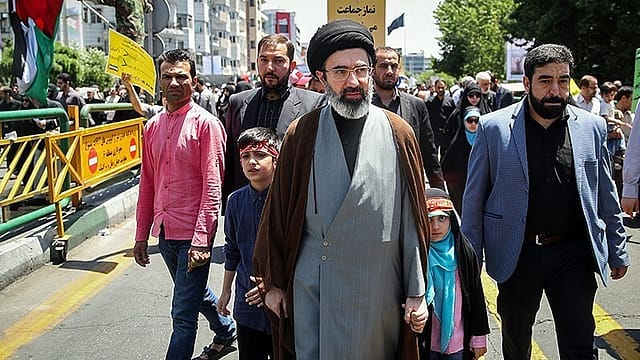
Israeli media has reported that Mojtaba Khamenei, the second eldest son of Iran’s Supreme Leader Ali Khamenei, has been chosen as his successor and is expected to take over as the next Supreme Leader.
Senior Israeli officials told Ynet that Iran’s Assembly is likely to formally announce Mojtaba Khamenei’s appointment in the coming hours.
However, there has been no independent confirmation from official Iranian state media.
Earlier, The New York Times reported that Mojtaba, 56, had emerged as the leading candidate for the position.

Zeroing In on ECI
09 Oct 2026 - Vol 05 | Issue 41
Constitutional legitimacy versus political opportunism
The newspaper said Iran’s Assembly of Experts had elected him as the new head of state, allegedly under intense pressure from the Islamic Revolutionary Guard Corps.
How Did Mojtaba Khamenei Influence His Father’s Office and the IRGC?
Mojtaba is said to have played a major role in running his late father’s office and maintains close ties with the top echelon of the Islamic Revolutionary Guard Corps and the Quds Force.
Israeli media described Mojtaba as holding a more hard-line position than his father and alleged that he was behind violent crackdowns on protesters in Iran.
In November 2019, the US Treasury Department imposed sanctions on Mojtaba, designating him for representing the then Supreme Leader in an official capacity despite never being elected or appointed to a government position.
The Treasury said that the Supreme Leader had delegated part of his leadership responsibilities to Mojtaba Khamenei, who worked closely with the commander of the Islamic Revolutionary Guard Corps-Qods Force and the Basij Resistance Force to advance his father’s destabilizing regional ambitions and oppressive domestic objectives.
It has also been reported that Mojtaba has access to luxury properties in London and accounts in the UK, Switzerland and Liechtenstein.
The developments come amid escalating conflict in the Middle East, which has entered its fourth day following US and Israeli strikes on Iran that killed Ali Khamenei along with other key figures in the country.
In retaliation, Tehran launched counter-strikes targeting American military bases and Israeli assets across the region.
What Did US Central Command Chief Admiral Brad Cooper Say About Ongoing Military Operations?
US Central Command Chief Admiral Brad Cooper warned Iran that operations would continue.
Amid the turmoil, Abdul Majeed Hakeem Ilahi, Special Representative of Iran's Supreme Leader in India, described the late leader as Iran’s "father" and a towering spiritual authority whose death marks a profound loss.
In an interview with ANI, Ilahi said, "Actually, our Supreme Leader wasn't just an ordinary leader. He was our father. He was our spiritual leader. He was our Marja in our religion. Marja means authentic, which we rely on him. He is not only for Iranians. There are millions of Muslims who like and love him. Millions of Muslims support him, and they follow him. He was our everything, and his martyrdom is a very big loss for everyone."
Ilahi said he had witnessed emotional scenes of mourning. "I met a lot of people here, and I saw in films and photos that they are crying very hard. So actually he was a very pious man."
What Did Abdul Majeed Hakeem Ilahi Reveal About Ali Khamenei’s Admiration for India?
Recalling Khamenei’s intellectual interests, Ilahi claimed the Iranian leader had read "more than a thousand volumes of novels" and had a deep admiration for India.
"He loved India too much, which is unimaginable," he said. "Whenever I met him, or he met anyone related to India, he was sending his salam to Indians. He knew Indian scholars by their name, whether Muslim or not Muslim, it didn't matter. He was saying we have much more civilisation with India, and he loves India too much."
Ilahi added that Khamenei would often speak about "the history of India and civilisation of India and philosophy of India and the poem of India," and would meet poets annually, including those invited from India.
"Whenever he met Indian poets, he was very happy and listened to them. Whenever I met him, he said, 'Please send my salam to Indians and take care of India."
Highlighting what he described as a special bond, Ilahi said only "less than five countries" had been assigned official representatives by the Supreme Leader.
What Did Abdul Majeed Hakeem Ilahi Say About Ali Khamenei’s Security in His Final Days?
"This depends on his love for that country. In Syria, he was, and also here in India and in Lebanon," he said.
Addressing reports about Khamenei’s security in his final days, Ilahi alleged there had been "a narrative war" filled with misinformation.
"They were saying that Ayatollah Khamenei is out of his house, his office, out of the city of Tehran capital and he lives in a basement or in some very safe place," he said.
"But when he was martyred, and he was killed, everyone in the world knows that he was in his office in the early morning with his family, with his grandchildren, with his daughter-in-law," he said.
He dismissed claims that the leader had fled Iran or amassed wealth. "They were saying that he took a lot of money, and he went to Russia. All of this was wrong and false," Ilahi said.
Why Did Ali Khamenei Refuse to Leave Tehran Despite Security Concerns?
Recalling a conversation with security officials, Ilahi said, "I asked his security, ' Why are you not providing security for him? Why are you not asking him to go out? Why do you allow him to stay here? They said because he's not accepting."
According to Ilahi, the Supreme Leader had refused to leave Tehran despite security concerns. "We asked him several times to move him from Tehran to another city. He said, 'If you can provide this opportunity for all Iranians to go out of Tehran, OK, I'm ready.'"
Ilahi also emphasised what he described as Khamenei’s simple lifestyle. "Even he had four sons. None of them has a house. They are living in rented houses. Really, they are living in rented houses," he said.
"He was in the power of Iran. Two terms he was president of Iran, but he has nothing. Even he has one house, a very small house, roughly 100 square meters, which he had from before the Islamic Revolution. Never did he buy even one meter of land,” he added.
Calling his death a moment of national grief, Ilahi said the late leader’s legacy would continue through his teachings and followers.
(With inputs from ANI)