After Ayatollah Khamenei’s killing, who holds power in Iran and what comes next?
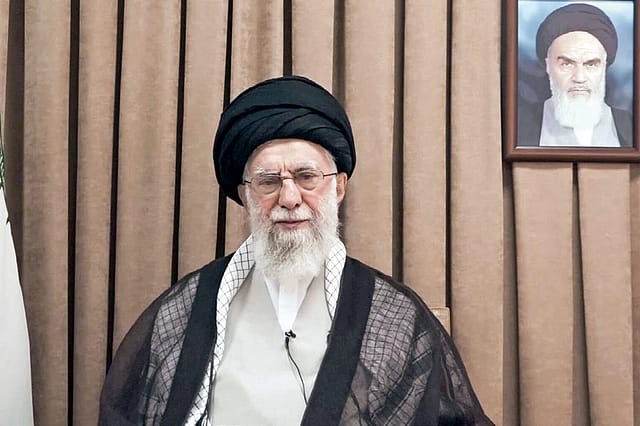
The killing of Iran’s Supreme Leader Ayatollah Ali Khamenei in joint US-Israel strikes has plunged the Islamic Republic into one of the most consequential transitions in its history. As Tehran mourns and vows revenge, a temporary leadership structure has been activated to steer the country through uncertainty, even as protests erupt across the region and military tensions intensify.
Who is leading Iran during this transition?
Alireza Arafi, a cleric and member of the Guardian Council, has been appointed as a jurist member of Iran’s Leadership Council, according to Al Jazeera. The council is tasked with fulfilling the supreme leader’s role until the Assembly of Experts elects a new leader.
Arafi will serve on the temporary Leadership Council alongside President Masoud Pezeshkian and Chief Justice Gholamhossein Mohseni Ejei.

Zeroing In on ECI
09 Oct 2026 - Vol 05 | Issue 41
Constitutional legitimacy versus political opportunism
Iran’s government has confirmed that an interim council, including President Pezeshkian, will oversee the country until a new supreme leader is elected. The Supreme Leader’s office has declared a period of national mourning, marking the end of a 37-year chapter that began when Ali Khamenei succeeded Ruhollah Khomeini in 1989.
Israeli Prime Minister Benjamin Netanyahu announced the joint operation with the US to “remove the existential threat to Isreal.”
In a video address, he said, “Good week, my brothers and sisters, citizens of Israel. This morning, Israel and the United States set out on a joint operation to remove the existential threat to Israel from the Ayatollahs' regime in Iran. I told you: The operation will continue as long as necessary, and patience is also required.”
“I thank my friend, President Donald Trump, for his leadership. I spoke with him again this morning and I commend the close cooperation between us. We will not allow a murderous terrorist regime to arm itself with nuclear weapons. We will continue to strike at the targets of the terrorist regime and remove the threat. And I also appeal to the citizens of Iran: Do not miss the opportunity. Unite together for your future and your freedom. Citizens of Israel, continue to follow the instructions of the Home Front Command. Together we will stand firm. The people of Israel live,” he added.
How has Iran responded to the killing?
Iran’s Foreign Minister Seyed Abbas Araghchi described the moment as one of profound religious and historical consequence.
In a post on X, the Foreign Ministry shared Araghchi’s reflections, which opened with a scriptural tribute: “Among the believers are men who have been true to their covenant with God. Some of them have fulfilled their vow (by sacrificing their lives), and some are still waiting, and they have never changed in the least.”
The ministry warned those responsible, stating that “He will remain a living nightmare for his killers forever.”
Expressing grief, Araghchi said, “With a heart overwhelmed by grief and sorrow, I extend my deepest condolences on the martyrdom--reminiscent of Imam Ali--of our wise Leader and perceptive guide, His Eminence Ayatollah #Imam_Khamenei (may his soul be sanctified), to His Holiness the Imam of the Age (may God hasten his reappearance), the noble nation of Iran, and the Islamic Ummah.”
He described the late leader as a “sagacious leader, resolute in decision, profound in wisdom, and steadfast on the path of truth,” adding that he “has left behind an enduring legacy of dignity, prudence, and perseverance for history.”
Calling the loss immense, Araghchi stated that the “martyrdom of such a towering figure is undoubtedly a tremendous loss and a heartbreaking sorrow, yet his luminous school of thought and steadfast path shall remain alive, dynamic, and inspiring.”
“Now, at this decisive juncture, safeguarding this precious legacy and continuing the radiant path of that righteous servant of God constitute a historic mission and a grave responsibility upon us all,” he said.
He further characterised the nation’s ideological course as “the path of faith, resistance, and hope--a path irrigated by the pure blood of martyrs and sustained by the unwavering resolve of its followers.”
“The banner he raised shall not fall to the ground, faithful and steadfast hands will carry it to ever loftier summits,” the statement asserted.
In a separate message, the Foreign Ministry said, “The Supreme Leader, Ayatollah Seyyed Ali #Khamenei, lived a pious life, loved #Iran, secured Iran's independence, opposed foreign domination, and worked tirelessly for our country's resilience and fortitude.”
It added, “His last phase of life--an honorable and dignified death as a martyr on the 10th day of Ramadan at the hands of the most corrupt and criminal individuals on earth--turns him into an inspiring legend in the history of Iran and Islam.”
Meanwhile, the Islamic Revolutionary Guard Corps pledged revenge and said it had launched attacks on 27 bases hosting US troops in the Middle East, as well as Israeli military facilities in Tel Aviv. Explosions were reported in Qatar and the UAE. US President Donald Trump warned Iran would be hit “with a force that has never been seen before” if it struck “very hard today.”
Iranian state media reported that at least 201 people were killed in the attacks across 24 provinces.
How has the region reacted?
Large-scale mourning gatherings and protests erupted across Iran and beyond following the reported killing.
In Tehran and other cities, millions were reported to have mourned. Crowds filled streets in Isfahan and Zanjan, while chants of “Death to America” and “Death to Israel” echoed at the Hazrat Masoumeh Shrine in Qom. A red “flag of revenge” was raised over the dome of the Jamkaran Mosque.
In Baghdad, crowds gathered in solidarity. In India, people assembled outside the Iran Cultural House in Delhi to mourn. In Jammu and Kashmir, members of the Shia community staged a massive protest outside the United Nations Military Observer Group in India and Pakistan headquarters in Srinagar. Participants carried portraits of Khamenei, waved black flags and raised traditional mourning chants.
According to Press TV, protests in Pakistan turned violent in some areas. Thousands reportedly gathered in Skardu, where the United Nations office was set on fire. In Karachi, demonstrators stormed the US consulate, leading to clashes with Pakistani security forces, and reports indicated that more than 10 people were killed after soldiers opened fire on protesters outside the consulate.
With an interim council now in place and the Assembly of Experts expected to begin the process of selecting a successor, Iran stands at a historic crossroads. The transition will not only determine its next supreme leader but could also reshape the balance of power across West Asia.
(With inputs from ANI)