Islamabad Under ‘Security Lockdown’ as Iran, US Prepare for Second Round of Talks
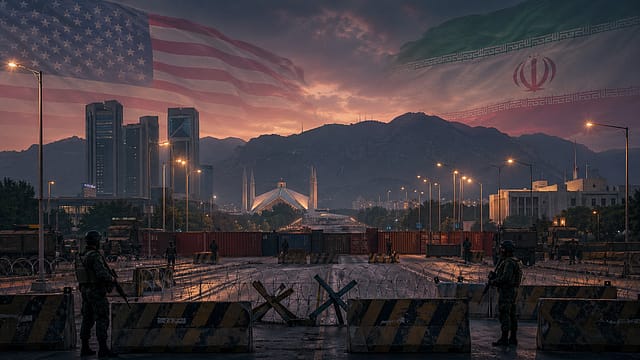
A delicate ceasefire in the Middle East has set the stage for a second round of talks between Iran and the United States, scheduled to take place in Pakistan on Saturday, even as tensions between the two sides remain unresolved.
Iranian Foreign Minister Abbas Araghchi met Pakistan’s Army Chief, Asim Munir, after arriving in the Pakistani capital with a delegation. The visit comes amid what has been described as a “deepening diplomatic deadlock” between Tehran and Washington.
The high-level engagement unfolded under extraordinary security arrangements, with Islamabad placed under a “suffocating security lockdown.” Authorities sealed major arterial roads and imposed a “strict cordon” around the high-security Red Zone.
The talks follow the extension of the Iran-Hezbollah ceasefire by three weeks, a development that has done little to signal an end to hostilities that began on February 28 after the United States and Israel traded attacks with Iran.

Open Minds 2026
26 Jun 2026 - Vol 05 | Issue 26
The power of ideas and arguments in 50 portraits
Pakistan’s Deputy Prime Minister Ishaq Dar said on social media that he was pleased to “receive and welcome my brother, Foreign Minister of Iran, Abbas Araghchi, to Islamabad,” adding that he would “look forward to our meaningful engagements aimed at promoting regional peace and stability.”
Why is the timing of Abbas Araghchi’s Pakistan visit crucial for Iran-US talks?
The White House indicated that its emissaries would engage in an “in-person conversation” with Iranian representatives. However, Iranian state media maintained that direct negotiations were not under consideration.
The timing of Araghchi’s visit is particularly sensitive. The White House recently announced that envoys Steve Witkoff and Jared Kushner would travel to the region for possible talks with Iran.
White House press secretary Karoline Leavitt said in an interview on Fox News Channel that the two envoys would hold talks with Araghchi.
She added that Vice President JD Vance would not be travelling but remains “deeply involved.”
Despite these overtures, Tehran has held its ground, asserting that it would “not be meeting” with the United States.
The diplomatic impasse has had visible repercussions in Islamabad, where the “commercial pulse” of the city has slowed considerably. Markets in the Blue Area remain largely deserted, and public transport networks have been severely disrupted.
An Iranian spokesperson said Araghchi is expected to visit Oman and Russia after his stop in Pakistan to further discussions aimed at ending the war.
Meanwhile, residents in the Pakistani capital are grappling with growing shortages of essential commodities and mounting psychological strain amid prolonged uncertainty.
(With inputs from ANI)