Is Earth Slowly Pushing Its Ancient Gold Upward? Scientists Say Yes
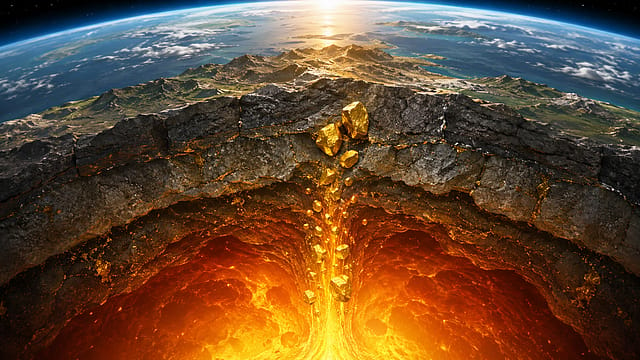
A study published in Nature has upended one of geology's most settled assumptions.
Scientists from the University of Gottingen found isotopic evidence inside Hawaiian volcanic rocks suggesting that ancient gold, long believed permanently sealed inside Earth's core, is slowly leaking upward through the mantle and reaching the surface via volcanic activity.
How Much Gold Is Locked Inside Earth's Core?
According to lead researcher Dr. Nils Messling, more than 99.95 percent of Earth's total gold reserves lie buried inside its molten core, as per India Times.
This reservoir formed approximately 4.5 billion years ago as precious metals sank into the planet's iron-rich centre. Until now, that ancient gold was considered permanently out of reach.

The Vanguard
21 Aug 2026 - Vol 05 | Issue 34
BJP Rearmed for 2029
What Did Scientists Find in Hawaiian Rocks?
The team obtained Hawaiian volcanic rock samples from the Smithsonian Institution, crushed them into powder, and analysed them for platinum-group elements.
According to CNN, scientists focused on ruthenium, a metal as rare in Earth's crust as gold. The Hawaiian rocks showed elevated isotopic signatures of ruthenium-100 matching material expected only from Earth's core.
Why Were Hawaiian Rocks Chosen for This Study?
Hawaii sits above one of the clearest examples of a deep mantle plume, a column of superheated rock rising from near the core-mantle boundary.
This makes any core-derived signal far easier to isolate than in volcanic systems fed by shallower processes.
What Makes This Discovery Scientifically Significant?
Earlier studies had detected unusual tungsten isotopes in certain volcanic rocks.
When combined with the new ruthenium data, both lines of evidence pointed to an ongoing exchange between Earth's core and outer layers, something the Nature study describes as diagnostic of a core contribution.
Does This Mean Earth's Core Is No Longer Sealed?
The core is not as isolated as previously assumed. However, the amounts of ancient gold reaching the surface remain minuscule.
Dr. Messling described the process as the Earth very slowly regifting its buried treasure, as per India Times.
Could This Rewrite the Origins of Surface Gold?
Some gold already present on Earth's surface may have originated in the planet's molten core, though whether this exchange has occurred throughout Earth's history remains an open question.
What Are the Limits of This Discovery?
This is one study built around one isotopic signal in one volcanic system. There is no prospect of extracting this material. What it does confirm is that Earth's internal architecture is far more interconnected than science previously believed.
(With inputs from yMedia)