From Hunger to Hope: Nepal’s Mid-Day Meal Scheme Becomes Lifeline for Students
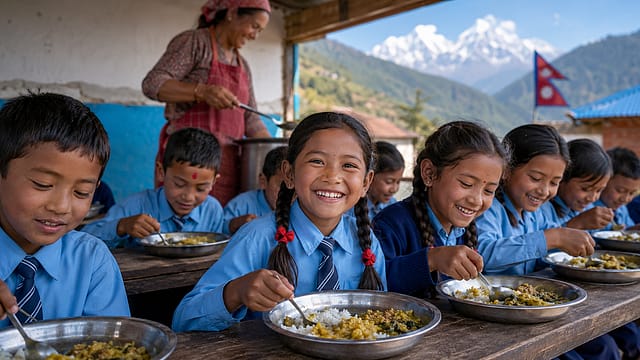
For Shishir Praja, a fifth-grade student in an impoverished pocket of Makwanpur, the school bell signalling the tiffin break is more than just a pause in lessons; it is a lifeline.
Standing in line with his plate, he is part of a generation of students for whom the government-sponsored "Diwa Khaja Karyakram" (Mid-Day Meal Program) has become the primary incentive for regular school attendance.
"Because the school provides tiffin, I attend regularly, which ultimately saves money for my home," said Shishir to ANI, whose community, the marginalised Chepang group, often faces the daily struggle of food insecurity.

The Vanguard
21 Aug 2026 - Vol 05 | Issue 34
BJP Rearmed for 2029
What began six decades ago as a scattered, donor-supported feeding scheme in famine-prone hill districts has evolved into a near-universal national entitlement.
Today, the program is a flagship government intervention that sits at the intersection of education, nutrition, poverty reduction, and gender equity, feeding basic-level students from early childhood education through grade five across Nepal's 29,000 community schools.
How does Nepal’s mid-day meal program ensure daily nutrition for students?
At the Shree Bal Jivan Jyoti Secondary School in Makwanpur, the daily menu is carefully curated to meet nutritional requirements.
Students receive a variety of options throughout the five-day school week, including porridge, grams, beaten rice, chamre (sticky rice), and eggs, with meat served as a special treat once a month.
To sustain this, the Government of Nepal allocates approximately $0.13 per student per day.
While this represents a significant increase from the previous $0.066 cap, local educators argue it falls short of the actual cost required to provide a nutritionally adequate meal, especially when accounting for infrastructure, kitchen space, and preparation staff.
To ensure the dietary requirements of the children, the school has developed a menu allotting dishes on the basis of the days, specially catered to fulfill the nutritional needs.
"We get halwa, porridge, grams and beaten rice, ghee/sticky rice- Chamre as well as eggs," Sony Praja, a third grader of the Shree Bal Jivan Jyoti Secondary School, told ANI.
The school also provides chicken/mutton meat to the students as a part of the meal, which indeed is the best day for the students here.
This midday meal program is designed to meet a meaningful share of a school-age child's daily caloric and protein needs (in-kind rations historically combined fortified corn-soya blend, flour, sugar, and oil to reach roughly 470 kilocalories per meal).
Locally, schools are increasingly encouraged to diversify menus with eggs, milk, pulses, and seasonal vegetables rather than relying on processed or packaged snacks.
(With inputs from ANI)