Inside China's dark factories: Where robots produce 'one smartphone per second'
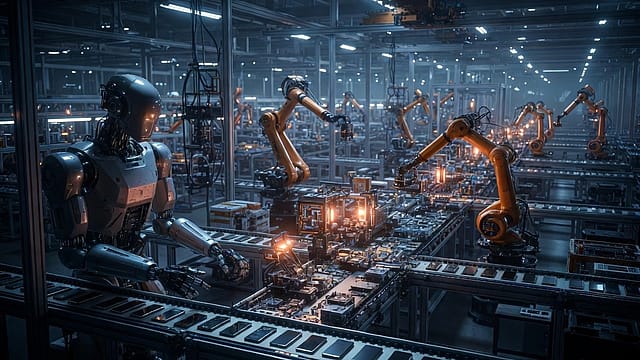
China's dark factories are no longer an experiment.
Hundreds of these lights-out facilities are running right now, with no workers, no lighting, and no interruption. Gartner estimates that by 2026, 60% of manufacturers worldwide will adopt some form of this model. The shift is already underway.
Here is what you need to know.
What Is a Dark Factory?
A dark factory is a fully automated manufacturing facility with no human presence on the production floor. Robots handle assembly, inspection, and logistics around the clock. Since no workers are present, no light is needed. These facilities run 24 hours a day, 365 days a year.
What Technology Powers These Factories?
Industrial robots, Light Detection and Ranging (LIDAR), infrared cameras, and IoT sensors form the backbone. AI makes real-time decisions across the line. Hyper-automation at this scale eliminates human input at every stage.

Look Who's Talking Regime Change
23 Oct 2026 - Vol 05 | Issue 43
Which Companies Are Already Running Them?
Dark factories in China lead in electronics and EVs. According to BGR, Xiaomi's Changping facility produces one smartphone per second with zero humans on the floor. Foxconn has rolled out lights-out lines across multiple sites, replacing over 60,000 workers at its Kunshan plant alone, per IEN. BYD and CATL, the world's largest EV battery maker, have both aggressively scaled robotic production across their manufacturing bases.
How Big Is the Job Displacement?
According to Bloomberg, China's manufacturing workforce fell from 115 million in 2013 to below 85 million in 2025, a loss of over 30 million jobs, even as exports hit record highs in early 2026. Hyper-automation is the central driver of this shift, enabling higher output with a shrinking workforce.
What Happens to Workers Going Forward?
Dark factories reshape roles rather than remove all of them. Demand is growing for robotics technicians, AI trainers, and cybersecurity professionals. Bloomberg states that China has invested over $15 billion in retraining programmes focused on advanced manufacturing since 2020.
What Does This Mean for Global Competition?
Dark factories in China now represent a structural edge rivals are struggling to match. According to the IFR's World Robotics 2025 report, China hit a world record of over 2 million factory robots in 2024, representing 54% of global demand. Its robot density stands at 392 per 10,000 workers, against a global average of 141. No other country comes close at this scale or speed.
Are There Limits to This Model?
Hyper-automation does not apply everywhere. Custom manufacturing still needs people. High upfront costs, cybersecurity risk, and system failure vulnerabilities remain real constraints on how far the dark factory model can scale.
(With inputs from yMedia)