Indonesia Earthquake: What We Know About the 7.7-Magnitude Quake That Struck Flores
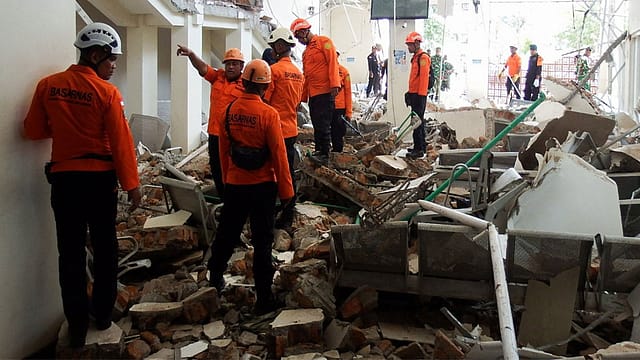
Hours after the earth shook beneath eastern Indonesia, the immediate fear of a tsunami has receded. What remains is a disaster still revealing its scale. Rescue teams are battling blocked roads, landslides, power outages and broken communication lines as they search affected communities across Flores. With at least 38 people confirmed dead and thousands displaced, here’s what we know about the earthquake, the damage it has left behind and the rescue operation now underway.
What happened in Indonesia?
A powerful 7.7-magnitude earthquake struck Indonesia's Flores region early Saturday, leaving at least 38 people dead and sending thousands fleeing their homes. The quake struck at 5:58 am local time, according to the US Geological Survey, with its epicentre about 68 km north-northwest of Ende in East Nusa Tenggara province. Several aftershocks followed.

Rise of the Pivotal Power
18 Sep 2026 - Vol 05 | Issue 38
The BRICS declaration is a strategic victory for Modi
How bad is the damage?
The confirmed toll stands at 38 dead, according to Indonesia's disaster management authorities. Two people were seriously injured and 11 suffered minor injuries, while roughly 2,000 people evacuated on their own. Buildings have collapsed, power outages have hit cities and villages, and communication disruptions are making it harder for authorities to establish the full extent of the damage. That means the picture could still change as rescue teams reach affected areas.
Was there a tsunami?
Authorities initially feared one. A tsunami warning was issued after the earthquake, prompting people in coastal areas to head for higher ground. It was subsequently lifted after Indonesia's Meteorology, Climatology and Geophysics Agency found no significant sea-level changes that threatened coastal communities. So, the immediate tsunami threat has passed. The danger on land hasn't.
Why are landslides now a major concern?
The earthquake triggered landslides in parts of Flores. Two villagers were believed to be buried under mud, according to the head of the Maumere Search and Rescue Agency, while landslides in Ende regency blocked sections of the Trans-Flores Highway, the roughly 700-km mountain road connecting communities across the island. That matters enormously for rescue operations. Damaged roads, difficult terrain and disrupted communications can turn kilometres into hours when emergency teams are trying to reach isolated communities.
What is happening at hospitals?
Local television footage showed patients being moved out of several hospitals as a precaution. Beds, oxygen cylinders and IV equipment were taken outdoors as medical teams established temporary treatment areas, underscoring concerns about the structural safety of buildings after the main quake and subsequent aftershocks.
How are rescuers reaching isolated areas?
Indonesia's National Disaster Management Agency has deployed a helicopter to support emergency operations and move supplies, with air evacuation available if required. Geography makes that particularly important. East Nusa Tenggara is spread across numerous islands, while Flores itself is mountainous. When roads are blocked and communications fail, helicopters can become one of the quickest ways to move people, equipment and emergency supplies.
Is the worst over?
The tsunami warning is over. The emergency isn't. Rescuers are still searching affected areas, aftershocks have followed the initial quake, some roads remain blocked and communication failures mean authorities are still assembling a complete picture of casualties and damage. For thousands of residents who fled their homes on Saturday morning, the next question is no longer how powerful the earthquake was. It is what they will find when they go back.
(With inputs from ANI)