India’s $450-million Lifeline: How Delhi Is Rebuilding Cyclone-Hit Sri Lanka, and Rewriting Regional Leadership
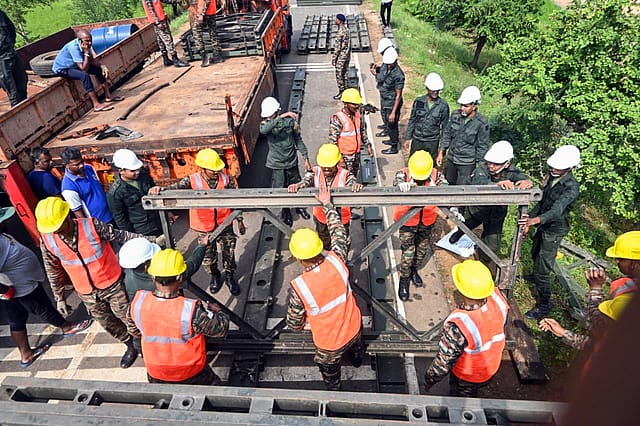
When Cyclone Ditwah tore through Sri Lanka, it left behind devastation on a near-historic scale. Within weeks, India stepped in with a $450 million reconstruction blueprint. This explainer breaks down what India is offering, why it matters, and how it reshapes India–Sri Lanka ties.
What exactly has India announced for Sri Lanka?
India has proposed a $450 million comprehensive assistance package to help Sri Lanka rebuild after Cyclone Ditwah. The package includes $350 million in concessional lines of credit and $100 million in direct grants, announced by External Affairs Minister S Jaishankar in Colombo
Why is this announcement being seen as a turning point?

Zeroing In on ECI
09 Oct 2026 - Vol 05 | Issue 41
Constitutional legitimacy versus political opportunism
Because of its scale, speed, and structure. This is not short-term relief. It’s a full reconstruction plan. It reinforces India’s role as the first responder in the Indian Ocean region and signals long-term commitment to Sri Lanka’s stability.
How severe was the damage caused by Cyclone Ditwah?
Cyclone Ditwah caused an estimated $4.1 billion in damage, roughly 4% of Sri Lanka’s GDP. Over 639 people were killed, nearly 2 million were affected, and large parts of the country’s roads, railways, and bridges were rendered unusable
What immediate help did India provide after the cyclone?
India launched Operation Sagar Bandhu the day the cyclone struck. It delivered 1,100 tonnes of relief material, medical supplies, rescue teams, helicopters, naval ships, and a field hospital that treated thousands of patients within days.
Which sectors will India’s $450 million package focus on?
The aid will prioritise roads, railways, and bridges; housing reconstruction; power and public infrastructure; and connectivity to tourism hubs. Infrastructure alone accounts for 42% of total cyclone damage, making it the core focus area.
How does India’s assistance compare with global aid?
India’s commitment is the largest bilateral package announced so far. By comparison, the World Bank has mobilised $120 million, while the IMF is considering additional support. India’s response dwarfs others in both speed and financial depth.
What does this mean for India–Sri Lanka relations?
The crisis has accelerated trust-building. Sri Lanka’s leadership has repeatedly acknowledged India’s role as a dependable neighbour. Bilateral trade already stands at $5.54 billion, with India remaining Sri Lanka’s largest trading partner.
Why is this strategically important for India?
The move reinforces India’s Neighbourhood First policy, strengthens maritime and defence cooperation, and counters regional influence competition—without coercion. It positions India as a problem-solver, not just a power.
How fast will reconstruction begin?
Indian officials have been directed by Prime Minister Narendra Modi to move quickly. Given the speed of Operation Sagar Bandhu, implementation is expected to begin without prolonged delays.
What does this mean for Sri Lanka’s recovery?
For Sri Lanka, this package offers more than money—it offers momentum. It bridges immediate recovery with long-term rebuilding, at a time when fiscal space and global goodwill are both limited.
(yMedia is the content partner for this story)