India Seen as ‘Reliable Partner’ as Shipping Risks Rise Amid Strait of Hormuz Tensions
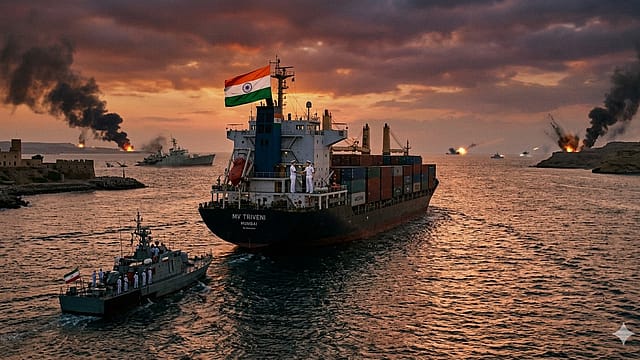
As tensions flare in the Strait of Hormuz, India finds itself navigating a delicate balance between diplomacy and maritime security.
Iran’s envoy has praised New Delhi as a “reliable partner,” even as geopolitical risks intensify and global shipping routes face renewed uncertainty.
What did Iran say about India amid rising tensions?
Iran’s Ambassador to India, Mohammad Fathali, struck a notably warm tone while addressing concerns around the Strait of Hormuz, calling India a trusted ally during a turbulent moment.
"We have a good relation with the Indian government, we want good preparation for Indian ships," he said, underlining Tehran’s intent to ensure safe passage for Indian vessels.
Reiterating this assurance, he added, “For Indian ships, you know that we have a good relation with the Indian government. We want good preparation for Indian ships. You know our Foreign Minister has described India as one of the five countries as a friend.”
Fathali also expressed gratitude toward both the Indian government and its people. “I want to thank all the Indian people. I believe that they have demonstrated that they are truly reliable and compassionate partners in times of hardship. I would like to thank the Government of India for facilitating all the necessary arrangements in this difficult time,” he said.

Open Minds 2026
26 Jun 2026 - Vol 05 | Issue 26
The power of ideas and arguments in 50 portraits
Fathali strongly defended Tehran’s position over the strategic waterway, asserting sovereignty while accusing Western powers of escalating tensions.
“Before the war, the Strait of Hormuz was open. They attacked us for days, and after that, they accepted a ceasefire. And they announced that we were on the negotiation table. And after that, they attacked us. They attacked schools and hospitals. This Strait is our territorial waters,” he said.
He further criticised the United States, stating, "For us, diplomacy is a continuation of the struggle of our defenders of Iran. We have not forgotten, and we will not forget US history breaches of commitments and ill intentions, because you know that we have so many experiences from the United States."
Referring to the escalation, he added, "In the twelve days' war, you have also heard and you have seen that Iran was in negotiation, and the Zionist (Israeli) regime and the United States started the attack."
The situation has worsened after US President Donald Trump announced a sweeping naval blockade. "Effective immediately, the United States Navy, the finest in the world, will begin the process of BLOCKADING any and all ships trying to enter or leave the Strait of Hormuz," Trump declared.
He warned further, "No one who pays an illegal toll will have safe passage on the high seas," adding that any hostile action would be "BLOWN TO HELL," with forces "LOCKED AND LOADED."
How is India responding to protect its ships and seafarers?
India has stepped up diplomatic and logistical efforts to safeguard its maritime interests. Even as tensions persist, the successful passage of the LPG tanker Jag Vikram marks a crucial breakthrough.
Union Shipping Minister Sarbananda Sonowal confirmed, "Update on Indian shipping operations. Indian-flagged vessel JAG VIKRAM, navigated by 24 Indian crew members, successfully sailed out of the Persian Gulf region on April 11, 2026."
The vessel, carrying 20,400 metric tonnes of LPG, is expected to reach Kandla, Gujarat, on April 14, highlighting the importance of maintaining supply lines, especially as nearly 90 per cent of India’s LPG imports come from the Gulf region.
Meanwhile, authorities are working to bring back other stranded ships. “We, in coordination with MEA, are trying, putting our efforts to bring our vessels back. And as soon as it is possible for our vessels to sail from the Strait of Hormuz, those vessels will come back. At present, a total of 15 Indian-flagged and Indian-owned vessels are there,” said Additional Secretary Mukesh Mangal.
He also reassured that, "We have received no report of any incident related to an Indian-flagged vessel in the last 24 hours. The Ministry has facilitated safe repatriation of more than 2177 Indian seafarers till now, including 93 seafarers in the last 24 hours."
Authorities confirmed that operations across Indian ports remain stable, with "no reports of any congestion," even as coordination continues with global stakeholders.
(With inputs from ANI)