Hungary Elections 2026: It Will Take Time and Vigilance to Dismantle Viktor Orbán’s System
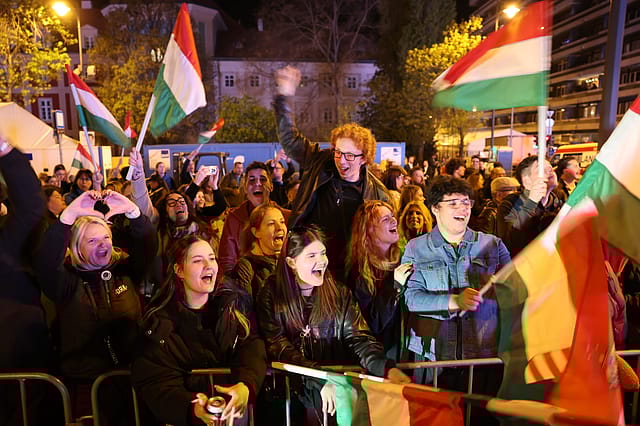
The Hungarian election that on Sunday, April 12, unseated Viktor Orbán after 16 continuous years in power has repercussions far beyond Hungary and the borders of the European Union (EU). It is, on the face of it, a defeat for the autocrat of Budapest and the authoritarian system he had built over the years. It is also the first major defeat for entrenched nationalist populism in Europe even as far-right parties prepare for office from Germany to France. It is a victory for those in Brussels and other European capitals worried about so-called democratic backsliding. It is a much-needed setback in the EU’s eyes for both Donald Trump and Vladimir Putin.
Having said that, it’s time to take of stock of reality. Orbán represents more than just one leader who went in a direction not conducive to EU interests and values. He built a system of favouritism and institutional capture that runs deep and will not be easy to dismantle. To begin with, it took an “insider” to defeat Orbán. Victorious Péter Magyar was a Fidesz member and Orbán loyalist till he decided enough was enough and went to nearly every Hungarian town and village to generate the groundswell that has ousted his former boss. He succeeded where others had repeatedly failed and the scale of the victory of Magyar’s Tisza party was unexpected as it heads for 138 seats against Fidesz’s 55. Granted, that’s five seats more than the two-thirds majority Magyar needed to initiate constitutional changes that would begin the process of dismantling the Orbán state.

Open Minds 2026
26 Jun 2026 - Vol 05 | Issue 26
The power of ideas and arguments in 50 portraits
But what is the Orbán state?
On paper, everything Orbán did was legal. Because he created the system that made it so. A democrat and liberal when the Soviet armies pulled back from the erstwhile East Europe in 1989, Orbán’s first stint as prime minister was from 1998 to 2002 but his return to power in 2010 had begun an era of democratic destruction through democratic institutions by capturing them—from education to state TV to the judiciary to law enforcement, Orbán filled nearly every institution and agency with party loyalists or people proclaiming fidelity to him. For example, Orbán has staffed Hungary’s Constitutional Court with loyalists with 12-year terms. Those judges and officials are still in office and, along with the presidency, have the power to delay and block new legislation. As academic Alberto Alemanno recently wrote in the EU Observer: “The primary issue that EU leaders consistently overlook is that Orbán did not just occupy Hungarian institutions. He legally rebuilt them to entrench his authority beyond the reach of elections. Experts call this ‘constitutional hardball’: the systematic use of formally legal instruments to make democratic reversal as difficult as possible.”
Tisza may have won its two-thirds majority, but it won’t be easy to reverse the democratic erasure of 16 years.
It might actually be easier to restore basic civil rights like freedom of speech and action as well as political criticism, which had increasingly disappeared from the Hungarian public space under Orbán. But Magyar is not yet trusted by the whole electorate, even many of those who voted to end Orbán’s reign. Magyar might find the two-pronged problem of bureaucratic and judicial obstruction and a re-democratised public sphere too much to handle. Voters would remember why they have voted for him: the corruption and authoritarianism of Fidesz, but more importantly, the economy.
Russian gas was one of Orbán’s purported reasons for breaking with Brussels—and he reneged on a €90bn loan for Ukraine—even as EU members were trying to end their reliance on Russian energy imports. But Orbán still oversaw an economic slowdown, which had stagnated by the time of Magyar’s landslide win on Sunday. Growth was only 0.4 per cent in 2025 while food prices were 43 per cent higher, although the inflation after his friend Vladimir Putin’s invasion of Ukraine—Hungary had the highest in the EU at 17.1 per cent in 2023—had cooled. Despite Hungarians’ eroded freedoms and constricted lives, it was the economy that, in the end, sped up Orbán’s downfall.
As for a Trump administration already furious with the US’ EU partners and NATO allies, the incongruousness of a US vice president campaigning in a foreign election, asking people to choose sides, was perhaps grounded on another misreading of the situation. This time, it wasn’t about overestimating the potential of public agency but underestimating public anger.
To return to Brussels, the EU errs in relaxing as soon as an autocrat or a quasi-autocratic system is electorally defeated. In Poland, liberal Prime Minister Donald Tusk finds himself gridlocked in a system that did not collapse with his electoral victory in 2023. The EU did not build a process that would ensure the reversal of privileges and networked institutions that continue to do the bidding of a party no longer in office. Alemanno warns: “Magyar would inherit the full hardball architecture, and a defeated Orbán would not be a neutralised Orbán. Freed from governing constraints and backed by Russian resources and American political endorsement, Orbán would have every incentive to use his deep state of loyalist judges and officials to obstruct a new government. Without external support, a Magyar administration could be paralysed before it can demonstrate that democratic governance works.”
Magyar has asked the European Commission to unblock €17 billion of funds frozen for corruption and lack of judicial independence. But the EU cannot make the mistake of releasing the money and sitting back. It must provide Magyar with the tools, an architectural framework, to reconstruct democracy in Hungary and to politically realign and morally reintegrate it with the EU.
Failure to do that or a return to complacency would let Putin still have the last laugh. And JD Vance might get the idea that his trip to Budapest was not wasted after all.
There was historical symbolism and irony in Magyar’s camp celebrating in Batthyány Square in Buda—the hillier, quieter, bourgeois half of the capital with its royal castle and all its history—and Orbán gathering his lot at the Bálna centre in Pest—the cosmopolitan heart of modern Hungarian life, boasting 19th-century boulevards, the parliament, and all the nightlife. Tisza must own Pest where the future moved into almost two centuries ago, long before the cities were unified in 1873.