How US forgot what Kissinger learnt in Rhodesia
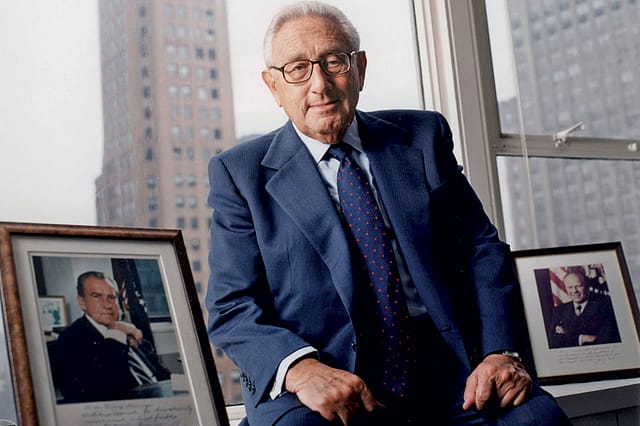
Legendary American diplomat, thinker and author Henry Kissinger’s record as a negotiator is often regarded as patchy and he is criticized for an over-reliance on secretive methods. The Vietnam war negotiations are in particular seen as a case where talks dragged on years and the final result was not very different from what might have been achieved much earlier. Yet, in the late 1970s, Kissinger persuaded Rhodesia’s strongman Ian Smith, a former World War II fighter pilot, to dismantle the apartheid regime he had presided over for 15 years without too much fuss leading to black majority rule in a country now known as Zimbabwe.
In their insightful book “Kissinger the negotiator: Lessons from dealmaking at the highest level,” James Sebenius, Nicholas Burns and Robert Mnookin – who can between them boast of considerable experience of negotiation – point out that Smith was a tough nut. He had twice been summoned to the decks of British aircraft carriers by prime ministers Harold Wilson and Edward Heath and cocked a snook at both. As late as 1976, he had defiantly declared that white minority rule will continue forever dismissing calls to end apartheid, saying “not in a thousand years.” Yet, three years later he threw in the towel and without much fuss in the end.

Open Minds 2026
26 Jun 2026 - Vol 05 | Issue 26
The power of ideas and arguments in 50 portraits
The Rhodesia Example
The point of the story as told by the authors was that Smith was a strong-willed character who bristled at being talked down to. He resented the “summons” issued to him by British leaders and rejected suggestions and he should sign on the dotted line. From the time he first met Smith, Kissinger made sure he did not come across as dictatorial. As he carefully plotted the negotiations, Kissinger zeroed in on getting Smith’s biggest backer and Rhodesia’s economic lifeline – the neighbouring fellow apartheid state of South Africa – to push Smith towards ceding power. He also displayed the perspicacity of ensuring complete unanimity among Rhodesia’s neighbours, where majority rule had been established, on Smith’s removal.
The key principle that you must make a nation or a leader being asked to accept concessions see the outcome as a mix of benefits and the best possible deal may seem an obvious mantra. But its application needs perseverance and skill. Getting South Africa to lean on Smith despite knowing full well that democracy in Rhodesia would sharpen similar demands at home was no mean feat. Kissinger did so through a combination of pressure tactics and offering economic and security advantages. The whites in Rhodesia felt they had been thrown to the wolves but came around to seeking guarantees once it became apparent that they were out of options.
China’s Leverage
In the case of Iran, the one nation with leverage to persuade the zealots running the country that there is zero global support for its nuclear weapons ambitions is China. Reports do suggest China had a role in persuading Iran to agree to face-to-face talks held over the weekend in Islamabad but it is unclear how far President Xi Jinping will go to convince Tehran that “no deal” is not in its interest. That the current stalemate due to Iran’s ability to hold up oil and gas flowing through the Strait of Hormuz can only be a temporary situation. A renewed American and Israeli offensive cannot be ruled out and looking at the underside of a B 52 is a distinctly unattractive prospect.
A key driver for US President Donald Trump agreeing to halt the war was the urgent feedback he received from Gulf allies. “Do you want to finish Iran or do you want to finish us” was the question Gulf Arab states posed after Iran’s retaliatory attacks across the region. While the sense of alarm among Gulf nations is palpable and Iran does indeed have a few cards to play, the war has only paused and the situation in West Asia remains highly unstable. While it can be argued that continued closure of the Strait will increase pressure on Iran’s adversaries, the converse is also true – the rest of the world will not put up with the blockade indefinitely. A conference being organized by the United Kingdom will see non-US allies discuss ways and means to reopen the Hormuz.
Back to the Drawing Board
Trump’s declaration of a counter-blockade of the Persian Gulf may make Iran think again, but it is the very opposite of what the US had hoped to achieve in the Islamabad talks. It is apparent that little preparation was done ahead of the talks between teams led by US Vice President J D Vance and Speaker of the Iranian Parliament Mohammad Qalibaf. No one expected a dramatic breakthrough given the mutual distrust and deeply conflicting demands aired by the two sides. Yet, finding ways to stabilize the current ceasefire and framing points for discussions going ahead should have guided the talks that ended without even a token promise to meet again.
The US will need to make more efforts to engage China but not need depend on appealing to Beijing’s altruism, something Xi and Co are not known for. Though no country, even America’s NATO (North Atlantic Treaty Organisation) allies joined Trump’s war on Iran, there is a strong consensus on reopening the Strait of Hormuz. The Gulf Cooperation Council (GCC) states acting in coordination with major European powers and Asian partners such as India can generate significant pressure and it will not be in China’s interest to be seen as aloof or insensitive to the sentiment. Iran’s leaders are counting on a nationalistic and religious fervor in time of war to bolster their rule but things can change if the crisis drags on. After all, it was a severe economic shock caused by a falling Rial that led to widespread protests not long ago. Though the regime in Tehran has demonstrated remarkable resilience, Iran’s economy is in a shambles
To begin with US declared war on Iran without a thought to the repercussions for Gulf Arab states. Then after the ceasefire it did not build clarity and consensus in the region ahead of engaging with Iran and, of course, also did not close the gaps in perceptions and objectives with China.