India-Poland trade target: Can Poland become India’s gateway to Europe by 2030?
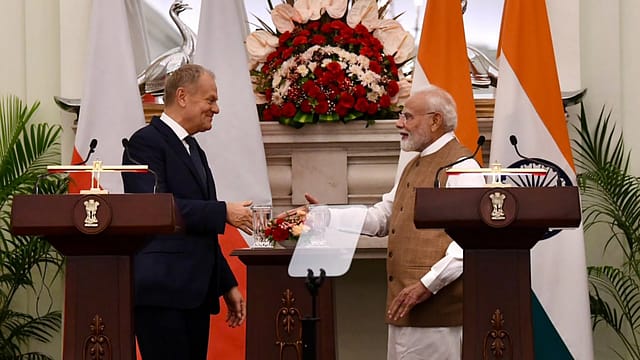
For Indian businesses looking to expand in Europe, Poland could be more than another export destination. It could be a launchpad into Central and Eastern Europe, connecting Indian companies with customers, industrial partners and supply chains across the region.
That opportunity was central to discussions between Prime Minister Narendra Modi and Polish Prime Minister Donald Tusk on Thursday, October 22, when the two leaders agreed to aim to double bilateral trade by 2030. Their joint statement called for closer cooperation across manufacturing, pharmaceuticals, defence, technology, energy and infrastructure, while urging progress on the India–European Union Free Trade Agreement (FTA).
The ambition is significant. But can a stronger relationship with Poland translate into a bigger foothold for Indian businesses across Europe?
Why is Poland important to India’s European trade ambitions?
India’s official figures put bilateral trade with Poland at $6.36 billion in 2025, up from $1.95 billion in 2013. That represents an increase of about 192 per cent over the period, according to the Embassy of India in Warsaw. Poland is also India’s largest trading and investment partner in Central and Eastern Europe.

Losing Memory
16 Oct 2026 - Vol 05 | Issue 42
The making of a medical and social emergency
The relationship already has a business foundation. Indian exports to Poland include textiles and apparel, pharmaceuticals, chemicals, engineering goods and electrical machinery. Indian IT companies, including Tata Consultancy Services, Infosys, Wipro and HCL Technologies, also have a presence in the country.
For these firms, Poland offers a base from which to develop regional operations and serve European customers. But being located in Poland does not automatically guarantee access to every European market: businesses must still navigate relevant EU rules, product standards and national requirements.
Could the India-EU FTA give Indian companies a bigger opening?
The proposed trade agreement between India and the European Union is an important part of the picture. Negotiations concluded in January 2026, creating the possibility of a wider framework for trade and investment between the two economies. The agreement must still go through the applicable signing and ratification procedures before it can take effect.
In their joint statement, Modi and Tusk pressed for the agreement’s prompt signing and ratification, followed by timely implementation. They said it could open new markets, encourage investment and strengthen supply chains.
For Indian exporters, improved market access could make sectors such as textiles, pharmaceuticals, engineering and manufacturing more competitive. The precise benefits, however, will depend on the final terms, implementation and the ability of companies to meet European regulatory requirements.
Which Indian industries could benefit from a stronger Poland partnership?
The trade opportunity extends beyond goods already crossing the border. At their meeting, Modi and Tusk encouraged businesses to explore partnerships in industrial machinery, pharmaceuticals, infrastructure, defence, mining, energy and information technology. They also highlighted cooperation in artificial intelligence, semiconductors, quantum technology and space.
The potential is not limited to Indian companies selling products in Poland. Joint ventures, research partnerships and local operations could help businesses develop long-term European relationships. According to India’s embassy in Warsaw, Indian investment in Poland exceeds $3 billion, with Indian companies active in manufacturing, pharmaceuticals and technology.
For the partnership to grow, however, businesses will need more than political support. They will need reliable local partners, knowledge of European regulations and a clearer understanding of where demand exists.
What could hold back India–Poland trade growth?
The doubling target is an ambition, not a guaranteed outcome. Bilateral trade stood at $6.36 billion in 2025, according to Indian official figures. Doubling that baseline would imply trade of around $12.72 billion by 2030, assuming the same measurement basis.
The challenge is turning broad agreements into actual contracts, investments and repeat business. Regulatory requirements, competition from established suppliers, logistics costs and differences in market demand can all affect how quickly companies expand.
The EU–India FTA could improve the commercial environment, but it will not remove every barrier. Nor does Poland’s position within the European Union automatically make it a frictionless gateway to every member state. Companies will still have to meet relevant rules and build their own distribution and customer networks.
Can Poland become India’s gateway to Europe by 2030?
The groundwork is already there: growing bilateral trade, established Indian companies in Poland and a political commitment to deepen economic cooperation. The leaders’ focus on supply chains, small businesses, technology and investment suggests they want the relationship to extend beyond a simple exchange of exports and imports.
The next test is whether businesses can turn that agenda into measurable results. Progress on the India–EU FTA, stronger company-to-company partnerships and concrete investments will matter more than the headline target alone.
Poland could become a valuable European base for Indian companies. Whether it becomes a gateway at scale will depend on how effectively both countries turn diplomatic goodwill into commercial opportunities before 2030.
(With inputs from ANI)