India Condemns Strike on Ship in Strait of Hormuz That Injured 11 Indian Crew Members
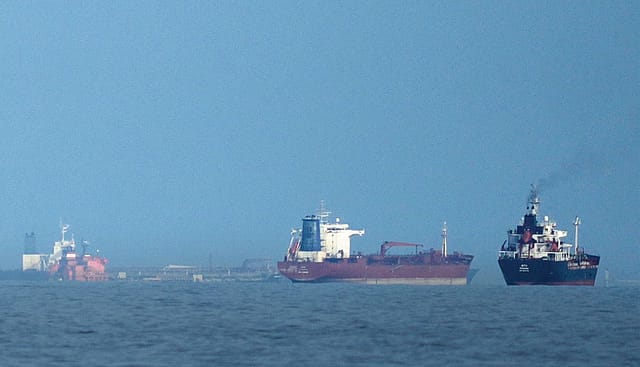
India on Tuesday condemned a projectile strike on the Panama-flagged commercial vessel MT On Peace in the Strait of Hormuz, which injured 12 of its 19 crew members, 11 of them Indian nationals, and called for an immediate cessation of attacks on civilian infrastructure and seafarers.
"We condemn the attack earlier today on a Panama-flagged commercial vessel MT On Peace (IMO 9893204) off the coast of Oman, where it was struck by a projectile while transiting the Strait of Hormuz.
Of the total crew of 19, 17 are Indian nationals," the Ministry of External Affairs (MEA) said in a statement. The ministry did not say who carried out the attack, and has not named the nationalities of the other injured crew.
The injured were evacuated with the help of Omani authorities and are being treated in Khasab, Oman. "We thank the Omani authorities for their valuable support," the MEA said.

The Modi Years
02 Oct 2026 - Vol 05 | Issue 40
A Nation Rebuilt
The ministry said continuing attacks on shipping in the region remain a cause of "deep concern."
"We reiterate our call for an immediate cessation of such attacks in the interests of peace and stability in the region," it said.
"The targeting of commercial shipping, seafarers and civilian infrastructure in the region must end, and navigation and commerce through international waterways must be restored at the earliest," the statement added.
A SEPARATE INCIDENT ON MONDAY
The strike followed a separate incident on Monday, when the United Kingdom Maritime Trade Operations (UKMTO) reported that a commercial tanker heading inbound through the strait was forced to turn around after being hailed and threatened by Iran's Islamic Revolutionary Guard Corps (IRGC). It happened at about 08:27 UTC, roughly 11 nautical miles north of Khasab.
UKMTO said the IRGC warned the vessel it would be targeted if it did not comply. The master confirmed the crew changed course. UKMTO is investigating and has advised ships in the region to exercise extreme caution. The agency's advisory does not link the two incidents.
JAISHANKAR RAISED THE ISSUE AT UN
External Affairs Minister S Jaishankar raised the issue last week in his address to the 81st UN General Assembly. "There have been attacks on commercial shipping and seafarers in the Gulf and from the Red Sea to the Black Sea. Indian seafarers have lost their lives, as have others from other nations. This is completely unacceptable," he said.
He said India had joined Liberia and 23 partner nations in a coalition to mobilise global opinion and defend shipping routes, and urged restraint and de-escalation in the Gulf to protect civilian crews and keep energy supplies and trade flowing.
HOW THE STRAIT BECAME A WAR ZONE
Attacks on shipping around Hormuz have been a feature of the conflict since it began early in 2026. After US and Israeli strikes on Iran, in which Supreme Leader Ayatollah Ali Khamenei was killed, the IRGC declared the strait closed to international navigation. Major shipping lines, including Maersk, suspended transits.
The first ship attacked was the Palau-flagged tanker Skylight, hit near Khasab on March 1. Oman said 15 of its 20 crew were Indian and all were evacuated.
The number of ships attacked in the war records two dead and four injured on that vessel, and later strikes on other ships, including a tug that sank, a Thai bulk carrier on which three crew died, and at least one Indian crew member killed.
WHY IT MATTERS FOR INDIA
The strait is one of the world's most important chokepoints for oil and liquefied natural gas. Most of India's crude imports pass through it, and the government has linked the disruption to higher wholesale inflation.
Wholesale price inflation was 9.92 per cent in August. Indian seafarers, who crew many foreign-flagged ships, have also been among the casualties.
With inputs from ANI