India-Brazil Trade Set for Major Expansion: What It Means
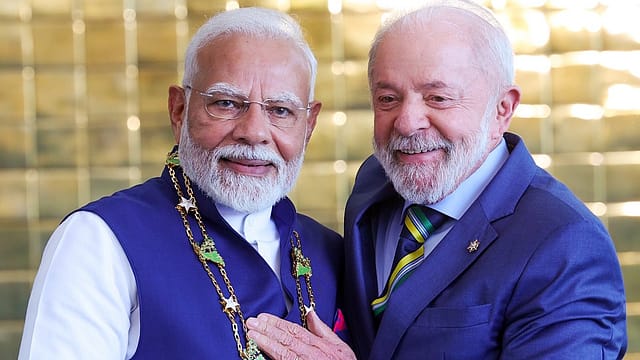
Brazil is intensifying its economic engagement with India, aiming to lift bilateral trade to USD 20 billion by 2026, as President Luiz Inácio Lula da Silva’s visit signals a renewed focus on South-South cooperation, investment, and market access
During President Lula’s visit, Brazil hosted the India-Brazil Business Forum 2026 and inaugurated the first office of ApexBrasil in New Delhi to boost exports and strengthen its commercial footprint in India. The move reflects growing confidence in India’s expanding consumer base, rising energy and food demand, and rapid infrastructure development.
Bilateral trade reached USD 15.2 billion in 2025, marking a 25 per cent year-on-year increase. Both sides now aim to scale this up to USD 20 billion by 2026 and diversify traded products, according to Brasil 247. President Lula has described India and Brazil as natural partners, citing shared democratic values, cultural diversity, and expanding economies.
The Modi Years
02 Oct 2026 - Vol 05 | Issue 40
A Nation Rebuilt
Brazilian exports to India touched USD 6.9 billion in 2025, the highest level in two decades, led by sugar, crude oil, vegetable oils, cotton, and iron ore. ApexBrasil has identified 378 new export opportunities spanning minerals, machinery, food products, health technology, and renewable energy. Agricultural inputs and industrial equipment for agribusiness and power generation have emerged as priority segments.
How Will the Partnership Expand Going Forward?
While Brazil is ramping up exports, India continues to strengthen its presence in the Brazilian market. Indian shipments to Brazil stood at USD 8.4 billion in 2025, driven by pharmaceuticals, chemicals, and auto components. This reflects India’s growing role as a supplier of higher value-added goods.
Investment ties are also deepening. Indian foreign direct investment in Brazil has reached USD 2.1 billion, with new industrial collaborations taking shape across manufacturing and infrastructure. These flows are reinforcing long-term economic integration between the two countries.
The partnership is supported by institutional frameworks such as the Mercosur-India Preferential Trade Agreement and multilateral platforms including BRICS, G20, BASIC, and IBAS. These platforms underscore the growing strategic importance of South-South cooperation in shaping global trade and development.
With expanding trade volumes, diversified exports, and rising investments, India and Brazil are positioning their partnership as a key pillar of economic collaboration among emerging economies in the coming years.
(With inputs from ANI)