India at UN: Pay Dues on Time, Keep Nuclear Weapons Decisions Under Human Control
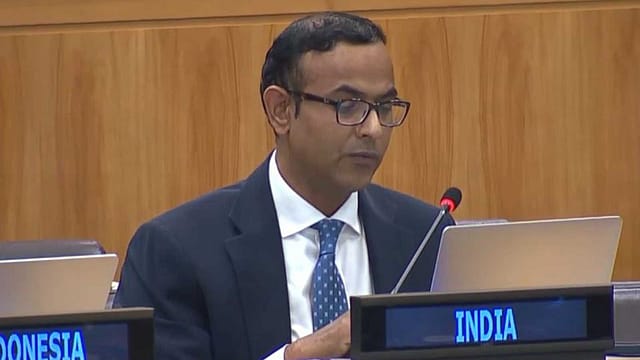
India has urged United Nations member states to clear their outstanding contributions and separately called for legally binding measures towards nuclear disarmament, stressing that decisions on using nuclear weapons must remain under human control.
The positions were outlined in statements to two UN General Assembly committees on Monday. Counsellor Surendra Adhana addressed the organisation’s financial situation at the Fifth Committee, while Congress MP Manish Tewari delivered India’s statement on nuclear weapons at the First Committee.
INDIA FLAGS UN’S CASH CRUNCH
Adhana said India had consistently paid its assessed UN contributions in full, on time and often in advance. He urged other member states to fulfil their obligations to ensure the organisation could carry out its mandates effectively.
“Full, timely and unconditional payment of assessments is a Charter obligation of every Member State,” India’s Permanent Mission said in a post on X highlighting his remarks.
Zeroing In on ECI
09 Oct 2026 - Vol 05 | Issue 41
Constitutional legitimacy versus political opportunism
Adhana expressed concern over uncertain collections and low cash balances, saying stronger receipts in the third quarter needed to be sustained.
By September 30, 141 member states had paid their assessments in full, compared with 136 a year earlier. Unpaid regular-budget assessments had fallen to $1.46 billion from $1.87 billion, but Adhana said the outstanding amount remained unacceptably high.
“Over 90 per cent of the regular budget arrears are owed by one member state,” he said, without naming the country in the statement provided.
PEACEKEEPING ARREARS RISE
The financial picture for peacekeeping operations had worsened. Unpaid assessments rose to $4.1 billion from $3.7 billion a year earlier, while collections remained around $1.4 billion.
“Two member states alone account for roughly 88 per cent of this amount,” Adhana said.
Outstanding assessments for UN tribunals also increased to $87 million, with two countries accounting for more than 80 per cent.
As a troop-contributing country, India welcomed the settlement of troop and contingent-owned equipment claims for active peacekeeping missions. It sought prompt payment of the remaining $30 million relating to closed missions.
Adhana urged countries, particularly those with the financial means, to act quickly, saying adequate and timely resources were essential for the UN’s work.
HUMAN CONTROL OVER NUCLEAR DECISIONS
At the First Committee, Tewari highlighted risks arising from the integration of artificial intelligence into nuclear command and control systems.
“India acknowledges that the use of artificial intelligence in nuclear command and control raises real questions,” he said. “We espouse the principle that the decision to use nuclear weapons should be taken by humans.”
He reiterated India’s commitment to nuclear disarmament that is “universal, non-discriminatory, and verifiable”, pursued through a step-by-step multilateral process.
Tewari also reaffirmed India’s policy of credible minimum deterrence, with a posture of no first use and non-use against non-nuclear weapon states.
“We are prepared to convert these undertakings into multilateral legal arrangements,” he said, adding that India’s capabilities reflected its security environment and were not directed against any specific actor.
LEGALLY BINDING ASSURANCES SOUGHT
India called for legally binding assurances protecting non-nuclear weapon states against the use or threat of use of nuclear weapons. Tewari said such guarantees could reduce insecurity and strengthen non-proliferation.
He reaffirmed India’s voluntary unilateral moratorium on nuclear testing and sought support for two resolutions it traditionally introduces at the First Committee.
The first, Reducing Nuclear Danger, calls for measures to lower the risk of accidental or unintended nuclear use, including taking weapons off hair-trigger alert and removing designated targets. The second seeks negotiations on an international convention prohibiting the use or threat of use of nuclear weapons.
Tewari said the Treaty on the Prohibition of Nuclear Weapons did not create obligations for India, while reiterating New Delhi’s commitment to global disarmament and non-proliferation.
He also stressed the need for international cooperation to prevent terrorists and other non-state actors from accessing nuclear weapons, materials and technology.
With inputs from ANI