India and Israel Vote Against Pakistan-Backed UN Arms Control Resolution
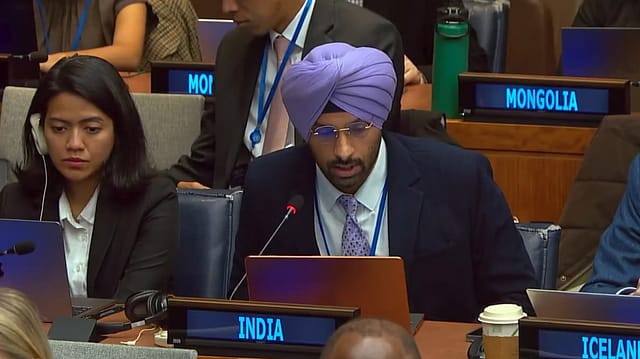
India and Israel were the only two countries to vote against a draft resolution on conventional arms control at the regional and subregional levels, tabled at the United Nations by Pakistan and Belarus. The text was adopted in the UN General Assembly’s First Committee, which deals with disarmament, by 180 votes to two, with no abstentions.
India told the committee that national security concerns cannot be confined within regional boundaries.
WHAT INDIA SAID
Anmol Sher Bedi, First Secretary at India’s Permanent Mission to the UN, said conventional arms control is a global matter. “We are not fully convinced that it should be pursued primarily in regional and sub-regional contexts,” he said in the explanation of vote, adding that this is consistent with India’s long-held position.

The Era of Forever Wars
30 Oct 2026 - Vol 05 | Issue 44
Coping with an explosive Middle East
He objected to the resolution’s approach of maintaining a balance of defence capabilities in a region or subregion. “This assumes that the security concerns of States politely stop at their regional borders. They do not,” Bedi said. “Those concerns, as everyone understands for well-known reasons, extend beyond narrowly-defined regions and subregions. More importantly, the notion of preserving balance in a region or a subregion appears unrealistic.”
“WE READ THIS REQUEST WITH CURIOSITY”
India also questioned the text’s request that the UN Disarmament Commission draw up principles that could act as a framework for regional agreements on conventional arms control. “We read this request with a certain degree of curiosity,” Bedi said.
The commission, he noted, has already reached consensus on the issue three times: guidelines on regional disarmament in 1993, guidelines on conventional arms control and disarmament in 1999, and practical confidence-building measures on conventional weapons in 2017.
“That makes three consensus outcomes on this very subject in the very body now being asked to start from scratch,” he said. “We fail to understand why a subject already deliberated at length needs another round of deliberation unless the aim is to keep the UN disarmament machinery busy.”
India also voted separately against a paragraph that notes with “particular interest” regional initiatives, including talks among Latin American countries and “the proposals for conventional arms control made in the context of South Asia.” The paragraph recognises the importance of arms limitation for regional stability.
WHAT THE TEXT SAYS
The resolution argues that conventional arms control should mainly be pursued through regional and subregional frameworks, since most threats to international peace in the post-Cold War period arise among neighbouring states.
It expresses a desire to promote agreements that strengthen regional security “at the lowest possible level of armaments and military forces,” and says “militarily significant States and States with larger military capabilities have a special responsibility” in such agreements.
NOT A NEW FIGHT
The resolution comes up every year, and India has voted against it for years. In 2017, India was the lone “no” in the General Assembly, which adopted it 184 to 1 with two abstentions. In 2024, a version sponsored by Pakistan and Syria was adopted in the First Committee with 179 votes in favour, India the only vote against and Israel abstaining. This year, Israel joined India in voting no.
With inputs from ANI