How Trump Used Davos to Reframe Power, Trade and Security
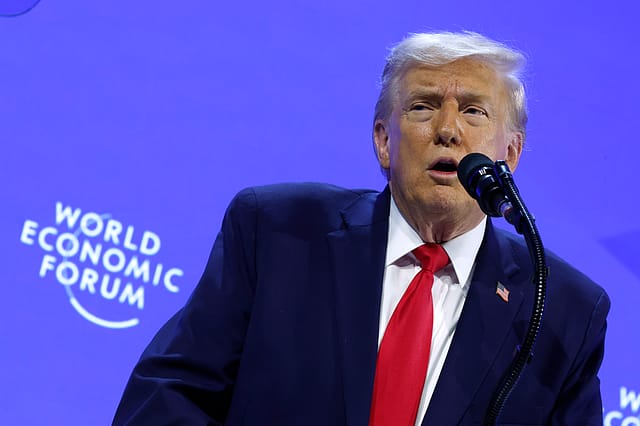
Donald Trump’s remarks on Greenland marked one of the most unsettling moments of Davos, not because of their aggression alone, but because of their logic.
After earlier suggesting that the United States could take control of Greenland by force, Trump softened his tone during a meeting with NATO Secretary General Mark Rutte. But the retreat was rhetorical, not substantive. Greenland, Trump insisted, remains vital to US national security, particularly as the Arctic opens up to new shipping routes, military positioning and resource extraction.
“It’s better that we have Greenland than not,” Trump said, framing the issue not as a violation of sovereignty but as a strategic necessity for the West. He argued that American presence would protect Europe as much as the United States.
Trump announced work on a “framework” for Greenland and Arctic security, which could include expanded US military bases and revisions to the 1951 US–Denmark defence agreement. Crucially, this approach stops short of annexation while still advancing American control, an evolution from forceful threat to coercive diplomacy.
The subtext was clear: territory still matters, and in Trump’s worldview, power confers entitlement.
Tariffs as Geopolitical Currency
Trump’s treatment of tariffs at Davos made one thing unmistakable: trade policy is no longer economic. It is strategic.
Earlier threats of 10% tariffs by February 2026 and 25% by June on European goods were quietly shelved after discussions on Greenland progressed. Trump made no attempt to hide the transactional logic. Tariffs, he said, are not punishments but tools to bring countries to the table.

India's Action Hero
27 Mar 2026 - Vol 04 | Issue 64
Riding the Dhurandhar Wave
This was not a rejection of global trade but a redefinition of it. Cooperation earns relief. Resistance invites cost.
Trump framed tariffs as leverage, not ideology, repeatedly stressing that economic pain is an acceptable means to secure political outcomes. At Davos—a forum built on multilateral consensus—this unapologetic transactionalism landed like a rupture.
$600 Billion, Apple, and Economic Nationalism
Trump’s economic argument rested heavily on numbers and confidence.
He claimed the United States is on track to collect $600 billion in tariff revenue, with expectations of significantly more in the coming year. According to Trump, these revenues are not merely fiscal windfalls but instruments reshaping corporate behaviour.
Pointing to Apple’s $650 billion investment commitment and expansions by companies such as Toyota, Trump argued that tariffs are successfully forcing global firms to invest in American manufacturing and supply chains.
For Trump, this validates his long-held belief that globalisation hollowed out US industry and disadvantaged American workers. Tariffs, in his telling, correct that imbalance—not by retreating from markets, but by reasserting national leverage.
At Davos, the pitch to global business leaders was simple: if you want access to the American market, build in America.
Ukraine, Russia, and the Limits of American Obligation
On geopolitics, Trump struck a familiar but deeply consequential tone.
He said Russia and Ukraine are “reasonably close” to a deal, despite “tremendous hatred” between Presidents Vladimir Putin and Volodymyr Zelenskyy. Trump portrayed himself as an active intermediary, claiming he had helped settle multiple wars and was now engaging directly with both sides.
Yet even as he spoke of peacemaking, Trump distanced the US from responsibility for the conflict. Ukraine, he said, is Europe’s problem, not America’s. “We’re very far away,” he noted, reiterating his belief that NATO allies have taken advantage of US security guarantees.
This framing recasts American leadership as conditional and selective. Influence, yes. Obligation, no.
Trump’s message was not isolationism, but cost-conscious dominance: America will shape outcomes, but only on its own terms.
(With inputs from ANI and yMedia)