Hormuz, Again: Trump Calls It ‘American Territory’; Iran Warns of a Return to ‘Colonialism’
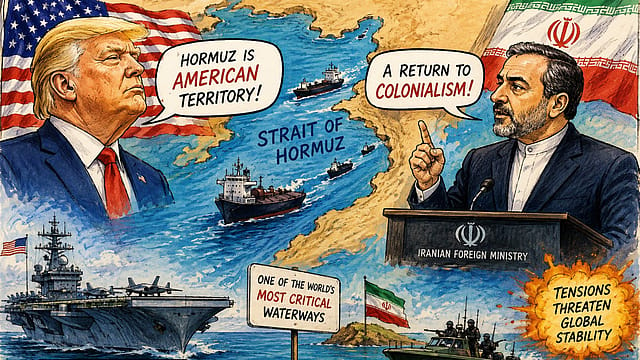
The Strait of Hormuz is only about 33 kilometres wide at its narrowest point.
Yet this narrow stretch of water has once again become the centre of one of the world's most dangerous geopolitical confrontations.
On one side is US President Donald Trump, who has called Hormuz "American territory," insisted the United States has "total control" over the strategic waterway and vowed that Iran will "never" obtain a nuclear weapon.
On the other side is Iran, which has responded with fury, accusing Washington of economic warfare, unlawful sanctions and what it calls a return to "full-scale classic colonialism."
What is unfolding is no longer simply a dispute about sanctions.
It is becoming a battle over who gets to dictate the rules of trade, security and power in one of the world's most strategically important regions.

Zeroing In on ECI
09 Oct 2026 - Vol 05 | Issue 41
Constitutional legitimacy versus political opportunism
Why Is The Strait Of Hormuz Suddenly Back At The Centre Of Global Politics?
If oil is the lifeblood of the global economy, Hormuz is one of its most critical arteries.
Before the current crisis, roughly a fifth of the world's traded oil and liquefied natural gas moved through the strait, making it one of the most important shipping routes on the planet.
That is why every statement about Hormuz reverberates far beyond Washington and Tehran.
When Trump recently told supporters in South Carolina that he viewed the Strait of Hormuz as "American territory," the remark immediately triggered reactions across the Middle East and energy markets. According to Reuters, Trump also reiterated that Iran would never be allowed to acquire a nuclear weapon and suggested the United States effectively controls the region through its military presence and blockade operations.
"We cannot let them have a nuclear weapon; we cannot let Iran have a nuclear weapon, or you will see some very bad things."
"They want to make a deal so badly, we don't even know if we want [a deal] because I view the Strait of Hormuz as an American territory right now, it's an American territory."
The comments followed weeks of increasingly provocative rhetoric from Washington about control of the waterway. Reuters previously reported Trump had also floated the idea of formally declaring Hormuz a US territory.
Why Is Iran Calling This 'Colonialism'?
For Tehran, the issue is no longer merely sanctions.
It is sovereignty.
Iranian Foreign Ministry spokesperson Esmaeil Baqaei reacted sharply after Washington announced what Trump described as the "most crushing economic operation ever taken" against Iran. The sanctions target Iranian oil networks, financial channels, shipping operations and entities accused of helping Tehran evade restrictions.
Baqaei accused Washington of trying to impose its authority not only on Iran but on every country that does business with it. "The United States' declaration of new economic sanctions on Iran is far more than continued unlawful 'economic warfare' against a single country. It is an assertion of extraterritorial sovereignty over every independent Member State of the United Nations."
He argued that secondary sanctions have no basis in international law and undermine the principle of sovereign equality enshrined in the UN Charter.
Then came his most striking warning. "The end result would be the complete erosion of sovereignty as the foundational basis of the UN-based inter-State system, and a recipe for an abysmal return to full-scale classic colonialism."
For Iran, Trump's comments about Hormuz and Washington's expanding sanctions campaign are part of the same story: a larger attempt to dictate how other nations trade, finance and conduct foreign policy.
What Happened To The US-Iran Deal?
That is where the story becomes even more complicated.
Just two months ago, there appeared to be a path toward de-escalation.
United States and Iran had reportedly reached a June memorandum of understanding designed to extend a ceasefire, reopen Hormuz and create a framework for broader negotiations.
It did not last.
Disputes over the Strait of Hormuz, sanctions relief and Iran's nuclear programme quickly derailed the process. Trump later declared the agreement "over," while Iran suspended its participation.
Today, both sides appear further apart than they were when the agreement was signed.
Iran's Parliament Speaker Mohammad Baqer Qalibaf has said the strait will not be fully reopened until Washington lifts sanctions, releases frozen Iranian assets and ends military pressure.
Trump, meanwhile, says no talks are currently taking place.
Why The Rest Of The World Is Watching Closely
The US-Iran confrontation rarely stays confined to the two countries involved.
Oil markets are already reacting.
Crude prices reportedly climbed as hopes for a diplomatic breakthrough faded and concerns about supply disruptions grew. Tanker traffic through Hormuz remains significantly below normal levels, creating uncertainty for energy markets and shipping companies worldwide.
There are also signs that the sanctions campaign is beginning to bite. Reuters reported that Iranian oil exports to China have fallen sharply since the latest US measures took effect, squeezing one of Tehran's most important sources of revenue.
That means the consequences are no longer theoretical.
They are already showing up in trade flows, energy prices and global markets.
The Real Fight Isn't About A Waterway
At first glance, this looks like a dispute over a narrow shipping lane.
It is much bigger than that.
Trump says the issue is preventing Iran from obtaining a nuclear weapon and maintaining security in a strategically vital region. Iran says the issue is sovereignty and resistance to economic coercion.
Both sides are talking about Hormuz.
But what they are really arguing about is power.
Who controls global trade routes?
Who sets the rules?
And how far can one country go in enforcing its will beyond its own borders?
For now, there are no negotiations scheduled, no breakthrough in sight and no sign that either side is preparing to back down.
Which is why the world's attention has returned to a narrow stretch of water between Iran and Oman.
Because history has a habit of reminding us that some of the biggest geopolitical storms begin in surprisingly small places.
(With inputs from ANI)