Global Tensions Rise as Russia Urges End to Persian Gulf Hostilities
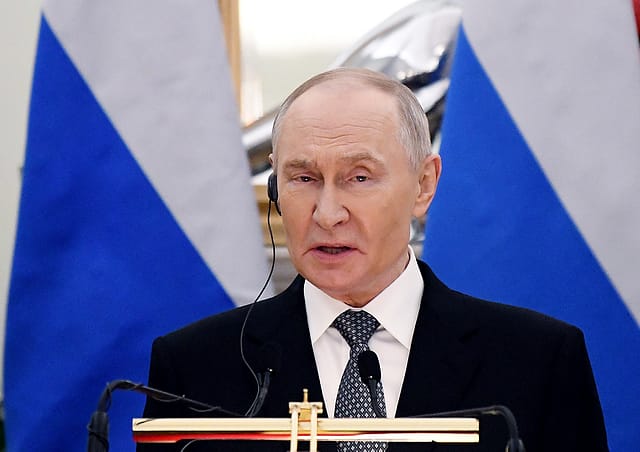
As tensions surge in the Persian Gulf, Russia has issued a sharp call for peace, warning that a rapidly expanding conflict risks spiralling into a wider geopolitical crisis.
Moscow has voiced deep concern over what it described as an “ongoing armed confrontation” in the Persian Gulf, warning that the situation is rapidly deteriorating.
In a statement, the Russian Foreign Ministry said, “Moscow is seriously concerned over the ongoing armed confrontation in the Persian Gulf and the risks of escalation. The scale of damage to energy and other critical infrastructure in Iran and neighbouring Arab states continues to grow.”
The remarks come as tensions between United States, Israel and Iran continue to intensify, with infrastructure damage and military activity spreading across the region.
What has Russia demanded from the US and Israel?
Taking a firm stance, Moscow called for an immediate halt to military operations, describing them as unjustified.
“We call for an immediate cessation of hostilities resulting from the unprovoked aggression by the US and Israel against Iran,” the Ministry said.
It further stressed that de-escalation must begin with Washington and Tel Aviv. "We emphasise that the first step must be an immediate end to the US and Israel's military venture,” the statement added further.
Is Russia positioning itself as a mediator?
Russia signalled its readiness to step into a diplomatic role, offering to work with global and regional powers.

Global By Design
29 May 2026 - Vol 04 | Issue 73
Is the future of fashion Indian?
“Russia, together with China, Turkiye and other like-minded partners, stands ready to facilitate a settlement and help resolve existing differences through political and diplomatic means, with a view to achieving long-term, sustainable stabilisation in the region, taking into account the interests of all states concerned,” the statement from Moscow read further.
Here, Moscow aligned itself with countries like China and Turkey, underscoring a multilateral approach to conflict resolution.
How does this fit into Russia’s long-term regional strategy?
The statement highlighted Russia’s broader vision for stability in the Middle East, emphasising coexistence and balance.
“We consistently advocate creating conditions for peaceful coexistence, security and good-neighbourly relations between the Arab countries, with which we maintain friendly ties, and Iran,” the statement said.
This reflects Moscow’s continued push for a regional security framework that includes all stakeholders.
What role does Oman’s proposal play in this?
Russia also referenced a proposal by Badr bin Hamad Al Busaidi, Foreign Minister of Oman, suggesting alignment in diplomatic thinking.
“In this context, we note the thoughtful and balanced article by Badr bin Hamad Al Busaidi, Minister of Foreign Affairs of the Sultanate of Oman, published in The Economist on March 18, 2026. The proposals outlined in the article are largely in line with our own vision of establishing a security architecture in the Middle East and the Persian Gulf based on a balance of interests among all regional states,” the statement said.
Russia endorsed the idea of “the need to launch an inclusive regional dialogue aimed at reaching agreements on confidence-building and transparency measures in the field of nuclear energy, as well as mutual security guarantees.”
What is the larger security framework Russia is proposing?
Reiterating its long-standing policy, Moscow called for a collective security system in the Gulf.
The statement read, “Russia has for several years been promoting an initiative to develop a concept of collective security in the Gulf, aimed at establishing lasting peace and cooperation among all littoral states. We remain ready to continue providing constructive assistance in resolving the conflict and overcoming existing contradictions in the Middle East through political and diplomatic means, including by fostering conditions for joint efforts towards a sustainable settlement based on a balance of the legitimate interests of all countries in the region.”
How did the conflict escalate to this point?
The crisis traces back to February 28, when a joint US-Israeli air campaign, Operation Epic Fury, triggered a broader conflict.
Since then, the war has expanded across multiple fronts, including retaliatory strikes on energy hubs and increased naval deployments in the Indian Ocean.
The growing scale of military engagement has heightened fears of a wider global confrontation.
(With inputs from ANI)